Best travel exercises portable: how to stay strong on the road
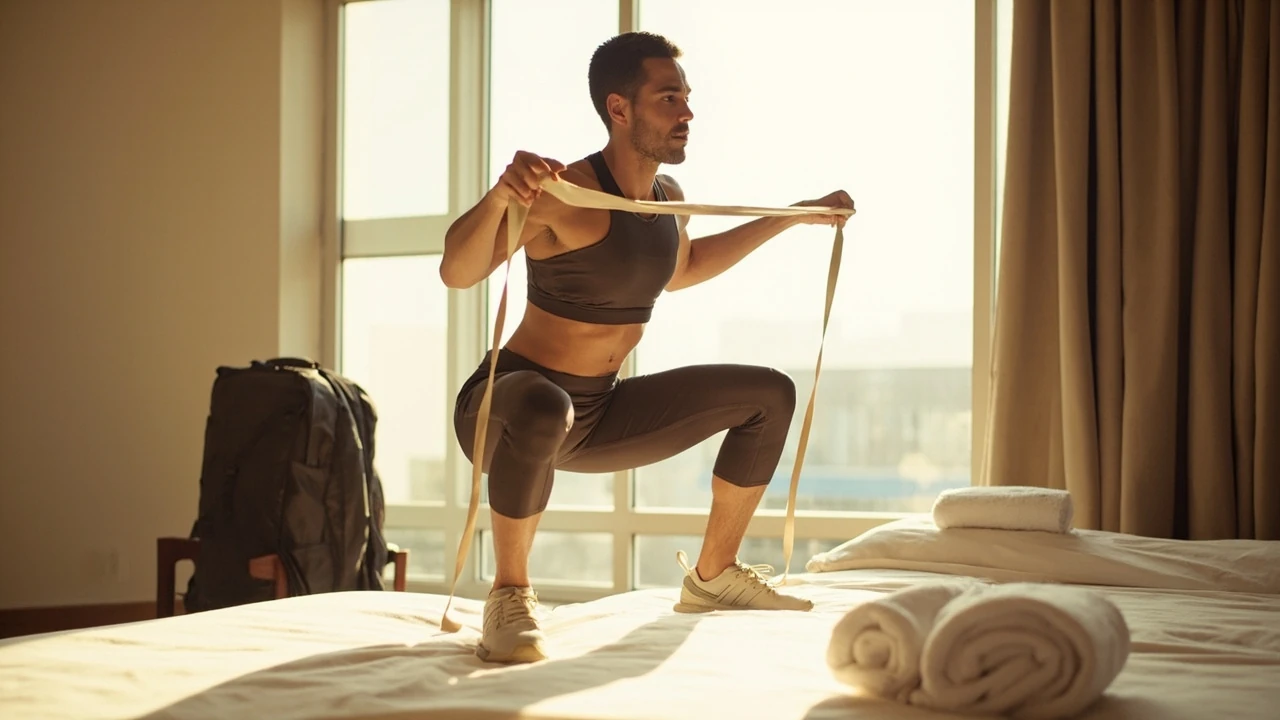
Best travel exercises portable enough to pack in any bag
A two-week trip used to undo a year of training for a friend of mine. He ran a half marathon in March, flew to Asia in April, and came back twenty pounds heavier with a lower back that clicked every time he bent over a suitcase. The problem was not the food, the long flights, or the hotel mattresses. The problem was that he had no plan for the best travel exercises portable enough to live in a carry-on, so he did nothing and hoped the gym would still be there when he landed.
That story repeats itself in hotel gyms full of treadmills nobody uses and in airport lounges where the only movement is between gates. Portable travel training is not about replicating a full gym session. It is about choosing a small set of exercises that survive cramped spaces, noisy rooms, time-zone fatigue, and a backpack that is already overweight. The right routine keeps muscle, protects joints during long travel days, and supports the active days you actually travelled for, whether that is a city walk, a beach day, or a stop at a high ropes course.
This guide focuses on the best travel exercises portable travelers can realistically use, the equipment that earns its weight in a bag, and the ways to structure short sessions around real travel constraints. It is written for people who treat training as a tool that supports travel, not as a separate identity that has to be paused every time they leave home.
What portable travel exercises actually need to do
Most travel workouts fail before they begin because the list was copied from a gym plan. A squat rack is not portable, a barbell is not portable, and a treadmill is definitely not portable. A useful portable plan has to clear a few simple tests before any rep counts.
- It must work in a hotel room, a hostel dorm, a short-term rental, or a patch of grass outside a station.
- It must run in 10 to 30 minutes, because meetings, sightseeing, and transit eat larger windows.
- It must be quiet enough not to upset the family in the next room or the Airbnb host downstairs.
- It must use equipment that earns every gram of luggage weight, or no equipment at all.
- It must leave enough energy for walking tours, hikes, and the occasional adventure park day.
When a routine clears those tests, it becomes a habit. When it does not, it gets skipped on day three, then day five, and the bag of bands comes home unused.
The best travel exercises portable travelers can rely on
Below is a core list of moves that work almost anywhere. Each one is described with the muscles it targets, why it earns space in a travel routine, and the small form details that keep the reps honest when you are tired and jet-lagged. None of them need a gym, and all of them can be scaled up or down depending on the time you have.
Bodyweight squat
Quads, glutes, and hamstrings carry you through airport terminals, museum queues, and the climbs at a ropes course, so a squat is the most honest place to start any portable routine. Stand with feet a little wider than shoulder width, lower until the thighs are at least parallel to the floor, and drive back up through the heels. If the back of your thigh hits your calf easily, depth is fine. If your lower back starts to round, stop a little higher and work on hip mobility later. Three sets of 12 to 20 is a strong base.
Push-up (and variations)
Push-ups cover chest, shoulders, triceps, and the front of the core, all in one rep. The angle is the portable version of a bench press. Hands on the floor is the standard. Hands on a desk, a bed, or a wall is the easier version. Feet on a bed with hands on the floor is the harder version. Two to four sets, anywhere from 6 to 25 reps depending on the variation, is plenty.
Plank and side plank
Planks train the deep core that protects your back during long travel days. Forearms on the floor, elbows under shoulders, body in a straight line, glutes gently engaged, and the head neutral. Hold 20 to 60 seconds. Side planks cover the obliques and the shoulder stabilizers that get abused by carrying a heavy backpack. Two to three sets per side, and stop when the hips start to sag.
Glute bridge and single-leg bridge
Glute bridges wake up the posterior chain, which is the muscle group that tightens up after a long flight. Lie on your back, feet flat, drive the hips up, and squeeze the glutes at the top. Single-leg bridges double the demand and double the feedback. Two to three sets of 10 to 15 per side is a small price for a back that does not lock up after a ten-hour bus ride.
Reverse lunge
Lunges cover the same muscles as squats but with a longer lever, which is useful when you cannot add weight. Step one foot back, drop the back knee toward the floor, keep the front knee over the front ankle, and stand back up. Reverse lunges are easier on the knees than forward lunges because the front shin stays more vertical. Two to three sets of 8 to 12 per leg.
Bird dog
Bird dog is a slow, controlled opposite arm and leg extension from a hands-and-knees position. It looks easy and is not. It trains the deep stabilizers around the spine and the glutes at the same time, which is exactly what tired travelers need. Two to three sets of 6 to 10 per side, with a two-second hold at the top of each rep, is enough.
Wall sit or isometric squat hold
Lean against a wall, slide down until the knees are at about ninety degrees, and hold. This is the most boring exercise on the list and one of the most useful. It builds quad endurance, which directly helps anyone planning long sightseeing days or steep trails. Start with 20 to 45 seconds and build to two minutes.
Hip hinge and good morning (bodyweight)
Stand tall, push the hips back like you are closing a drawer with your backside, keep the knees soft, and return to standing. The bodyweight hip hinge is the travel version of a deadlift and protects the back that gets abused by suitcase hauling. Two to three sets of 10 to 15 reps.
Carry and walk
Walking is the most underrated portable exercise, and carrying a loaded backpack turns it into a conditioning tool. If you already need to walk from the station to the hotel, treat it as a set: a fixed distance, a tall posture, and a controlled breath rate. This is the only exercise on the list that doubles as transport.
Jumping jack or step march
Five minutes of easy jumping jacks or step marches raises the heart rate enough to count as cardio when the day has otherwise been a flight, a taxi, and a hotel check-in. Low-impact step marches are kinder to downstairs neighbors in apartment rentals. Either way, the goal is to move blood, not to set a record.
Portable equipment that actually earns its weight
Portable gear is a small category and easy to overpack. The items below are the ones most travelers keep using after a few trips, and the rest can stay at home.
| Item | Approx. weight | What it adds | Best use |
|---|---|---|---|
| Loop resistance bands (set of 3) | 100 to 200 g | Variable load for upper body, lower body, and mobility | Hotel rooms, parks, and outdoor warm-ups |
| Single jump rope | 120 to 250 g | High-intensity cardio with no footprint | Outdoor courtyards, balconies, and trails |
| Travel yoga mat (1.5 mm) | 500 to 900 g | Cushion, grip, and a defined workout space | Floor work, mobility, and stretching in any room |
| Suspension trainer | 400 to 600 g | Dozens of bodyweight angles, anchored on a door | Hotels with solid doors and outdoor play areas |
| Inflatable exercise ball | 100 g deflated | Core, balance, and posture training | Longer stays in rentals with a pump nearby |
| Light weight vest | 1 to 3 kg | Adds load to bodyweight moves without free weights | Walking days and bodyweight circuits |
| Foam roller (compact) | 250 to 500 g | Self-myofascial release for tight travel muscles | Post-flight recovery and pre-activity warm-ups |
The simplest kit is a set of loop bands. They are cheap, replace a lot of machines, and slip into a side pocket of a backpack. Everything else is optional, and it is worth adding only after a few trips when you know what you will actually use.
How to build a portable travel workout
The exercises are the easy part. The harder decision is how to structure a session when you have 15 minutes, an unfamiliar room, and a meeting in an hour. A simple framework keeps things honest.
- Warm up for three to five minutes with step marches, hip circles, and a few bodyweight squats.
- Pick one lower-body move, one upper-body or push move, one core move, and one cardio or carry move.
- Run the four moves as a circuit, 30 to 45 seconds of work, 15 to 30 seconds of rest.
- Repeat the circuit three to five times depending on the time you have.
- Cool down with a slow round of the same mobility moves you used in the warm-up.
The pattern of a circuit, not the specific exercises, is what makes portable training work. A circuit stays efficient when attention is low, the room is small, and the schedule is messy.
Sample portable workouts for real travel days
Below are three short sessions that match the most common travel situations. Each one uses only the moves in the core list, so it can be done with no equipment or with a single band.
15-minute hotel room reset
- Step march in place, 2 minutes
- Bodyweight squat, 12 reps
- Push-up on bed or floor, 8 to 15 reps
- Glute bridge, 15 reps
- Plank, 30 seconds
- Reverse lunge, 8 reps per leg
- Repeat the circuit twice
25-minute band session in a small space
- Band rows, 12 reps
- Band-assisted squat, 15 reps
- Band press, 10 reps
- Glute bridge with band above the knees, 15 reps
- Side plank, 20 to 30 seconds per side
- Bird dog, 8 reps per side
- Repeat the circuit three times
Outdoor day warm-up before a hike or ropes course
- Walk briskly for 5 minutes to a flat spot
- Hip hinge drill, 10 reps
- Bodyweight squat, 12 reps
- Reverse lunge, 8 reps per leg
- Plank, 30 to 45 seconds
- Glute bridge, 12 reps
- Walk the last 10 minutes to the activity at a steady pace
This last routine pairs well with a planned visit to an active attraction, including the kind of high ropes day described in the first-time high ropes course guide, because the warm-up primes the hips, glutes, and grip for the demands of climbing and balancing.
How to fit portable training into a travel schedule
The hardest part of any travel workout is not the workout, it is the slot. A few patterns work better than willpower.
- Tie training to a habit you already have, such as the first coffee of the day or the moment you put on sneakers for a walk.
- Use a transition window, like the 20 minutes between landing and leaving the airport, for a brisk walk and a few mobility drills.
- Stack training with another activity, so a body-weight circuit becomes the warm-up for a hike or a swim rather than a separate task.
- Plan a short session the night before a long travel day, so you arrive looser and sleep better.
- Skip the occasional day on purpose, and treat a real rest day as part of the plan rather than a failure.
Most travelers over-plan their first trip and under-plan their fifth. The routine that survives is usually the one that can shrink to five minutes on a hard day, not the one that needed a full hour to be worth doing.
Matching portable workouts to different trip styles
The best travel exercises portable enough to pack depend on the kind of trip you are taking. A short city break asks for something different from a month-long digital nomad stay, and a family trip has to fit around other people.
| Trip type | Biggest training risk | Best portable focus | Suggested session length |
|---|---|---|---|
| City break (2 to 4 days) | Doing too much on day one and skipping day two | Walking plus a 10-minute mobility circuit in the room | 10 to 15 minutes |
| Business travel | Late dinners, no routine, low energy | Morning band circuit, short and predictable | 15 to 25 minutes |
| Adventure or hiking trip | Under-trained legs and lower back on day three | Bodyweight strength plus loaded carries | 20 to 35 minutes |
| Long stay or slow travel | Comfort eating and shrinking activity | Mix of bands, jump rope, and outdoor runs | 25 to 45 minutes |
| Family or group trip | Everyone’s schedule is different | Early morning solo sessions in the room | 15 to 20 minutes |
This is also where a travel budget matters. Spending on a compact set of bands, a jump rope, and a thin mat often beats a day-by-day gym drop-in fee, and it pays off across the whole year, not just this trip. If you are weighing that trade-off, the realistic day trip budget guide walks through how small gear costs compare to per-day activity spend.
Recovery, mobility, and sleep on the road
Portable training is not only about the work. A routine that ignores recovery tends to feel harder than it should, and the travel part of the trip starts to suffer. Three recovery habits fit easily into a luggage kit.
- A five-minute mobility flow each morning: cat-cow, hip circles, shoulder rolls, and a slow bodyweight squat.
- A short foam roll or tennis ball session after long transit days, focused on calves, quads, and upper back.
- A consistent wind-down routine at night, including a few minutes of slow nasal breathing, which doubles as core and diaphragm training.
Sleep is the biggest recovery tool most travelers ignore. A dark room, a cool temperature, and a fixed bedtime matter more than any cool-down stretch. The body adapts to training when it has time to rest, not when it is dragged from one time zone to the next.
Common mistakes with portable travel exercises
Even a good routine can fail when it is set up badly. The most common problems are easy to spot and easier to fix.
- Packing too much gear and using none of it. Two to three items is plenty.
- Trying to copy a home gym plan, then skipping it because the room is too small or the session is too long.
- Ignoring the warm-up, especially after a long flight, which is when the body is most injury-prone.
- Training hard on the first day of a trip, then sleeping through day two.
- Eating in a calorie surplus every day because it is a holiday, and expecting the routine to outrun that.
- Skipping water during transit, which makes the first session feel much harder than it is.
Fixing one or two of these usually matters more than adding a new exercise. The best travel exercises portable routines work because they remove friction, not because the programming is clever.
Sample weekly plan for a two-week trip
Here is a realistic week of portable training for a traveler who is also sightseeing, with two rest days and one longer outdoor day.
| Day | Session type | Time | Focus |
|---|---|---|---|
| Day 1 | Mobility and walk | 15 minutes | Loosen up after travel |
| Day 2 | Band circuit | 25 minutes | Full body |
| Day 3 | Rest or light walk | 0 to 20 minutes | Recovery |
| Day 4 | Bodyweight circuit | 20 minutes | Strength and core |
| Day 5 | Outdoor activity | 60 to 120 minutes | Active day, no separate session |
| Day 6 | Band circuit | 25 minutes | Full body |
| Day 7 | Rest or mobility only | 0 to 10 minutes | Reset |
The pattern repeats with small swaps, and the active day on day five can be almost anything: a long hike, a city walk, a beach run, or even a ropes course visit if the conditions are right. The wet-weather trail packing list is a useful reminder that weather can also shape which days are good for hard sessions and which are better for rest.
Frequently asked questions
What are the best travel exercises portable enough to do without any equipment?
Bodyweight squats, push-ups (with hands on a bed, wall, or floor), reverse lunges, glute bridges, planks, side planks, bird dogs, and step marches cover nearly everything a traveler needs in a small space. Add a few sets of jumping jacks or stair climbs for the heart. The full core list is described earlier in this guide.
How long should a travel workout be?
For most trips, 15 to 25 minutes is the sweet spot. Shorter sessions fit more often, and frequent short sessions are usually better for travel than one long gym-style workout that gets skipped on busy days. On rest-heavy trip days, even 5 to 10 minutes of mobility and a short walk is enough to keep the habit going.
Do I need to bring resistance bands?
Bands are not required, but they are the single most useful piece of portable gear for the money. They add load to bodyweight moves, replace several machines, fit in a side pocket, and weigh very little. A set of three bands with light, medium, and heavy tension is enough for most travelers for years.
Can I keep my strength on a two-week vacation?
Yes, with two or three short sessions per week using the moves in this guide. Strength drops a little when volume drops, but it comes back quickly once the routine is resumed. The bigger risk on a two-week trip is losing the habit, which is why short, frequent sessions tend to work better than one long weekly workout.
Is a hotel gym enough instead of portable exercises?
Sometimes. Hotel gyms are useful when they have at least a bench, a pull-up bar, or a few dumbbells, and when they are not crowded. On other days, a 15-minute bodyweight or band circuit in the room is faster and more reliable, especially if the gym closes early or the line for equipment is long.
What should I do on travel days with long flights?
Keep it light. Walk the airport before boarding, do ankle circles and hip flexor stretches in the seat, and avoid heavy lifting. The day after a long flight is the right time for a mobility-focused session rather than a hard strength workout, since the lower back and hips are usually the most affected.
How do I train quietly in a shared room or apartment?
Drop jumps, jumping jacks, and burpees are usually the first to go. Replace them with step marches, slow squats, glute bridges, planks, and bird dogs. A thin travel mat also reduces the noise from floor work and protects the floor of a rental property.
What should I eat to support travel training?
Keep protein steady at roughly 1.4 to 1.8 grams per kilogram of body weight per day, spread across meals, and drink water steadily through the day. On heavy training days, add a small portion of carbohydrates around the session, such as rice, bread, fruit, or oats, to support energy and recovery.
Can portable training prepare me for active travel like hikes or ropes courses?
Yes. Bodyweight strength, hip hinge work, single-leg balance, and grip practice are all useful foundations for hiking, climbing, and rope-based activities. Building these qualities before a trip is one of the main reasons travelers who train on the road enjoy the active parts of their itinerary more.
How do I restart a routine after getting back from a trip?
Start with two short sessions in the first week, using the same band and bodyweight circuit you used on the road, then add a third session and a little load in the second week. Within two to three weeks, most travelers are back to their normal plan without needing to reset from zero.
Related reading
Explore High Ropes Adventure
Trip tools
Essential adventure planning guides
Use these practical guides to compare rope park activities, prepare for a first high ropes day, check a booking, choose suitable footwear and contact the editorial team. Each page links to the relevant live tools and current planning sections.
Latest articles
- Tame Impala tickets: how to find them, what they cost, and what to know before you buy
- Outdoor pillows: how to choose the right ones for a deck or trail rest stop
- How to find Morgan Jay tickets without overpaying
- How to find national parks near me: a practical local search guide
- Paylater travel: how buy now, pay later works for trip bookings
- Bagsmart Blast Travel Backpack: A Practical Review for Day Trips and Adventure Days
- How to choose an outdoor rocking chair that actually lasts
- Indiana travel advisory map: how to read it before a day trip
- How to plan an outdoor day around a concert stop: a cardi b tickets field guide
- Outdoor sectional sofas: a practical buyer’s guide for patio living