Outdoor activity guide
Adventure park activities: ropes, ziplines and forest days
A forest adventure park may combine high ropes, ziplines, nets, climbing challenges and quiet ground-level routes. The best choice is the activity that fits the group's rules, confidence and available time, not the one with the tallest platform.
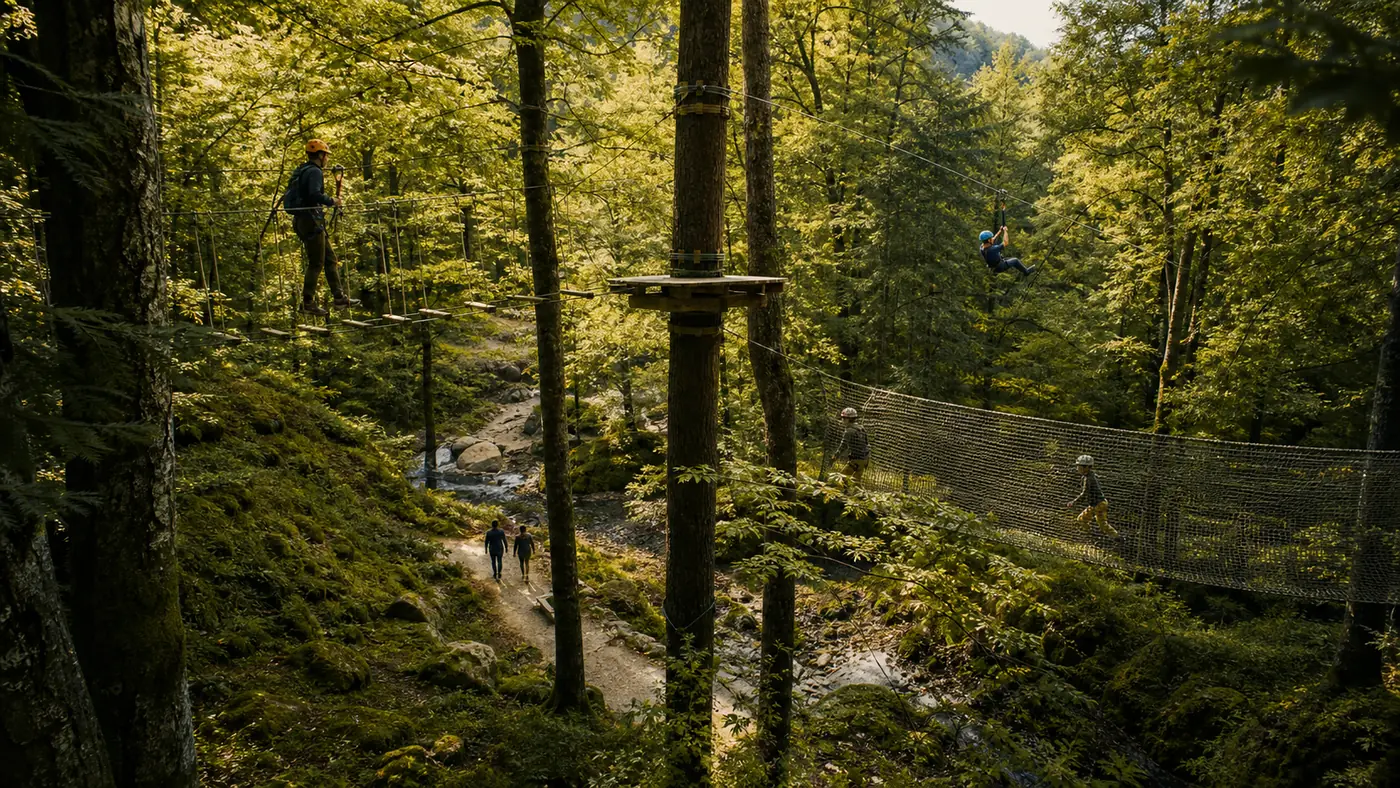
High ropes and canopy courses
High ropes courses link elevated platforms with moving bridges, logs, cables, nets and short ziplines. Participants wear a harness and use the venue's safety system after a briefing. Difficulty usually comes from balance, exposure, reach and the need to manage progress between platforms.
A canopy course may emphasise the journey through the trees, while a challenge course can focus on individual obstacles or team tasks. Names are not standardised. Look at the route height, length, safety system and exit arrangements rather than relying on the label alone.
Zipline experiences
A zipline carries a harnessed participant along a sloping cable. Some parks include several short lines inside a ropes course; others sell a separate zipline tour with longer transfers between launch points. Braking systems and staff involvement vary.
Ask whether the experience includes climbs, ladders or rope obstacles as well as ziplines. Check weight and age rules, footwear, how equipment is attached and whether a participant must control any part of the arrival. The operator briefing is the source for the live procedure.
Low ropes, nets and junior courses
Low ropes use balance and team challenges closer to the ground. Net parks create enclosed spaces where visitors move through tunnels, bridges or bounce areas without following the same harness routine as a high course. Junior courses may use scaled obstacles but still apply strict age, height and supervision rules.
These options can work well for mixed-confidence groups, yet low does not mean unrestricted. Confirm the surface, staff supervision, adult participation and the way the venue separates age groups. A child who meets the minimum age may still need an adult on the route.
Climbing walls, towers and free-fall jumps
Some adventure parks add climbing walls, tower descents, giant swings or controlled free-fall devices. These are distinct activities with their own briefings and equipment. They may not be included in a standard ropes ticket.
Check the number of attempts, queue arrangements and any health or participation restrictions. Do not infer that experience on one device qualifies someone for another. Staff must make the live equipment and participation decision.
Forest trails and activities for non-climbers
A good group day does not require everyone to climb. Woodland walks, orienteering, play areas, cycling routes, cafés and viewing points can give non-participants a real plan rather than a long wait by reception.
Check whether the ground route can see any part of the course, whether dogs are allowed, and whether the path suits pushchairs or mobility needs. A map pin for the park does not describe gradients, surfaces or accessible toilets. Ask the venue for current access details.
How to choose an adventure park activity
List the fixed facts first: participant ages and heights, adult supervision, available time, travel, budget and any access requirements. Then compare how much of the ticket is spent on briefing and transfers, the likely route difficulty and whether there is a practical early exit.
For a first visit, a course with visible progression and a practice area may be a better match than the venue with the largest headline. Experienced visitors can compare obstacle variety, course length and the number of ziplines. Both groups should check the same current rules.
- First-timers: practice area, clear briefing and easy exit points
- Families: exact age, reach and adult-supervision rules
- Groups: staggered start times, total capacity and finish-time range
- Non-climbers: paths, shelter, toilets, food and viewing access
- Wet days: operator weather policy and ground conditions
Plan the rest of the day around the main activity
Choose one anchor activity and leave space around it. Trying to add a long hike, restaurant booking and fixed train immediately after a ropes session can turn a good day into a timetable problem. Food, warm layers and a flexible return are more useful than another rushed attraction.
Use the park finder to inspect mapped venues, then go to the operator for tickets and rules. Our weather, daylight, transport and budget tools can help compare options, but none of them confirms that a course is open or suitable.
Frequently asked questions
What is the difference between a high ropes course and a zipline?
A high ropes course combines elevated obstacles and platforms; a zipline is the cable ride between two points. A ticket may include both, but not every zipline experience includes a ropes course.
Are adventure parks suitable for adults?
Many venues offer adult and mixed-age routes, but participation rules and difficulty vary. Check the exact course description rather than assuming a junior park represents the whole venue.
What can non-participants do at a rope park?
Some parks have forest trails, cafés, play areas or viewing points. Facilities and course visibility vary, so ask the operator before planning a spectator's day.