Can glasses be worn on a zipline safely?
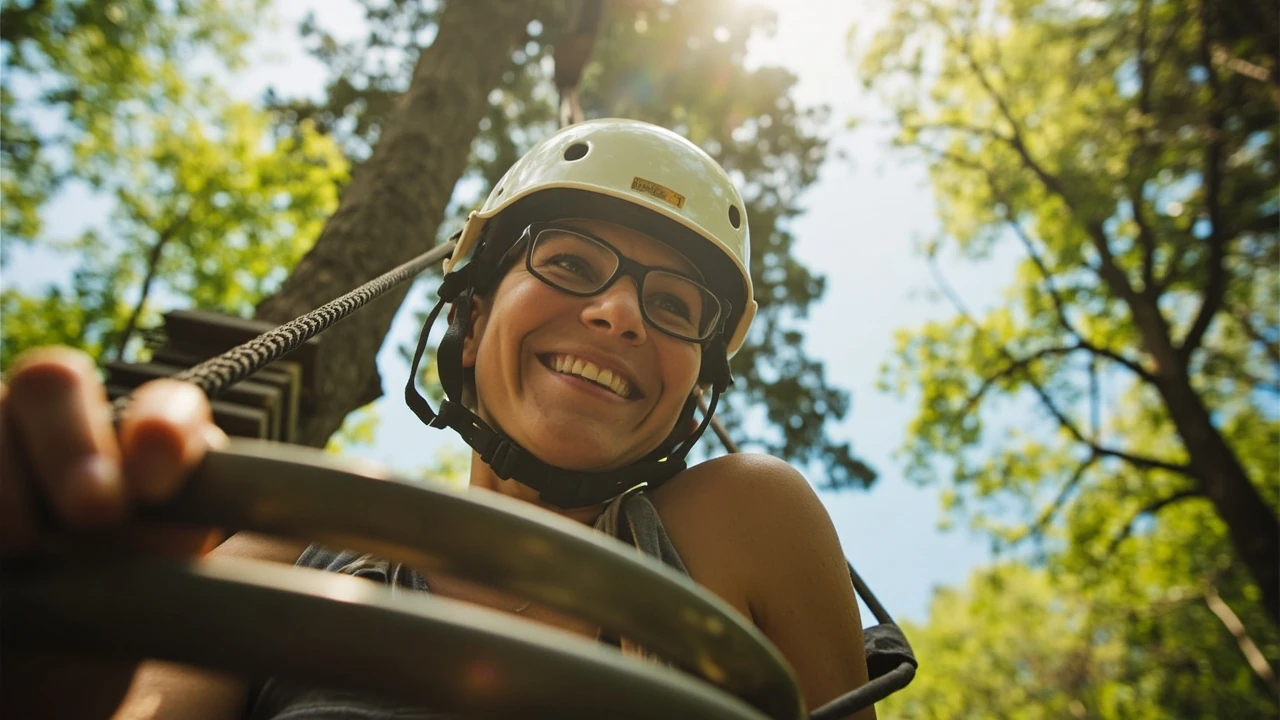
Can glasses be worn on a zipline safely?
Most people who need prescription lenses ask the same question before their first zipline ride: can glasses be worn on a zipline safely without losing them, breaking them, or risking an eye injury? The short answer is yes for the majority of riders, because the speed, harness setup, and the use of a helmet all work in your favor. The longer answer is that glasses are safe only when the rider understands the real risks, chooses the right retention, and follows the operator’s rules. A loose pair of lightweight reading glasses behaves very differently from heavy prescription sunglasses on a high-speed cable, and the difference matters when the trolley engages, when the wind picks up at the midpoint, and when the rider decelerates at the end.
This guide walks through what actually happens to your face and your eyewear during a zipline ride, the retention methods that operators and adventure parks recommend, and the practical checks to do before you clip in. It also covers sunglasses, sport-specific eyewear, contact lenses, and the edge cases that lead most riders to swap one type of eyewear for another.
What a zipline actually does to glasses
A zipline is a controlled descent, not free fall, but several forces act on your face and head during the ride. Understanding those forces is the first step in deciding whether your particular pair of glasses will stay put.
The trolley engages the cable with a spring-loaded mechanism or a gravity catch, and the moment of engagement creates a small jerk. That jerk is rarely enough to dislodge glasses on its own, but it can rotate a loose frame on a wide nose bridge. Once the rider is in motion, two factors dominate: wind speed across the face and the angle of the head. Most recreational ziplines run between 10 and 25 miles per hour, and the apparent wind can feel much stronger because the rider is moving through still air rather than standing in a breeze. A heavy frame with long temple arms catches that wind and tends to slide forward or down the nose.
At the receiving end, the rider either decelerates on a bungee, a magnetic brake, or a hand-operated pad. The deceleration phase is the moment when most glasses fall, because the rider’s head often tilts slightly backward at the same moment the body stops moving. Anything that has shifted forward on the nose during the ride now has a chance to drop. Helmets, chin straps, and retainer cords all work together to prevent this.
Operator rules about glasses and sunglasses
Reputable high ropes and zipline operators deal with the eyewear question every day, and most have a written or verbal policy. The following table summarizes the rules you will commonly see, why they exist, and how strictly they are enforced.
| Rule | Why operators set it | How strict it usually is |
|---|---|---|
| Glasses must be secured with a strap or retainer | Prevents loss and protects riders behind or below from dropped frames | Strict on long or high lines, relaxed on short park courses |
| Sunglasses must be impact-rated or sport-specific | Wind-driven debris at speed can shatter standard lenses | Strict for off-road canopy tours, relaxed for short park lines |
| Loose or non-secured glasses can be refused | Liability and rider safety on multi-line courses | Strict on commercial and school groups |
| Hats and visors that shade glasses may be restricted | Stacked accessories can interfere with helmet fit and retainer cords | Varies by course |
| Riders may be asked to remove glasses for photos | Avoids glare and lost eyewear during staged moments | Common request, not a rule |
If you are booking through an established adventure park, the pre-arrival email or waiver usually explains their eyewear policy. When in doubt, call ahead and ask whether you need to bring a retainer strap or whether the park sells one on site.
Prescription glasses on a zipline
Prescription glasses are the most common case, and the one that worries riders the most. The good news is that a standard pair of prescription glasses, whether single-vision or progressive, is normally safe to wear on a zipline as long as it fits well and is secured. The risk is not the lens itself but the frame geometry and the fit.
Frames with adjustable nose pads grip the bridge of the nose more reliably than molded one-piece bridges, especially under wind load. Lightweight titanium and thin metal frames flex slightly with movement and tend to stay seated better than thick acetate frames, which can slide forward more easily. Long temple arms that curve behind the ear hold better than straight temples, because the curve hooks into the natural anchor of the ear.
The most common failure mode is not that the glasses fall off entirely but that they slide down the nose far enough to push the optical center out of alignment with the pupil. On a short, slow line, this is a minor inconvenience. On a long canopy line at 25 miles per hour, a sliding frame can briefly obscure the view of the landing platform and the next cable. A simple elastic retainer solves both problems.
Sunglasses and sport-specific eyewear
Sunglasses raise a separate set of concerns, because the lenses are usually larger, darker, and more exposed than everyday prescription frames. Standard fashion sunglasses, the kind sold for driving and casual wear, are usually fine for short recreational ziplines but less suitable for long canopy tours and high-speed lines.
Sport-specific eyewear, such as cycling glasses, running shades, and watersport goggles with polarized lenses, is engineered to stay in place under wind, vibration, and sudden stops. These models usually have rubberized nose bridges, temple grips, and wraparound geometry that resists forward movement. Many of them also meet basic impact-resistance standards that standard sunglasses do not. If you already own a pair for cycling or trail running, it is a good candidate to bring along.
Polarized lenses are helpful on a zipline because they cut glare off water, metal cables, and platform hardware, which makes the landing platform easier to read at speed. Photochromic lenses, which darken in sunlight, work well in open-canopy courses but can stay lighter in dense forest where light is already low.
Retention options that actually work
Retention is the single biggest factor in keeping glasses on a zipline. There are four common methods, each with strengths and weaknesses. The table below compares them across the situations a rider is most likely to face.
| Retention method | How it works | Best for | Limitations |
|---|---|---|---|
| Elastic retainer strap (Croc-style or branded) | Loops over each temple and tightens at the back of the head | Daily prescription glasses on any line | Can interfere with helmet strap if fitted too low |
| Foam or rubber temple sleeves | Adds grip where the temple meets the ear | Light frames on short park lines | Wears out quickly and adds bulk |
| Wraparound sport band | Elastic band that wraps around the back of the head | Sport sunglasses, larger frames | Needs removal to take glasses on and off |
| Helmet clip or magnetic catch | Anchors one temple to the side of the helmet | High-speed canopy lines, harness work | Requires a compatible helmet and frame |
For most riders, an elastic retainer strap combined with a properly fitted helmet is the simplest and most reliable setup. The strap keeps the glasses against the face even if the helmet shifts, and the helmet keeps the strap from sliding off the back of the head. Many operators sell generic retainers at the check-in desk for a few dollars, and most outdoor retailers carry them in the eyewear section.
Helmet fit and how it changes eyewear safety
Helmet fit is closely tied to glasses security, because a helmet that rocks back and forth on the head will transfer that motion to the temples of the glasses. A well-fitted helmet sits level on the head, with the front edge about two finger-widths above the eyebrows, and the chin strap snug under the jaw. Once that fit is correct, the temples of the glasses can rest lightly against the inner surface of the helmet without pressure points.
If the helmet is too large, it tends to slide forward on the face, which pushes the glasses down the nose. If the helmet is too small, the front edge sits low on the forehead and can crowd the top of the frame, which limits peripheral vision. Operators at good adventure parks spend a few minutes adjusting every rider’s helmet before they leave the platform, and it is worth the time. A practical zipline safety overview for riders and operators covers the same checks in more detail and is useful to read before your visit.
Contacts, sport tape, and other workarounds
Some riders choose to skip glasses entirely on a zipline and rely on contact lenses, prescription goggles, or sport tape over the bridge of the nose. Each of these approaches has its own profile.
Daily disposable contact lenses work well for most zipline riders, because they stay seated through wind and sudden stops and do not interfere with the helmet or harness. The main risk is dry eye from the wind, which can make contacts uncomfortable on long tours, and the small possibility of losing a lens if a rider instinctively rubs an eye after the ride. Carrying a spare pair, a small bottle of saline, and a mirror is a sensible precaution.
Prescription goggles, the kind used for skiing or motorcycling, are the most secure option for high-speed lines and windy canopy tours. They seal against the face, which keeps wind out of the eyes, and the elastic band wraps around the helmet for a very stable fit. They are not necessary for a typical park zipline but are worth considering for adventure courses that combine ziplines with long transfers or technical descents.
Sport tape, a small piece of adhesive athletic tape applied to the bridge of the nose, can keep glasses from sliding without a strap. It works best on riders whose glasses tend to slip because of low nose bridges or oily skin. It is less reliable than a proper retainer, and the adhesive can irritate the skin after an hour of sun and sweat, so it is best reserved for shorter rides.
Edge cases that change the answer
Several rider situations change the standard advice and are worth thinking through before you arrive at the course.
- Children and first-time riders. Younger riders often have smaller face geometry, and adult-sized glasses can slip more easily on a narrow nose bridge. A retainer strap combined with a well-fitted junior helmet is the safest combination.
- Progressive or bifocal lenses. These lenses have a clear distance zone at the top and a near zone at the bottom. Riders who need to read the harness buckles or the platform signage should make sure the bottom of the lens is visible, which sometimes means tilting the head up slightly. A retainer keeps the lens zone aligned with the pupil.
- High-prescription or thick lenses. Lenses above a certain prescription thickness can be heavier than average and shift the center of gravity of the frame forward. A wraparound sport frame balances the weight better than a flat everyday frame.
- Wet weather. Water on the bridge of the nose and on the temples reduces friction dramatically. A retainer strap is essentially mandatory in the rain, and you may want to consider a wider temple grip or sport band. The same logic applies if you are combining a zipline with a wet-weather trail segment, which is covered in a practical wet-weather trail packing list.
- Off-road or remote canopy tours. Long lines in remote areas raise the stakes of a lost pair of glasses, because there is no easy replacement on site. A helmet-mounted retainer or wraparound sport strap is a sensible upgrade.
Pre-ride checklist for glasses and zipline safety
A short routine before you clip in takes most of the uncertainty out of the eyewear question. The list below works for a single park visit, a school group, or a multi-line canopy tour.
- Confirm that your prescription is current and that you can see the landing platform clearly at the start of the line.
- Inspect the frame for loose screws, cracked temples, or worn nose pads, and tighten or replace anything that moves.
- Attach a retainer strap, sport band, or helmet clip and test the fit by shaking your head gently from side to side.
- Put on the helmet and adjust the chin strap so one finger fits between the strap and your jaw.
- Check that the temples of the glasses sit flat against the inside of the helmet without pressure.
- Confirm with the operator that your eyewear setup meets their rules, especially for commercial and school groups.
- Carry a small soft case in your daypack so you have somewhere to put the glasses if conditions change mid-tour.
What to do if your glasses slip during the ride
Even with a good setup, glasses can shift slightly during a high-speed line, especially in crosswinds or on long descents. The right response depends on where you are in the ride.
During the active part of the line, do not try to adjust the glasses with one hand while holding the trolley with the other. The trolley is designed to run on the cable without rider input, and one-handed adjustments can rotate the body into the cable or the harness. Instead, keep both hands on the trolley or the handle, look forward toward the landing platform, and trust the retainer to hold the glasses in place.
If the glasses fall after deceleration at the landing platform, stay clipped in until the operator signals that you are clear, then step off the platform and pick them up. Most platforms are designed so that a dropped pair will land on the platform deck rather than on the ground below, but a quick scan of the area before you step off is a good habit.
Choosing the right eyewear for your next zipline
Choosing eyewear is a balance of prescription needs, course type, and personal comfort. The table below maps common rider profiles to the most appropriate setup.
| Rider profile | Recommended eyewear | Recommended retention |
|---|---|---|
| Adult with everyday prescription, short park line | Standard prescription frames with adjustable nose pads | Elastic retainer strap |
| Adult with progressive lenses, multi-line course | Lightweight titanium frame with wider reading zone | Retainer strap plus helmet clip |
| Active adult with sport sunglasses, canopy tour | Wraparound polarized sport sunglasses | Built-in sport band or wraparound strap |
| Child on a junior course | Light frame with rubber nose bridge | Elastic retainer strap with helmet |
| Contact lens wearer, any course | Daily disposable contacts plus light sunglasses | Sunglasses with sport band |
| High-prescription rider, off-road canopy line | Prescription sport goggles or inserts | Helmet-mounted clip or goggle strap |
The same logic that keeps glasses secure on a zipline also applies to other parts of a high ropes day, including the harness work and any bridges or ladders between lines. A small investment in the right retainer pays for itself the first time the wind picks up on an exposed platform.
Common myths about glasses on a zipline
A few ideas come up often enough that they are worth addressing directly.
Some riders believe that glasses always fall on the first line of a multi-line course. In practice, glasses fall on the first line when the rider is not wearing a retainer and the helmet is loose. Once those two issues are fixed, fall rates drop sharply.
Others believe that contact lenses are always safer than glasses. Contacts avoid the loss problem but introduce a comfort and dry-eye problem, especially on long canopy tours in dry or windy conditions. The two options are roughly equivalent in safety when glasses are properly retained.
Finally, some riders assume that sunglasses with dark lenses reduce visibility on a zipline. The opposite is usually true. Good polarized sunglasses cut glare off the cable and the platform, which makes depth perception at the landing point noticeably easier, especially for riders who struggle with bright overhead light.
How operators decide what is allowed
Behind the scenes, course operators look at three factors when they set their eyewear policy. The first is the line itself. Long, high, or fast lines require stricter retention because the consequences of a lost pair are higher. The second is the rider profile. School and corporate groups, where many riders are first-timers, prompt stricter rules than experienced club groups. The third is insurance and local regulation. Some jurisdictions require specific retention standards on commercial courses, and operators document their rules to meet those standards.
If you are choosing a course for the first time, the way an operator answers your glasses question is a small but useful signal of overall safety culture. A course that takes eyewear seriously is usually a course that takes harness inspection, helmet fit, and weather limits seriously as well. The same logic is used in how to find a safe adventure park near you, where small details often reveal how a course is run day to day.
Frequently asked questions
Do I need to remove my glasses before a zipline ride?
No, in most cases you can keep your glasses on throughout the ride. You may be asked to remove them briefly for a harness check or a photo, but the operator will tell you when. Removing them on your own during the ride is not safe, because both hands should stay on the trolley or the platform.
What is the best retainer strap for zipline glasses?
An elastic retainer strap with adjustable sliders is the most versatile option, because it fits most frame sizes and can be fitted in a few seconds. Sport bands and helmet clips are more secure but require a matching helmet or frame and are best for high-speed or multi-line courses.
Can I wear contact lenses on a zipline instead of glasses?
Yes, contact lenses work well for most zipline riders. Bring a spare pair, a small bottle of saline, and a mirror, especially on long canopy tours where wind can dry the lenses.
Are polarized sunglasses better than regular sunglasses on a zipline?
Polarized lenses reduce glare off the cable, the platform hardware, and any water below, which makes the landing point easier to read at speed. They are particularly useful on open-canopy lines with strong overhead light.
Will my glasses break if they fall on a zipline platform?
Most modern frames, especially those with polycarbonate or trivex lenses, survive a short drop onto a wooden platform. Glass lenses are more fragile and are rarely a good choice for active sports. If you are worried, a small soft case in your daypack gives you somewhere to store the glasses between lines.
What if I wear bifocals or progressive lenses?
Progressive lenses work well on a zipline, but make sure the distance zone is large enough to cover the landing platform. A retainer strap keeps the lens zone aligned with your pupils, which is especially important on multi-line courses where you need to read buckle labels and signage between lines.
Do children need special glasses or straps for a zipline?
Children benefit from light frames with rubber nose bridges and an elastic retainer strap. Many junior helmets are not compatible with all sport bands, so a simple retainer strap is the most reliable option for younger riders.
Can I wear a hat and glasses at the same time on a zipline?
It depends on the course. Some operators prefer no hat under the helmet because it can change the fit. If you are wearing both, a retainer strap keeps the glasses from being pushed off by the hat brim, especially in crosswinds.
Are sport goggles or sunglasses safer than everyday glasses?
Sport goggles are the most secure option for high-speed lines, because they seal against the face and resist wind. Everyday glasses with a retainer strap are perfectly safe for typical park and tour lines and are more comfortable for riders who are not used to goggles.
What should I do if my glasses fog up during the ride?
Fog is more common on cool mornings and in dense forest where humidity is high. Anti-fog spray, a small dab of mild soap on the lenses, or a slight tilt of the head usually clears the lens within a few seconds. Most retainers leave enough room to wipe the lens quickly between lines if needed.
Related reading
Explore High Ropes Adventure
Trip tools
Essential adventure planning guides
Use these practical guides to compare rope park activities, prepare for a first high ropes day, check a booking, choose suitable footwear and contact the editorial team. Each page links to the relevant live tools and current planning sections.
Latest articles
- How to find Morgan Jay tickets without overpaying
- How to find national parks near me: a practical local search guide
- Paylater travel: how buy now, pay later works for trip bookings
- Bagsmart Blast Travel Backpack: A Practical Review for Day Trips and Adventure Days
- How to choose an outdoor rocking chair that actually lasts
- Indiana travel advisory map: how to read it before a day trip
- How to plan an outdoor day around a concert stop: a cardi b tickets field guide
- Outdoor sectional sofas: a practical buyer’s guide for patio living
- How amusement parks actually work: rides, safety, and what to expect
- Beis Travel: What the Bag Brand Offers for Outdoor Days