Kids activities at high ropes parks: a practical parent’s guide
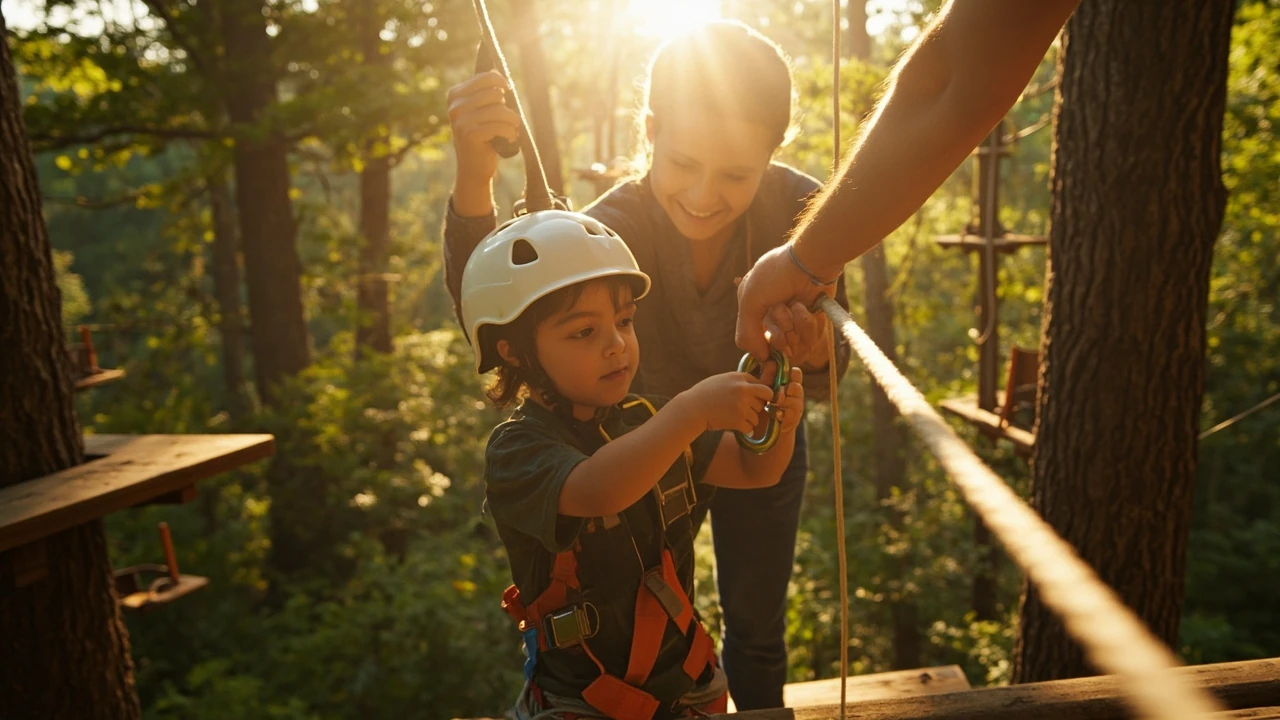
A high ropes course is one of the few kids activities that combines real physical challenge, visible progress, and a quiet dose of courage, all within a controlled safety system. When parents first arrive at a course, the questions arrive faster than the children do: Will my child be tall enough? Will they panic halfway across? How long will we wait? What happens if it rains? The questions are practical, and the answers are usually specific to the operator and the course layout.
This guide is written for parents, grandparents, school trip organisers, and group leaders who want to plan kids activities around a high ropes park without overpromising or under-preparing. It covers the age and height rules you will actually meet, the safety systems a first-time visitor should be able to recognise, a realistic time budget for the day, and a checklist for the gear and clothing that make the difference between a smooth visit and a frustrating one. A short comparison table near the end helps you decide whether a high ropes park, a low ropes course, or a simpler ground-based programme is the right fit for your child on a given day.
Kids activities at a high ropes park: what to expect
High ropes parks sit inside a wider family of outdoor kids activities, but they have a few features that are worth understanding before you book. The course is built as a series of wooden or steel platforms strung between trees or poles, usually 4 to 12 metres above the ground. Each platform is connected by an obstacle element (a wobbling bridge, a cargo net, a wire traverse) and is protected by a continuous safety system. The child is clipped to that system at all times once they leave the starting platform, which is why a high ropes course is a controlled challenge rather than an open-ended risk.
For most operators, the day is structured into a briefing, a practice loop, a main course, and an optional second course. The briefing usually lasts 15 to 25 minutes and covers harness fitting, clip-and-unclip technique, the lanyard or smart belay device, and the communication signals between climber and ground staff. The practice loop is a low element, often only one or two metres off the ground, where the child can make their first mistakes safely. Only after the practice loop is the child cleared for the main course, and many parks run a height-based separation so younger children and adults are not on the same element at the same time.
If you want a more general overview of how adventure parks are built and run, our adventure parks explainer covers the layout, terminology, and pricing models you will see at most European sites.
Age and height rules: the gatekeepers of the day
Age and height rules are the most common reason a child is turned away or moved to a different course. Operators set these rules for two reasons: the harness and helmet must fit correctly, and the obstacle spacing must match a usable arm reach. A 110 cm minimum height is the most common threshold for an “adult” high ropes course, with younger or shorter children routed to a dedicated kids course or a low ropes area.
Most operators publish a clear table, but the small print matters. The chart below summarises what is typical at European high ropes parks. Always confirm the exact numbers with the operator you plan to visit, because local rules vary and a one-centimetre shortfall is enough to be turned away.
| Course level | Typical minimum height | Typical minimum age | Supervision rule | Best suited for |
|---|---|---|---|---|
| Kids course (low elements) | 90-100 cm | 4-6 years | One adult per child usually required | First-time climbers, short attention spans, school groups |
| Junior course | 110-120 cm | 7-9 years | Adults can climb alongside or belay from below | Confident children, mixed-age families |
| Main adult course | 130-140 cm | 10+ years | Children climb independently, staff supervise from below | Older children, teens, adults |
| Extreme / advanced course | 140 cm and above | 12+ years (operator dependent) | Independently, often with a signed waiver | Experienced climbers, taller teens, adults |
Two practical points often catch parents out. First, height is measured in socks, with shoes off, against a rigid measuring stick. A child wearing thick-soled shoes will not be allowed to add that height to the result. Second, the “minimum age” is rarely enforced as a hard cutoff; height and demonstrated competence carry more weight. A calm, coordinated eight-year-old at 130 cm is usually cleared for the main course, while a nervous ten-year-old at 125 cm may be routed to the junior course for a better experience.
For a deeper walk-through of how to read a specific park’s rules, our family rope park age and height guide goes through the most common edge cases, including twins of different heights and mixed-age birthday groups.
Safety systems: what a parent should be able to recognise
You do not need to be a climbing instructor to supervise a child on a high ropes course, but it helps to recognise the two main safety systems, because the rules your child is taught in the briefing will make more sense once you know which one is in use. A solid operator will explain the system before your child climbs, and the harnesses and lanyards on the course will be visibly consistent with the explanation.
The first system is the traditional “double lanyard” or “Y-lanyard” setup, in which the child carries two short lanyards with snap-hook carabiners at the ends. The rule is simple: at any moment, at least one lanyard must be clipped to the safety line. The child moves by unclipping one, clipping it ahead, and only then unclipping the second. Most adult courses in Europe still use this system, and it is the one that requires the most attention from the climber.
The second system is the “smart belay” or continuous belay, common on newer German, Austrian, and Scandinavian courses. The child clips a single trolley to the safety line at the start and does not unclip it for the rest of the course. The trolley locks onto the cable at each platform and only opens at the next platform. This system is popular with families because it removes the most common beginner mistake, forgetting to re-clip after moving.
| Feature | Traditional double lanyard | Smart belay / continuous system |
|---|---|---|
| Clips per child | Two carabiners, alternating | One trolley, never removed mid-course |
| Beginner error risk | Forgetting to re-clip after moving | Low, because re-clipping is automatic |
| Typical age for first use | 10+ with good focus | 7+ on junior and kids courses |
| Common in | Traditional adult courses, France, UK, Italy | New-build German, Austrian, Dutch parks |
| Cost to operator | Lower | Higher, often passed on in ticket price |
| What to watch for as a parent | Hesitation mid-element, two unclip moves in a row | Trolley not audibly clicking onto the cable |
You can read more about the hardware and how the trolley is checked daily in our zipline safety explainer, which covers the related trolley systems used on zip lines that share the same safety cable.
How long the day actually takes
The single biggest planning mistake is underestimating the time a ropes course takes. The climbing itself is only one part of the day, and the rest is waiting, watching, and changing. A realistic budget for a family of four, with one adult climbing and three children of mixed ages, is three to four hours from arrival to leaving the car park. The breakdown below reflects what most operators report on busy weekends.
- Arrival, parking, and check-in: 20-30 minutes, longer on rainy days when the kiosk queue builds.
- Harness fitting and briefing: 20-30 minutes for a family group, including waiting for previous groups to clear the briefing area.
- Practice loop: 15-25 minutes per child, including the walk back to the starting platform.
- Main course climb: 45-90 minutes per child, depending on how busy the course is and how many elements the child wants to attempt.
- Optional second course or zip line: 30-60 minutes, if included in the ticket.
- Snack, water break, and change of clothes: 20-30 minutes, which most families underestimate.
Two adjustments will save you frustration. First, book the earliest possible slot, because queues build from late morning and the course closes on a fixed schedule regardless of how many people are still climbing. Second, treat the zip line as a separate ticket, because many parks sell it as an add-on and the queue can add 30 minutes to an already tight schedule.
For a more general framework on planning a full day around a ropes visit, our one-day forest escape planner walks through a tested morning-to-evening structure that works well for families.
What to pack for kids activities at a ropes park
Most parks refuse closed-toe street shoes, open sandals, or bare feet on the course, and they will turn a child away at the harness fitting if the footwear does not meet the rule. A small, deliberate packing list prevents that and avoids the most common reasons a child has to abandon the course mid-way through.
- Closed-toe sports shoes with grippy soles: running shoes or light hiking shoes, not fashion trainers with smooth soles.
- Long trousers or leggings, even in summer: a harness worn on bare legs in 28°C heat will chafe within 20 minutes and the child will ask to come down.
- A thin long-sleeve top for cooler mornings, which can be tied around the waist later.
- Hair tie for any child with shoulder-length hair, because long hair caught in a helmet strap is a regular minor delay.
- Small water bottle, ideally with a carabiner-style clip: a falling bottle from 8 metres is a real hazard for people below.
- Sunglasses with a strap, not loose in a pocket.
- Sunscreen already applied, because most courses are in partial shade and reapplication at height is impractical.
- A small snack for afterwards: the activity burns more energy than children expect, and a hungry child finds the next zip line much harder.
For a full wet-weather version of the same list, our wet-weather trail packing guide covers the additional layers, dry bags, and towel choices that make a rainy ropes day workable rather than miserable.
High ropes, low ropes, or ground-based: choosing the right kids activities
A high ropes course is not always the right kids activity for a given day, and a good operator will not push a family onto a course that does not match the group’s mood, weather, or energy. The table below compares the three most common outdoor activity types you will find at an adventure park, with a focus on what each one realistically demands from the child and the supervising adult.
| Activity | Typical height | Minimum age (typical) | Physical demand | Focus demand | Best for |
|---|---|---|---|---|---|
| High ropes main course | 6-12 m | 8-10+ | High | High | Older children, confident teens, mixed-ability groups with a brave adult |
| Low ropes / kids course | 1-3 m | 4-6+ | Medium | Medium | First-time climbers, school groups, nervous children, mixed-age families |
| Zip line | 8-30 m | 6-8+ (operator dependent) | Low | Medium (brief burst) | Children who want a thrill without a long climb, end-of-day reward |
| Ground-based team games | 0 m | 4+ | Low | Low | Younger children, hot afternoons, large groups with limited staff |
A useful rule of thumb: if a child has never been to a ropes park before, start them on the low ropes or kids course regardless of their height. The child who has a good first experience on a low course will almost always come back and ask for the high course on the next visit. The child who is pushed onto a high course too early, before they have the focus to manage the clips, often refuses to try again for a year or more.
Managing fear on the course
Most courses have a small number of children who freeze on an element and need to come back down. This is normal, well-drilled, and not a failure on anyone’s part. The two main strategies operators use are a staff-led “rescue” from the element (a rope and harness system that lowers the child gently to the ground) and a verbal coaching approach from the ground, where a staff member talks the child through the next clip while the parent remains on the platform.
What does not help is repeated reassurance from below, because the child cannot process two voices at once and the parent’s anxiety amplifies the child’s. A short, calm sentence from a parent (“you are clipped in, take the next step when you are ready”) followed by silence is more effective than a long conversation. Most operators will tell you this in the briefing, and it is worth remembering before you arrive.
For children who are very nervous, asking the operator in advance to start them on a specific element (usually a wider, more stable bridge) makes a noticeable difference. The first element of any course is the one that sets the tone for the rest of the climb, and a stable start lets the child settle into the rhythm of the safety system.
Group bookings, school trips, and birthday parties
If you are organising kids activities for a group, the planning question changes from “will my child cope” to “how do I keep twelve children safe and on schedule at the same time”. Most operators offer a dedicated group rate and a slightly different format, with a fixed start time, a fixed group size (usually 8-12 children per staff member), and a simpler menu of courses.
A few practical points make the day run more smoothly:
- Send parents a short kit list in advance: closed-toe shoes, long trousers, no loose jewellery, hair tied back.
- Ask for the group to be split by height, not by age, because a tall seven-year-old will be more comfortable with ten-year-olds than with other seven-year-olds.
- Book the earliest possible slot. Group slots in the middle of the day are the hardest to staff, and the first slot of the day is usually the calmest on the course.
- Confirm the rain policy in writing. Some operators cancel the day; others move the group to a ground-based programme or an indoor low ropes area. You do not want to discover this on the morning of the event.
- Plan food before or after, not during. Most ropes parks do not allow eating on the course, and most group packages include a 30-minute lunch break at a fixed time.
For broader logistics around a group day out, including transport and budget trade-offs, our train-versus-car comparison for outdoor day trips covers the decisions a group leader usually faces.
Budgeting for the day
The headline ticket price at a high ropes park usually covers one or two courses, the harness and helmet, and the safety briefing. It rarely covers the zip line, food, parking, or photos. A realistic family budget for a day at a ropes park includes the items below. Exact numbers vary by country and operator, and we have not invented specific prices here; the categories are what to plan for.
- Adult ticket: one climb, usually 1-2 hours on the course.
- Child ticket: one climb, often with a height-based price tier.
- Second course or zip line add-on: a fixed per-person fee, often around half the price of the first course.
- Food and drink: usually available on site, often more expensive than a nearby café.
- Parking: sometimes free, sometimes a flat fee for the day.
- Photo package: optional, usually sold at the end of the course on a tablet or printed sheet.
For a more detailed framework that applies to any family day out, our realistic day trip budget guide walks through how to set a per-person number and stick to it without surprises at the kiosk.
Weather, closures, and what to ask before you go
Rain and wind are the two weather conditions that affect a high ropes course. Most courses run in light rain, because the safety system is a steel cable that does not lose grip in the wet. They close for lightning within a certain radius, for wind above a set threshold (often 60-70 km/h gusts at platform height), and occasionally for ice in winter. The honest answer to “will it run tomorrow” is always “ask the operator in the morning”, because the closure call is usually made one to two hours before the first slot.
Useful questions to put to the operator in advance:
- What is your rain policy, and at what point is a partial refund or reschedule offered?
- What is the height measurement process, and is it rigid or flexible?
- Is the zip line included in the main ticket or an add-on?
- What is the staff-to-climber ratio on the main course during our time slot?
- Are there shaded picnic tables, and can we bring our own food?
- Is there a same-day re-climb policy if the child wants a second attempt?
For a fuller discussion of how ropes parks handle weather and what to expect on a borderline day, our rope park weather and closures guide covers the most common policies in plain language.
Choosing a safe operator: a short checklist
Not every operator meets the same safety standard, and the difference between a well-run park and a poorly run one is visible in small details before your child ever leaves the ground. A short on-site walk-through is more useful than any online review, because the signs of a careful operator are physical and immediate.
- Harnesses and helmets are stored indoors, in good condition, and visibly clean.
- Briefing staff are speaking to the children, not just to the parents.
- Every child is fitted with their own harness and the fit is checked by a second staff member.
- The safety cable is taut, free of rust, and visibly attached at both ends of the course.
- Rescue kits (ropes, descender, helmet) are on the platform or visible at the start of the course.
- There is a written daily inspection log, usually on a clipboard at the start of the course.
- Children are not climbing while the briefing for the next group is in progress, which means the course is not over-booked.
For a more detailed walk-through of what to look for, including a checklist you can print, our how to find a safe adventure park guide covers the same points in longer form.
Frequently asked questions
What is the minimum age for kids activities at a high ropes park?
There is no single minimum age across the industry. The most common rule is a minimum height of 110 cm for a junior course and 130 cm for the main adult course, with operators adjusting for harness fit and demonstrated competence. A four-year-old at 100 cm is usually accepted on a low kids course, while a nervous ten-year-old at 125 cm is often routed to the junior course for a better experience. Always confirm the exact numbers with the operator before you travel, because rules vary by country and by course.
Can my child climb if they are scared of heights?
Yes, with caveats. Most operators will start a nervous child on the lowest course available, and the continuous belay system removes the most common cause of mid-course panic, which is the fear of forgetting to re-clip. A short conversation with the operator in advance, asking them to start the child on a wider, more stable element, makes a noticeable difference. If the child freezes on an element, a staff member will talk them through the next move from the ground, and a calm one-sentence reminder from a parent on the platform is more helpful than repeated reassurance.
What should my child wear to a high ropes course?
Closed-toe sports shoes with grippy soles, long trousers or leggings even in summer, and a thin long-sleeve top for cooler mornings. A hair tie for any shoulder-length hair, a small water bottle with a clip, and sunscreen already applied are the three most commonly forgotten items. Jewellery, loose scarves, and open sandals are usually not allowed on the course, and the operator will ask your child to remove them at the harness fitting.
How long does a typical high ropes visit take?
Allow three to four hours from arrival to leaving the car park for a family of four with mixed-age children. The climbing itself is only 45 to 90 minutes per child, but the briefing, harness fitting, practice loop, optional second course, and a snack break all add up. Booking the earliest possible slot of the day keeps the queues short, and most courses close on a fixed schedule regardless of how many people are still climbing.
Is a high ropes course safe for children?
Within the limits of an outdoor physical activity, yes. The child is clipped to a continuous safety cable at all times once they leave the starting platform, and a well-run operator briefs the child, checks the harness fit, supervises the course from the ground, and has a written rescue plan for any child who freezes on an element. The main safety risk is the clip-and-unclip mistake on a traditional lanyard system, which is why many operators have moved to a continuous belay trolley for younger courses.
What happens if it rains on the day we booked?
Most courses run in light rain, because the safety cable is steel and does not lose grip when wet. The course is usually closed for lightning within a set radius, for wind above a set threshold, and occasionally for ice in winter. The closure call is made one to two hours before the first slot, so it is worth phoning the operator on the morning of your visit. A partial refund or reschedule is offered by most operators if the course is closed before you arrive, and a smaller number will offer a credit if the course is closed mid-day.
Do parents have to climb with their child?
Not usually on the main course, where children climb independently with staff supervision from below. On the kids course and on most junior courses, an adult is required to be on the platform, and on some courses an adult must climb alongside. The exact rule is set by the operator and is usually printed on the booking page, so it is worth checking before you arrive. One adult per two climbing children is a common ratio, and some operators charge a small spectator fee for non-climbing adults who want to watch from below.
Can we bring our own food and drink?
Most ropes parks have a picnic area and allow you to bring your own food, but they usually do not allow eating on the course itself or in the harness fitting area. A small water bottle with a clip is almost always allowed on the course, and the operator will usually point this out in the briefing. For groups and birthday parties, the catering options are usually a fixed menu booked in advance, and outside food is restricted to the picnic area outside the climbing zone.
What is the difference between a high ropes course and a ropes course?
In common use, the two terms are interchangeable, and the industry’s own pages often use both. A “ropes course” is the broader category, covering any obstacle built from ropes, wood, and a safety system, while a “high ropes course” specifically refers to the version built several metres above the ground. A “low ropes course” is usually one to three metres off the ground and is the most common format for younger children. The safety system, harness, and briefing are otherwise the same across all three.
How do I know if an operator is reputable?
A reputable operator will show you, on request, a written daily inspection log for the safety cables and harnesses, the staff-to-climber ratio for your time slot, and the specific safety system in use on the course. The harness and helmet store will be indoors, in good condition, and visibly clean. The briefing will be addressed to the children, not just the parents. If any of these details are missing or vague, choose a different operator. The price difference between a careful operator and a careless one is usually small compared with the difference in how the day goes.
Related reading
Explore High Ropes Adventure
Trip tools
Essential adventure planning guides
Use these practical guides to compare rope park activities, prepare for a first high ropes day, check a booking, choose suitable footwear and contact the editorial team. Each page links to the relevant live tools and current planning sections.
Latest articles
- Sweet tart ropes: what the flavour means in a ropes course
- Demon Slayer movie tickets: how to find a screening and prepare for a day out
- How to choose NBA tickets without overpaying
- Time travel movies worth watching on a slow weekend
- Overseas adventure travel: how to plan a trip that actually works
- Choosing an outdoor bench that actually lasts
- Lows adventure: how low-ropes courses work and who they suit
- outdoor couch
- United travel bank: how prepaid travel money cards actually work
- National parks in California: a practical guide to choosing your trip