Lows adventure: how low-ropes courses work and who they suit
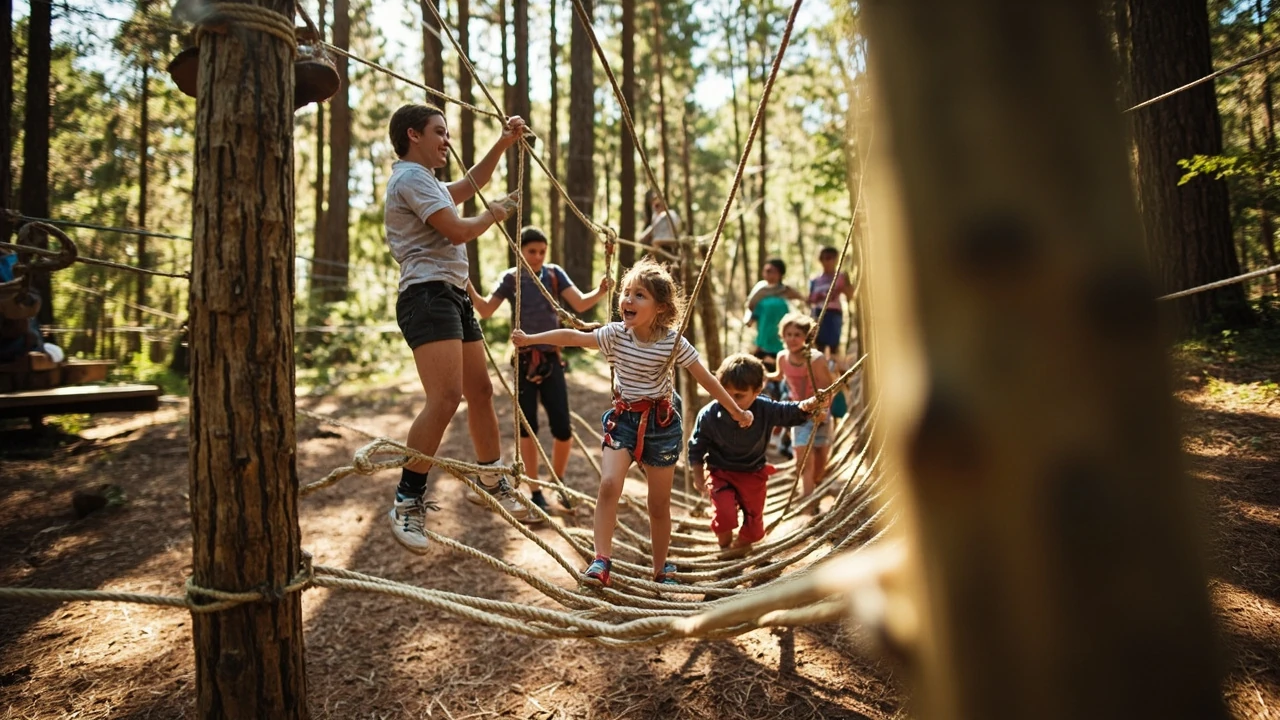
A six-year-old is halfway across a wobbly log bridge, hands gripping a rope above her head, while a parent walks next to her on the ground. Nobody is strapped into a harness. The course sits barely a metre off the forest floor, but the children are concentrating as hard as the teenagers on the high tower in the clearing behind them. This is the everyday scene at the heart of a lows adventure course, and it explains why low-ropes have become a default family activity at many outdoor parks.
This guide focuses on one specific subject: the low-ropes part of an adventure park, often searched as a “lows adventure” experience. It explains what the course is, how it differs from a high-ropes course, what equipment is used, who the activity is designed for, and what a first-time visitor should realistically expect. It does not cover climbing walls, ziplines, or full adventure-park planning in detail. For those, separate guides exist further down.
Lows adventure: the basic idea
A lows adventure course is a sequence of balance, climbing, and team obstacles installed just above ground level, usually under one metre high. The participant walks, crawls, balances, or climbs from one element to the next while staying connected to a safety line or simply by following the rules of the element. Because the fall factor is small, the courses can use simpler safety systems than a high-ropes tower, and many are designed for children, families, and mixed-ability groups.
The term “lows” is a common shorthand among instructors and operators for “low-ropes course”. Visitors will also see names like “junior course”, “kids’ course”, “ground course”, or “adventure trail” on signage, but the underlying activity is the same: an obstacle sequence that tests balance, coordination, and confidence without the height exposure of a full high-ropes circuit.
Low-ropes elements vary widely, but the typical list includes:
- Wobbly bridges made of rope, logs, or suspended planks.
- Net tunnels and cargo-net climbs.
- Balance beams and narrow walkways.
- Tyre swings, barrels, and rolling logs that need a team to pass along.
- Stepping stones and rope ladders just above the ground.
- Tightrope-style elements with a hand line for stability.
Many parks run a lows adventure as a self-paced circuit that visitors enter and exit independently after a short safety briefing, while others run it as a guided group activity tied to team-building or school programs. Both formats are valid, and the difference matters mainly for booking and timing.
How a low-ropes course differs from a high-ropes course
The most common confusion at a new park is the difference between low-ropes and high-ropes. The comparison below is the one staff usually explain at reception, and it is the simplest way to decide which activity to book first.
| Feature | Low-ropes (lows adventure) | High-ropes course |
|---|---|---|
| Typical height | 0.2 to 1.0 metres off the ground | 3 to 15 metres off the ground |
| Continuous safety system | Often none, or a simple loop on a top rail | Full belay system (smart belay, traditional belay, or self-belay) |
| Personal protective equipment | Usually none required; optional helmet for some elements | Harness, helmet, and lanyards are standard |
| Typical minimum age | From around 3 to 5 years, depending on the operator | Usually 7 to 10 years, with height requirements |
| Session format | Self-paced circuit or short guided rotation | Briefing, harnessing, then timed ascent and descent |
| Main challenge | Balance, coordination, problem-solving | Height exposure combined with the same physical skills |
| Supervision needed | Parents can usually walk alongside or wait at the exit | An adult on the ground rarely suffices; ratios are stricter |
| Typical time on course | 30 to 75 minutes depending on group size | 60 to 120 minutes including briefing |
The key practical point is that a lows adventure course is designed so that a fall, while still undesirable, is from a height and onto a surface that does not normally cause injury. That is why most operators allow younger children and let adults participate in regular shoes rather than specialist climbing footwear. It is also why low-ropes is the part of the park most schools, scouts, and birthday parties use.
Who a lows adventure course is actually for
Marketing pages often describe a low-ropes course as “for everyone”. The reality is more specific, and a clearer picture of the audience helps visitors pick the right session.
Families with younger children
Low-ropes is the part of a park where a four-year-old and a twelve-year-old can take turns on the same elements. The obstacles are scaled so that small legs can reach the next step, and an adult can stand on the ground next to the trickiest bridge to offer a steadying hand. For families considering a first visit to any outdoor adventure venue, the practical age and height rules are worth checking in advance, and the related guide on family rope park age and height rules covers those specifics in more detail.
School and youth groups
Teachers and group leaders tend to use lows adventure circuits for two reasons: they fit a standard class period once you include the briefing, and the obstacles lend themselves to team challenges such as moving everyone across a gap using only two planks. Many parks package a low-ropes session with a short high-ropes taster for older classes, and instructors often design specific “problems” to discuss cooperation and communication afterwards.
First-time visitors and cautious adults
Adults who are not comfortable with heights can still take part in a low-ropes session alongside their children. The course is a useful way for a parent who is unsure about a high-ropes tower to understand the park’s safety culture from the ground, before deciding whether to climb. For visitors who have never been to any rope park, the step-by-step walkthrough in your first high ropes course: what to expect also applies in spirit to a low-ropes visit, even if the equipment is simpler.
Team-building and adult groups
Low-ropes remains popular for corporate and adult groups because the obstacles are social, not extreme. Classic problems like the “spider web”, “toxic waste”, or “all aboard” islands are essentially low-ropes elements with a group challenge bolted on. They work well for mixed-fitness groups, intergenerational family gatherings, and any setting where the goal is shared problem-solving rather than individual athletic performance.
Safety systems used on a lows adventure course
Most visitors assume that if there is no harness, the course is unsupervised. The opposite is usually true: low-ropes courses rely heavily on clear rules, ground supervision, and well-maintained equipment because there is no mechanical safety net catching a slip.
When no personal equipment is required
On simpler lows adventure elements, the safety model is straightforward. Participants stay within marked zones, one person crosses at a time, hands stay on the ropes, and ground-level staff position themselves at the trickiest obstacles. The risk of falling is reduced by low height, soft ground surfaces such as bark or woodchip, and physical padding on posts. A short safety briefing covers the rules for each element before the group enters.
When a simple loop or top rail is used
Some parks add a continuous loop, carabiner, or magnet system on the top rail of the course. This is not the same as a high-ropes belay. It exists to keep participants from wandering off the structure, and in some designs to give an extra handhold, but it is not engineered to catch a fall from height. A more detailed explanation of what genuine high-ropes belay systems do, and how they differ, is in the guide to high ropes belay systems explained.
Supervision and group sizes
Operators set their own supervision ratios. A common pattern is one trained staff member per ten to fifteen children on a self-paced low-ropes circuit, with higher ratios for younger groups or guided problem-solving sessions. For parents visiting with their own children, supervision is shared: the adult stays on the ground within arm’s reach, and staff are positioned at choke points along the route.
What the day actually looks like on a lows adventure visit
Once visitors know what a lows adventure is and who it suits, the next question is almost always about timing. Below is a realistic sequence for a first family visit, which can be compressed for a quick after-work session or stretched for a full day out.
- Arrival and check-in (10-15 minutes): The group checks in at reception, signs any required waivers, and receives a wristband or token for entry to the course.
- Safety briefing (10 minutes): A staff member explains the rules, demonstrates the trickier elements, and answers questions. For younger children, the briefing is short and visual.
- Warm-up circuit (5-10 minutes): Most parks start visitors on a simple balance element near the entrance before they reach the harder bridges.
- Main circuit (30-60 minutes): Visitors work through the elements in their own order and at their own pace. Staff reposition along the route as groups move through.
- Optional high-ropes taster (30-60 minutes): Some visitors move on to a high-ropes course after the low-ropes session, which requires a separate harness fitting and briefing.
- Cool-down and exit (5-10 minutes): Visitors return equipment, collect bags, and often finish at a café or picnic area on site.
For families planning a longer day, the one-day forest escape planner walks through how to combine a low-ropes session with travel, food, and rest stops without overrunning the schedule.
What to wear and bring to a lows adventure
Because no harness is required, the dress code for a lows adventure course is closer to a forest walk than to a climbing session. That said, a few practical items make a visible difference to comfort and safety.
| Item | Why it matters | What to avoid |
|---|---|---|
| Closed-toe shoes | Grip on ropes and wooden elements; protection from roots and stones | Sandals, flip-flops, and any open footwear |
| Comfortable trousers or leggings | Prevent rope burn on the back of the knees on cargo nets and tunnels | Short shorts that expose the skin to rope friction |
| Layers that can get dirty | Bark dust, mud, and pine resin transfer to clothing | Brand-new or purely white outfits |
| Hair tied back | Stops hair catching in carabiners and on rope loops | Loose long hair near moving elements |
| Small backpack or waist bag | Keeps water, snacks, and a phone accessible between elements | Large backpacks that unbalance the wearer on bridges |
| Water bottle | Low-ropes is more aerobic than visitors expect, especially in warm weather | Sugary drinks as the only fluid, especially for children |
Jewellery, especially rings and bracelets, is best left in a pocket or at home. Rope fibres can catch on metal, and any small item that falls into the bark mulch is rarely seen again. Phones should be in a zipped pocket or a waist bag; the rule of thumb is that anything that cannot survive a short drop onto soft ground should be left in a locker.
Limits and rules to check before booking
Low-ropes is the most accessible part of an adventure park, but it still has limits. A few of them are decided by the operator and are worth confirming before travel, because they change the experience noticeably.
- Minimum age and height: Some parks accept children from three, others only from five or six. A few have separate “tots” and “juniors” circuits with their own age bands.
- Maximum weight per element: A small number of bridges have a posted per-person limit to keep the rope tension within design tolerances.
- Group size per circuit: Self-paced circuits often have a maximum number of visitors on the course at any one time to keep queues short and supervision clear.
- Weather policy: Rain changes grip and visibility on ropes. Operators have published thresholds, which are not the same across parks, and the practical questions to ask are covered in rope park weather and closure questions.
- Photography policy: Most parks allow photos from the ground, but a few restrict filming on the structure itself. This matters for birthday parties and school groups.
- Accessibility: Some elements are reachable by wheelchair users or visitors with limited mobility, but not all. Operators can usually describe the accessible route in advance.
Common mistakes first-time visitors make on a lows adventure
Most issues on a lows adventure course are not safety incidents but avoidable frustrations. The list below is drawn from common visitor feedback rather than from any one operator.
- Booking the high-ropes course first and skipping low-ropes: Families who arrive with energy and time to spare often find that low-ropes is the more relaxed part of the day, and a better warm-up than the high tower.
- Letting very young children run ahead unsupervised: Even on low-ropes, one child on an element at a time is the standard rule, and younger children misread the queueing system without an adult nearby.
- Wearing the wrong shoes: Trainers with good tread are ideal. Smooth-soled fashion trainers, wellingtons, and brand-new boots are the most common sources of slips.
- Skipping the safety briefing: The briefing is short for a reason. It explains the order of elements, the ground rules, and where staff can be found if a child is stuck.
- Underestimating the time needed: A group of six children on a low-ropes circuit easily spends an hour, and that is before any high-ropes add-on, travel, or food.
How a lows adventure fits into a wider outdoor day
Most visitors do not travel to a rope park for the low-ropes course alone. The course works best as part of a longer day, and the surrounding programme usually decides whether the visit feels relaxed or rushed. The general pattern across most adventure parks is described in the broader guide to adventure parks explained, and a few practical combinations stand out for different kinds of visitors.
For families with children under ten
A typical day starts with a low-ropes warm-up while energy is high, moves to a high-ropes taster for older siblings, and ends with a picnic or café lunch. The low-ropes session also works as a quiet fallback if the high-ropes course closes for weather, because it is less exposed and easier to operate in light rain.
For school and youth groups
Schools often run low-ropes as a structured team-building block of 60 to 90 minutes, with defined problems to solve and a debrief at the end. The session can be paired with an outdoor classroom or a short nature walk in the same forest, which keeps travel time low and keeps the group on a single site.
For adult groups and celebrations
Birthday parties, family reunions, and corporate days tend to use low-ropes as a social anchor, with food and unstructured time around it. For these groups, the practical cost of the day is the main constraint, and the realistic day trip budget guide gives a clear way to plan it without surprises.
How to choose between a lows adventure and other low-cost outdoor activities
Low-ropes sits in a crowded field of family outdoor activities. The table below is a quick comparison for visitors trying to decide whether to book a lows adventure session or to spend the time on a more familiar option.
| Activity | Cost per person | Physical effort | Social element | Works in light rain |
|---|---|---|---|---|
| Lows adventure course | Low to medium | Low to medium | Strong, especially for groups | Often yes, with operator approval |
| High-ropes course | Medium to high | Medium | Moderate | Often suspended for wind or storms |
| Forest walking trail | Free or very low | Low | Weak; mainly shared scenery | Yes, with suitable clothing |
| Zipline session | Medium to high | Low | Weak; sequential rather than shared | Suspended in wind and lightning |
| Bouldering wall (indoor) | Medium | Medium to high | Moderate | Yes, indoor |
The honest answer is that a low-ropes course is the rare activity that combines a clear physical challenge, a strong social element, and a low cost per person, which is why it has become a default choice for groups with mixed ages and mixed confidence levels. The trade-off is that it requires travel to a suitable park, and not every forest has one.
Booking, pricing, and what to ask before you go
Pricing for a lows adventure session varies by country, operator, and whether the course is bundled with a high-ropes ticket. A few questions cover most of the practical variation.
- Is the low-ropes course included in the general admission, or is it a separate ticket?
- Are time slots assigned, or can visitors enter the course at any point during opening hours?
- Is a deposit required for groups, and how far in advance should the booking be made?
- What is the cancellation policy if the weather turns?
- Is the course accessible for visitors with limited mobility, and which elements are reachable?
- Are there lockers, toilets, and a place to eat on site?
For visitors travelling without a car, the choice between train and car for a day trip to a forest park is one of the most common planning decisions, and the comparison in train or car for an outdoor day trip covers the practical trade-offs in detail.
Lows adventure and the wider ropes-course landscape
For visitors who want to understand where a lows adventure course fits in the broader family of rope-based attractions, the ropes courses explained guide covers the main types of structures, the safety systems each one uses, and the audiences they suit. The short version is that low-ropes is the most accessible member of that family, and the entry point most parks recommend for first-time visitors and younger children.
How safe any given course is depends less on the height of the obstacles and more on the operator’s maintenance routine, staff training, and briefing quality. The practical checklist for assessing any adventure park before booking is in the guide to finding a safe adventure park, and the same questions apply, with slightly less weight, to a low-ropes course.
Frequently asked questions
What does “lows adventure” actually mean?
It is a common short form for “low-ropes adventure course”. It refers to the part of an adventure park where the obstacles are installed just above ground level, usually under one metre, and are navigated without a climbing harness.
Is a lows adventure course safe for young children?
Low-ropes courses are the part of an adventure park most operators design for young children, often from age three or four upwards. The risk is reduced by low height, soft ground surfaces, and ground-level supervision, but the safety briefing and operator rules should still be followed.
Do I need a harness for a low-ropes course?
Usually not. Most low-ropes elements rely on rules and ground supervision rather than a personal belay. A small number of parks add a simple loop on the top rail, but this is not a climbing harness and does not catch a fall from height.
How long does a lows adventure session take?
A typical self-paced visit lasts 30 to 75 minutes depending on group size and how busy the course is. With check-in and the safety briefing, a full visit is usually 60 to 90 minutes.
What should my child wear for a low-ropes course?
Closed-toe shoes with good grip, comfortable trousers or leggings to reduce rope burn, and layers that can get dirty. Jewellery and loose items are best left in a pocket or locker.
Can adults who are afraid of heights do a lows adventure course?
Yes. Low-ropes is well suited to adults who are uncomfortable with high-ropes towers. The obstacles challenge balance and coordination, not height exposure, and many adults use a low-ropes session to gauge a park before deciding whether to climb higher.
What happens if it rains during our visit?
Many low-ropes courses continue to operate in light rain, because the obstacles are low and surfaces stay manageable. Operators have their own weather thresholds, which should be checked before travel, and the rope park weather guide covers the common questions.
Is a lows adventure course suitable for school groups?
Yes. Low-ropes is widely used for primary and early secondary school groups because it accommodates mixed ages and abilities, runs in a standard class period, and lends itself to team-building problems that teachers can debrief afterwards.
Can I combine a lows adventure with a high-ropes course in one day?
Most parks are designed for exactly that. A common pattern is a low-ropes warm-up followed by a high-ropes session for older children and adults, with food and rest in between. The exact combination depends on the operator and on the group.
Do I need to book in advance?
For individuals at quiet times, walk-in entry is often possible. For weekends, school groups, and birthday parties, advance booking is strongly recommended, because operators limit the number of visitors on the course at any one time.
Related reading
Explore High Ropes Adventure
Trip tools
Essential adventure planning guides
Use these practical guides to compare rope park activities, prepare for a first high ropes day, check a booking, choose suitable footwear and contact the editorial team. Each page links to the relevant live tools and current planning sections.
Latest articles
- Lows adventure: how low-ropes courses work and who they suit
- outdoor couch
- United travel bank: how prepaid travel money cards actually work
- National parks in California: a practical guide to choosing your trip
- How to buy chris brown usher tickets without overpaying
- Ariana Grande tickets: how to find real seats, avoid resale traps, and plan the day around the show
- Outdoor fireplace ideas, fuel choices, and safety for a back-garden build
- Raffle tickets for fundraisers and community events
- Parks Explained: Types, Rules, and How to Plan a Visit
- Planning a Parks Project: From Site Vision to Built Adventure Space