What a travel guard does on a high ropes course and why it matters
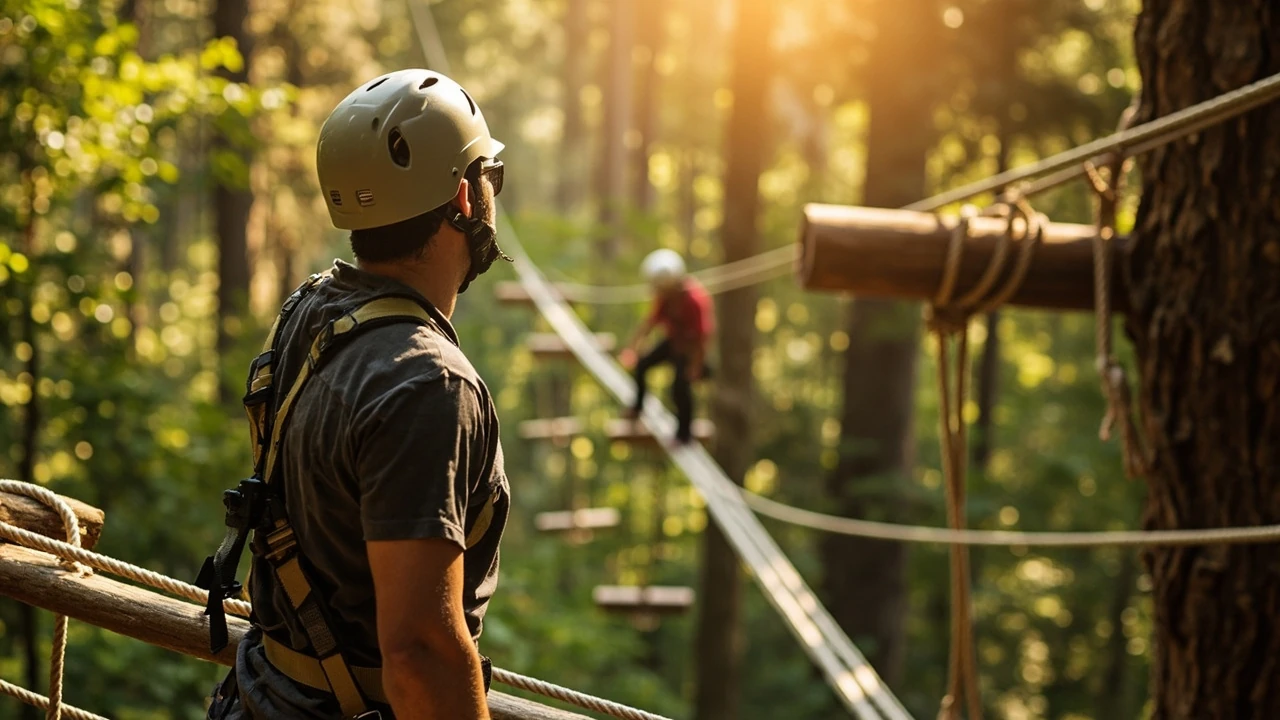
A climber steps off the launch platform, clips into the safety line, and freezes for a second when the cable sways under their weight. On the platform behind them, a staff member in a helmet and harness watches every move, ready to call a correction or step in if a hand slips. That staff member is the travel guard, and on a well-run course they are the reason a nervous first-timer can finish the course instead of freezing twenty feet up.
A travel guard is the on-course attendant who manages the moving safety system as each climber moves between elements. They stand at key points along the route, watch how climbers attach to the cable, give real-time feedback, and rescue anyone who cannot finish. The role is distinct from the ground instructor who runs the safety briefing, and from the park manager who oversees the whole operation. On a high ropes course, the travel guard is the closest set of eyes a climber has while they are up in the trees.
Travel guard: the on-course safety role on a high ropes adventure
If you have ever watched a ropes course from the ground, you may have wondered who the people are on the platforms above, and why they seem so focused. This guide explains what a travel guard does, how the role fits into a wider safety team, what training the position usually requires, and what visitors should expect from one during a typical session.
What the role actually covers
The travel guard’s job is to keep climbers moving safely from one element to the next. They do this by managing the continuous belay or attachment system, watching body positions, and stepping in when someone is stuck, exhausted, or misusing the equipment. The work happens entirely on the course itself, often at height.
Most travel guards rotate between two or three platforms during a session. While on a platform, they will typically:
- Check that the arriving climber is still correctly attached to the safety line before letting them leave the platform.
- Signal the next climber when the platform is clear, so the system does not get overstressed.
- Coach grip, foot placement, and pacing when a climber hesitates on a tricky section.
- Talk a nervous climber through a crossing, sometimes minute by minute, until they reach the next platform.
- Manage a controlled descent or rescue if a climber freezes, feels unwell, or cannot continue.
The work is physical. Travel guards climb the course themselves to reach their station, hold awkward positions for long periods, and stay alert in weather that can shift from sun to wind to light rain within an hour. For readers who are also looking at the wider field of rope courses, the overview of ropes courses on this site explains how the different safety systems affect what a guard has to manage.
How the travel guard fits into the wider safety team
High ropes parks usually run on a layered safety model, and the travel guard is one layer among several. Understanding the layers helps visitors know who to listen to at each moment of the visit.
| Role | Where they work | Main responsibility | When a visitor meets them |
|---|---|---|---|
| Ground instructor | At the training platform, on the ground | Runs the safety briefing, fits harnesses, teaches the clip-in system | Before the climb, once |
| Travel guard | On platforms along the course | Watches climbers in transit, manages the safety system on each element | Throughout the climb, at every transfer point |
| Course manager or lead guide | Walks the course, monitors the system as a whole | Supervises guards, handles evacuations, makes closure calls | Only on request or in an incident |
| Ground crew and check-in staff | At the base, the harness area, the finish zone | Fit gear, run the queue, manage group flow | At the start and end of the session |
On smaller courses, the same person may take on two of these roles, which is why a single staff member can seem to be everywhere at once. On larger operations, especially courses with sixty or more elements, the travel guard role is kept separate so that the person at height is not also responsible for the briefing area.
What a travel guard checks at every transfer
The most important moment of the travel guard’s job is the platform transfer, the point where one climber leaves the platform and the next one begins. At that point, two things have to be true: the arriving climber must still be safely attached to the system, and the departing climber must be correctly clipped to the next section before they unclip from the previous one.
On a continuous belay system, the cable is the safety line that stays connected to the climber from start to finish. The carabiner or shuttle at the end of the lanyard slides along that cable, and the guard’s task is to make sure it never gets unhooked at the wrong moment. On a self-belay or smart-belay system, the design is supposed to make a wrong unhook almost impossible, but the travel guard still watches every transition because hardware can fail, latches can jam, and climbers can panic.
A typical transfer check covers five things.
- Both trolley or carabiner attachments are on the correct cable section before any unclip happens.
- The lanyard is not twisted and the shock pack, if fitted, sits against the back of the harness.
- Helmet straps are still fastened and the chin strap is snug.
- Loose items such as phones, scarves, or unsecured cameras have been stowed.
- The climber has acknowledged the next element and looks steady enough to begin.
On a busy summer day, a single travel guard may run this checklist for several hundred transfers, which is part of why the role is demanding and why good parks rotate staff through it.
Training and qualifications most parks expect
There is no single international certificate for a travel guard, but most reputable parks require a baseline of training before a new staff member is allowed to work on a course alone. The exact mix depends on the country, the insurer, and the park’s own internal program, but the core areas are similar.
- Working at height and fall arrest: how to move safely on the course itself, how to use a backup line, and how to arrest a fall if a climber drops.
- Rescue from height: how to lower a panicking or injured climber from an element, either with a partner on the ground or with a kit carried on the course.
- Equipment inspection: daily checks of lanyards, harnesses, carabiners, and pulleys, and how to remove damaged gear from service.
- Customer care and group management: how to coach nervous adults, how to handle children, and how to communicate clearly from height.
- First aid: at minimum, basic outdoor first aid, with at least one qualified first aider on site at all times.
Many parks build their program on a national outdoor activity standard, for example the British Association of Snowsport Instructors’ outdoor activity framework or national climbing body qualifications in other countries, and then add in-house training on the specific course the guard will work on. New travel guards are usually signed off only after a number of supervised sessions, with a senior guard or course manager watching from a nearby platform.
What a travel guard does when something goes wrong
Most sessions end with no incidents, and a good travel guard keeps things quiet by preventing small issues from turning into real ones. When something does happen, the response depends on the kind of problem.
| Situation | What the travel guard does first | How the situation usually ends |
|---|---|---|
| Climber freezes on a section | Stops the next climber from following, talks the frozen climber through breathing and weight shift | Climber reaches the next platform under their own power |
| Climber drops from the element but the safety line holds | Reassures the climber, asks them to test their legs, talks them back to the platform | Climber is lowered from the platform and may be asked to stop for the day |
| Climber becomes unwell, panics, or refuses to move | Calls the course manager, sets up a rescue kit, prepares to lower or winch | Climber is brought down, often with a small team and a ground spotter |
| Equipment fault on a carabiner or lanyard | Stops that element, swaps the climber to a backup line, takes the kit out of service | Maintenance is called in and the element stays closed until signed off |
| Weather change, such as gusts or lightning | Stops new climbers leaving the platform, follows the park’s weather protocol | Course is closed, climbers are walked down by the fastest safe route |
Two things are worth noting here. First, a travel guard is allowed to take a climber off the course. If a guard says someone is done for the day, that decision stands and is usually backed by the course manager. Second, the rescue kit on a platform is for exactly these moments. Visitors sometimes feel embarrassed about needing it, but for staff it is a routine part of the day.
What a travel guard is not responsible for
It helps to be clear about the limits of the role, because visitors often make assumptions that the travel guard can solve any problem. A travel guard is not:
- A medical professional. They can give basic first aid and call for help, but they do not diagnose injuries or prescribe what a climber should do next.
- A therapist or anxiety coach. They can talk a frightened climber through a crossing, but they are not trained to manage long-term phobias or panic disorders.
- A weather forecaster. They follow the park’s weather policy, but the actual call to close the course sits with the course manager or operations lead.
- A photographer. Even if a park sells photos, the travel guard cannot leave the platform to take them.
Knowing these limits can actually make a session go more smoothly. A climber who needs medical reassurance, for example, is better served by asking to come down to the ground and speaking to a first aider, rather than waiting on a platform for a guard who is not equipped to help.
How visitors can make the travel guard’s job easier
Most of the small problems that travel guards have to manage are caused by things visitors can control before they leave the ground. A few habits make a real difference.
- Listen fully at the briefing. The travel guard assumes that what was said in the harness area still applies up in the trees, and will treat a missed step as a safety issue.
- Secure loose items. Hair ties, scarves, sunglasses on cords, and phone wrist straps all get caught in carabiners. Stow them before the climb.
- Keep one hand on the safety line whenever possible. It is tempting to let go for a photo, and travel guards will usually call out when they see it.
- Tell the ground staff about any medical condition, even a mild one, before the climb. Travel guards need to know if they are dealing with a sore knee or a heart condition before they decide whether a climber can finish.
- Speak up at the platform. If a section looks too much, the guard can talk through it, suggest an easier route on a parallel element, or arrange a quick rest on the platform.
These are not special requests. They are the everyday inputs that let a travel guard keep a busy course running without anyone having to be rescued.
What a travel guard sounds like on the course
One of the underappreciated parts of the role is the way a travel guard uses their voice. Climbing in the trees is loud, with wind in the canopy, other groups nearby, and the creak of cables under load. A guard has to project over that noise without sounding like a drill sergeant.
Good travel guards tend to fall into a few patterns. They give short, specific instructions such as “left foot up, hand over hand, one more step” rather than vague encouragement. They confirm safe states with a simple word, often the name of the next platform, so a climber knows they have done the right thing. They keep banter light but do not push jokes on someone who is clearly overwhelmed. And they hand control back to the climber as soon as possible, because the goal is for the climber to do the climb, not the guard.
For visitors who want a sense of how the on-course communication works in practice, the article on high ropes belay systems on this site gives a useful picture of what the guard is actually managing while they are talking.
When the role changes with the weather
Weather is the single biggest reason a travel guard’s day looks different from one session to the next. Most parks have written thresholds for wind, rain, and lightning, and the travel guard is responsible for enforcing them at platform level.
In light wind, the guard’s job is to coach more deliberate foot placement and to keep climbers from rushing between elements. In stronger wind, the guard may pause new climbers from leaving a platform and wait for a steady gap between gusts. In heavy rain, the guard watches the cables and platforms for slip risk, and may shorten the route to the easier elements. In lightning, the course is closed immediately and every platform evacuates in a set order.
None of this is the guard’s personal decision. It comes from a written policy, and the guard is expected to apply it the same way every time. Visitors who want to know how a park decides on closures can read more in the guide to rope park weather, rain, and wind closures.
How the travel guard role differs from the ground instructor
It is common for visitors to mix the two roles up, especially because the same staff member may do both on a quiet day. There are real differences, though, and they matter when you need help.
| Aspect | Ground instructor | Travel guard |
|---|---|---|
| Location | Mostly on the ground, in the training zone | On platforms, at height, for most of the shift |
| Climber contact time | Concentrated, around 20 to 30 minutes for the briefing | Spread out, in short bursts at each platform |
| Main teaching point | How the safety system works | How to apply the system on this element |
| Rescue focus | Initial response, ground-based first aid | On-element rescue, lowering or winching |
| Decision authority | Can refuse to let someone climb at the start | Can stop a climb mid-course and bring someone down |
The practical takeaway is that questions about how the system works belong to the ground instructor, and questions about how to handle a specific element belong to the travel guard on that platform. If you are unsure who to ask, the travel guard on the nearest platform will redirect you.
How the role changes for different age groups
Family groups are now the most common visitors to high ropes parks, and the travel guard’s communication style changes depending on who is crossing. With children, the guard keeps instructions concrete, avoids abstract language like “center of gravity,” and is more likely to call out a small victory at every transfer. With teenagers, the guard treats them closer to adults but watches more carefully for show-off behavior, such as skipping a step or running on a platform. With adults, the guard usually assumes competence but stays alert for signs of fatigue or overconfidence on the longer elements.
For visitors planning a family day, the practical write-up on family rope park age and height rules covers the age-based limits that affect which elements a travel guard will be assigned to monitor.
Common mistakes visitors make with the travel guard
Most of the friction on a course comes from a small set of predictable mistakes. None of them are malicious, and the travel guard is trained to handle them, but they do slow the course down and use up the guard’s attention.
- Asking the travel guard to take a photo. The guard cannot leave the platform and still keep climbers safe. Photos are usually handled at the finish.
- Ignoring the guard’s call to wait on a platform. If a guard says hold, it is almost always because the next element is overloaded or the next platform is not yet clear.
- Treating the guard as a tour guide. The guard is happy to point out the view, but their priority is the safety system, not the scenery.
- Clipping in to the wrong line by accident. It happens, especially on busy courses. The guard will sort it out, but it is faster if the climber stops and says so instead of trying to fix it mid-air.
If a mistake happens, the simplest thing to do is call out, stay still, and let the guard give the next instruction. Travel guards are used to all of these situations and would rather hear about a problem early than discover it later.
Why the role matters for nervous first-timers
For a climber who has never been on a high ropes course, the travel guard is the difference between a fun afternoon and a miserable one. The ground briefing teaches the system, but the climb is what turns that knowledge into a felt experience, and the travel guard is the person who bridges the two.
Research on outdoor adventure education consistently points to the instructor’s role as a key factor in whether a participant feels safe enough to keep going, and high ropes courses are no exception. The travel guard’s calm presence at each platform gives a nervous climber a predictable human point of contact on an unfamiliar structure. That is not a small thing. It is often the reason a first-timer leaves the park planning a return visit.
Visitors who want a preview of what that first climb feels like can read the walkthrough of a first high ropes course, which describes the same sequence of moments from the climber’s side.
Frequently asked questions
What is a travel guard on a high ropes course?
A travel guard is the staff member stationed on the platforms along a high ropes course who watches climbers, manages the safety system at every transfer, coaches technique, and rescues climbers who cannot continue. They work at height, in rotation between two or three platforms per session.
Is a travel guard the same as a belayer?
Not exactly. A belayer manages a rope from the ground or from a base anchor, often for a single climber at a time, and is the traditional role in rock climbing. A travel guard manages a continuous safety system for many climbers in sequence on a self-contained course, often from a platform on the course itself.
Do I need to tip a travel guard?
Tipping is not expected in most countries, and the guard’s pay does not depend on it. A simple thank you, and listening carefully to their calls, is the most useful appreciation for the role.
Can a travel guard refuse to let me climb?
Yes. A travel guard, and the ground instructor before them, can refuse a climb if a climber is visibly unwell, intoxicated, under the minimum age or height, or showing behavior that puts others at risk. The decision is final for that session.
What happens if I freeze on a high ropes element?
The travel guard will stop the next climber from following, then talk you through breathing, weight shift, and the next few moves. If you cannot move after a few minutes, the guard will set up a rescue and lower you from the platform in a controlled way.
How do travel guards handle bad weather?
They follow the park’s written weather policy, which usually has clear thresholds for wind, rain, and lightning. Light conditions may only slow the course, while lightning usually forces an immediate evacuation in a set order.
Can a travel guard rescue someone on their own?
Often yes, with a rescue kit carried on the platform, but for serious incidents a small team is brought in. The course manager coordinates the wider response, and the on-platform travel guard focuses on the climber in front of them.
What should I tell the travel guard before I climb?
Tell the ground staff about any medical condition, recent injury, pregnancy, or strong fear of heights, so the travel guard is prepared. Once on the course, speak up at the first platform if you are unsure, rather than waiting until you are mid-element.
How many climbers does one travel guard look after?
It depends on the course design and the safety system, but a common ratio is one travel guard per transfer point, with a course manager supervising several platforms. On a busy day, a guard can run several hundred transfers in a session.
Do travel guards work in all weather?
They work in most conditions that the park allows the course to operate in, which usually means dry to lightly wet weather, with limits on wind and a full stop for lightning. The role is more demanding in poor weather because the guard’s attention has to cover slip risk as well as the usual safety checks.
Related reading
Explore High Ropes Adventure
Trip tools
Essential adventure planning guides
Use these practical guides to compare rope park activities, prepare for a first high ropes day, check a booking, choose suitable footwear and contact the editorial team. Each page links to the relevant live tools and current planning sections.
Latest articles
- What a travel guard does on a high ropes course and why it matters
- Choosing an outdoor heater for patio evenings and trail-side stops
- Travel quotes that actually help you plan the next trip
- Ring outdoor camera placement and setup for adventure parks
- Blink outdoor camera: a practical guide for property monitoring
- Outdoor bar ideas: design, layout, and practical choices
- Tate McRae tickets: how to find, compare, and buy seats without the stress
- Tame Impala tickets: how to find them, what they cost, and what to know before you buy
- Outdoor pillows: how to choose the right ones for a deck or trail rest stop
- How to find Morgan Jay tickets without overpaying