Continuous belay vs smart belay for families: a practical guide
Continuous belay vs smart belay for families: how the two systems actually differ
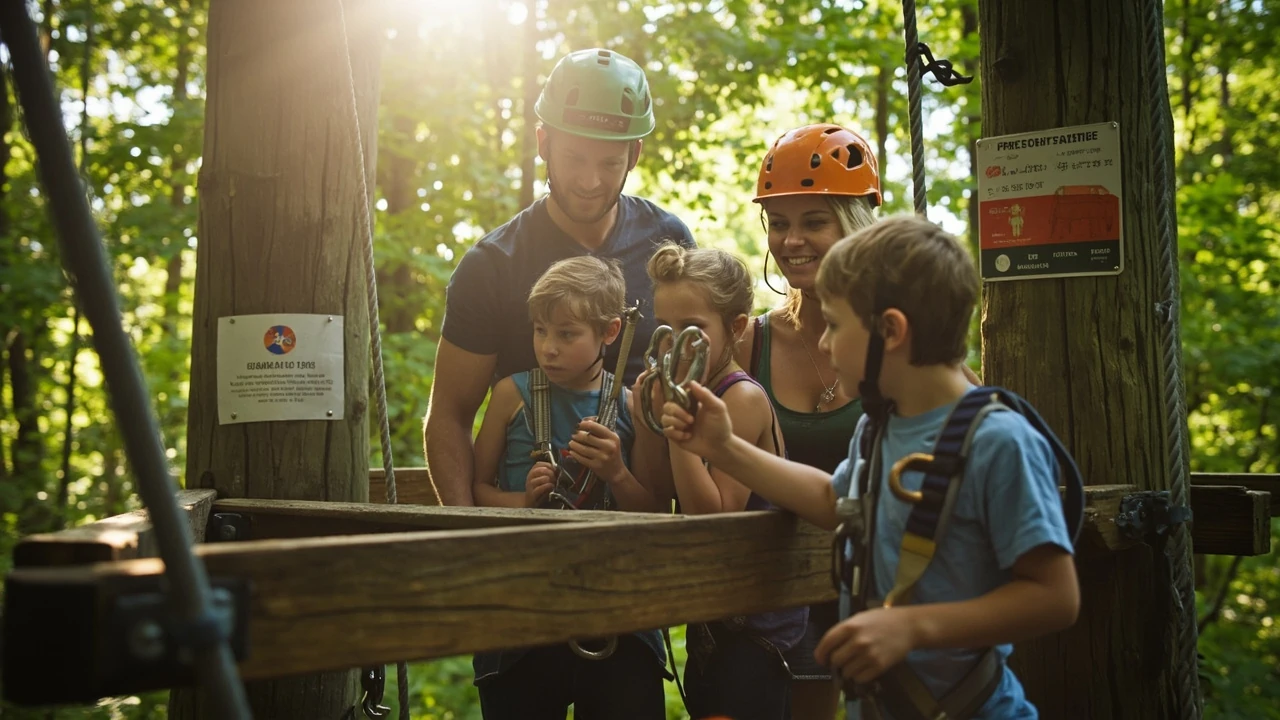
A parent stands on a high ropes platform, eight meters up, with a nervous nine-year-old clipped in beside them. The guide points at a stainless carabiner on the safety line and says, “You can only unhook this at the end of the course, and only at one specific point.” On the next platform, another guide is showing a different family a red and yellow hook that opens with a deliberate two-hand motion. The first family is on a continuous belay system. The second is on a smart belay. The choice between the two affects how the climb feels, how mistakes are handled, and whether a tired six-year-old will still be safe at element twelve.
When families compare continuous belay vs smart belay for families, they are usually weighing two very different safety philosophies dressed in similar hardware. Both are modern alternatives to the traditional double lanyard, and both are designed to keep a climber attached to the safety line at all times. The differences show up in how the carabiner behaves, who can operate it, and what happens if a climber forgets a step mid-course.
This guide is written for parents, teachers, group leaders, and operators who are choosing between the two systems for a family day out, a school trip, or a course build. It explains how each system works, where each one shines, and the practical questions worth asking before booking.
How a continuous belay system works
A continuous belay system uses a carabiner or hook that travels along a safety cable or rail without ever detaching. The climber receives the hook at the start of the course and carries it the entire way. To open it, the climber must arrive at a designated transition point, usually marked by a special plate, gate, or key, and follow a set sequence to release and reattach. Until that sequence is complete, the hook cannot come off the line.
Because the carabiner never leaves the cable between start and finish, the system removes a class of mistakes that plagued older setups: the forgotten clip, the missed double-check, the open hook. As long as the climber is on the line, they are on the line.
Continuous belay is not a brand. It is a category. Within it, operators use systems from manufacturers such as Petzl, Kanopeo, and Edelrid, often under names like “Continuous Belay,” “Safeline,” or “Smart Belay” depending on the hardware. The common thread is unbroken attachment.
How a smart belay system works
A smart belay system also uses a carabiner that follows a safety line, but it is designed to be opened and closed at any transition point. The “smart” part is usually a two-gate or locking mechanism that requires a deliberate, often two-handed, action to open. The climber unclips at the end of one element and clips into the next element’s cable before moving forward.
Most smart belay carabiners are shaped to make incorrect use difficult. Common safety features include:
- Two-handed opening that mimics the action of unclipping a seatbelt.
- A gate that closes and locks automatically once the climber lets go.
- A key shape that cannot be opened while the gate is under tension on the cable.
- A color-coded closed or open indicator visible to the guide below.
The result is a system that still demands attention at every transition, but does not require the climber to carry a single hook from start to finish. For some families, that is a comfort. For others, it is a source of stress.
Continuous belay vs smart belay for families: the core comparison
Both systems are widely used in modern aerial adventure parks, and both meet recognized industry standards. The right choice depends on the age of the children, the height of the course, the staff-to-guest ratio, and how much responsibility you want to place on the climber.
| Feature | Continuous belay | Smart belay |
|---|---|---|
| Climber detaches from line | Only at designated end-of-course point | At every transition between elements |
| Number of clip actions per course | Two: attach at start, release at end | One per element, often 8 to 20 actions |
| Forgetting to clip | Not possible between start and end | Possible if climber steps off without reattaching |
| Best suited to | Younger children, tired climbers, nervous first-timers | Older children, teens, adults, repeat visitors |
| Cognitive load on the climber | Low; one rule to learn | Higher; same action repeated at every platform |
| Rescue complexity if a climber freezes | Lower; climber is still on the line | Slightly higher; staff may need to assist the next clip |
| Typical course height range | Often lower and mid-height courses | Used across low, mid, and high courses |
| Common hardware colors | Often steel, red, or branded colors | Often red and yellow safety colors |
The table is a starting point, not a verdict. Many parks run both systems on different courses, and a family may experience a continuous belay on the kids’ loop and a smart belay on the main circuit in the same visit.
Why the two systems exist in the first place
To understand the family decision, it helps to know why the industry moved away from the older “traditional lanyard” approach. In a traditional setup, a climber wore two cow-tail lanyards and had to clip and unclip them in a specific order on every element. Mistakes led to unprotected windows, and several well-documented accidents in the 2000s pushed operators toward fail-safer designs.
Continuous and smart belay systems both emerged from that push. Continuous belay reduced decisions by making the carabiner physically unable to leave the line. Smart belay reduced the consequence of a wrong decision by making the device forgiving, hard to misuse, and quick to lock shut. Different parks, different manufacturers, and different countries landed on different answers. Parents comparing continuous belay vs smart belay for families are really comparing two answers to the same question: how do we make the climber’s next move as safe as possible?
What changes for younger children
Children under about ten often struggle with multi-step motor tasks performed under mild fear. A smart belay asks them to remember, on every platform, to unclip, move, and reclip in a specific order. Most do it fine with practice. A few freeze, especially on the first or second element, and need a guide to walk them through it.
A continuous belay changes that calculation. The child has one job: stay clipped in. Once the carabiner is on the cable at the start, there is no decision to make until the end of the course. For first-timers, tired kids, and children with attention or motor-planning differences, that simplicity is often the deciding factor.
If you are planning a family rope park day, it is worth reading how to plan a family rope park day around age and height rules before booking, since many parks set different minimum ages for the two systems.
What changes for teens and adults
Older climbers usually prefer the feeling of control that a smart belay provides. Each transition is a small accomplishment. Many teens find continuous belay “boring” after their second visit because there is so little to do with the hands. Smart belay gives them a rhythm, a count, a small challenge to master.
Adults traveling in mixed groups often split up by comfort level, with one parent on the continuous belay kids’ course and the other on the main smart belay circuit. Operators who run both systems can often place the whole family in the same physical area while still matching each climber to a course that suits them.
Safety differences that matter on a real course
Both systems are engineered to meet the same international standards used by reputable rope course builders, and both are inspected regularly. That said, the failure modes are not identical.
If a climber freezes on an element
On a continuous belay, the climber is still on the line. A guide can talk them through, or, in a true freeze, assist from the element. There is no need to reattach the carabiner because it never came off.
On a smart belay, the climber may have unclipped to step off an element and be standing on the platform without being attached to the next cable. Guides are trained to coach the clip, but this is a moment when error is possible. Good parks minimize this with platform markings, colored guides, and verbal cues.
If a climber drops the carabiner
On a continuous belay, dropping the carabiner is essentially impossible once the start sequence is complete, because it is closed around the cable.
On a smart belay, a climber can in theory drop the carabiner on a platform. Most devices are designed to stay closed if released, and a quick verbal check by the guide catches the rare mishap. Still, this is one of the reasons smart belay courses usually have a higher guide-to-climber ratio.
If a climber panics mid-bridge
Both systems are engineered to keep the climber attached through a panic. The bigger variable is rescue. With continuous belay, a guide can lower a frozen climber from almost any point on the line. With smart belay, a frozen climber is still on the line, but rescue logistics depend on which element they are on and whether they have unclipped already.
For a deeper look at how operators think about safety, the zipline safety guide on the same site explains the parallel checks performed on cable-based systems.
The role of the guide in each system
One often-overlooked factor in continuous belay vs smart belay for families is the role of the on-course guide. Both systems rely on trained staff, but the staff’s job is different.
- Continuous belay guides focus on coaching technique, encouraging nervous climbers, and managing the end-of-course transition. They spend less time checking clips because clips are not changing.
- Smart belay guides watch transitions closely, coach the open-close rhythm, and visually verify that each climber is attached before they leave the platform. They carry a slightly higher cognitive load per group.
A well-staffed smart belay course can be just as safe as a continuous belay course, but staffing costs and guide training tend to be higher. That can show up in ticket price.
Cost, throughput, and course design
For families, the cost difference between the two systems is usually small, but it exists. Continuous belay hardware tends to be more expensive per unit and to require more elaborate start and end structures, which raises build cost. Smart belay hardware is more flexible, easier to retrofit, and works on more course shapes, which lowers build cost.
In day-to-day operations, smart belay courses often move groups faster because there is no single bottleneck at the start. Climbers can be spaced more evenly. Continuous belay courses sometimes run slower at the start while each climber learns the one-time hookup, then move quickly through the elements.
| Operational factor | Continuous belay | Smart belay |
|---|---|---|
| Per-climber hardware cost | Higher | Moderate |
| Course design flexibility | Lower; needs dedicated start and end points | Higher; works on most layouts |
| Group throughput | Slower start, smoother mid-course | Smoother throughout |
| Staff training emphasis | Coaching and motivation | Clip verification and transitions |
| Best for school and large groups | Often preferred for under-12s | Often preferred for teens and adults |
What to ask the park before you book
Before you commit to a course, it is worth asking a few direct questions. Operators welcome these, and the answers tell you a lot about how they run their day.
- Which belay system does each course use, and at what height?
- What is the minimum age and the minimum height for the continuous belay course versus the smart belay course?
- How many guides are on the course during a typical session, and what is the climber-to-guide ratio?
- Are children under a certain age required to be on the continuous belay course, or can a parent choose?
- What happens if a child freezes mid-element? Is there a practiced rescue drill?
- How often is the carabiner hardware inspected, and by whom?
- Is there a lower practice course where younger kids can try the system on the ground first?
For context on how these questions fit into the wider planning picture, the article on how to find a safe adventure park near you walks through the same checks in more detail.
Common mistakes families make when choosing
Even well-prepared parents sometimes pick the wrong course for their group. A few patterns show up often.
The first is overestimating a child’s readiness for a smart belay course because the child is “good with zip lines” or “fine on playgrounds.” Aerial courses have a specific kind of focus, and the repeated clip-unclip motion is its own skill. If you are not sure, start on the continuous belay course and move up later.
The second mistake is putting a tired child on a longer smart belay circuit. Fatigue, not height, is what most often leads to a missed clip. A two-hour smart belay course at the end of a long day is harder than a forty-minute continuous belay course at the start of the day.
The third mistake is assuming the two systems are interchangeable. They are not. The “best” system depends on the climber, the day, and the course. Treating them as one and the same leads to either an under-stimulating course for a capable teen or an over-demanding course for a nervous seven-year-old.
How to introduce a nervous child to either system
Most parks offer a ground-level practice course. Use it. Let the child hold the carabiner, open and close it on a practice cable, and hear the click. If the park uses a continuous belay, walk them through the start sequence on the ground. If it uses a smart belay, run them through two or three clip transitions on a low practice loop before going up.
Three small habits help on the day itself:
- Ask the child to say “clipped” out loud after each transition on a smart belay course. The verbal cue catches slips before they become problems.
- Walk the course map together before clipping in. Knowing the shape reduces fear.
- Agree on a hand signal for “I want to come down.” Both systems allow assisted descent, and the child should know it before they are eight meters up.
How weather changes the decision
Rain affects both systems, but not equally. Smart belay carabiners with two-handed gates can be slightly harder to operate with cold, wet hands, especially for children in gloves. Continuous belay hooks, which only open once, sidestep that issue entirely. Wind is a different variable, more about course height than system type, and is covered in the article on rope park weather, rain, wind and closure questions to ask.
For families planning a wet-weather visit, it is worth asking whether the park runs its continuous or smart belay courses in light rain, and whether the metal hardware gets slippery. Operators usually have a clear answer.
Which system is best for a first family visit?
For a first visit with children of mixed ages, the continuous belay course is usually the safer, calmer choice. It removes the most common first-visit mistakes, lets younger children join in, and keeps the focus on the experience rather than the hardware. Teens and confident adults can be placed on the smart belay main course in parallel.
For a second or third visit, when the family knows what to expect, the smart belay course often becomes the more rewarding option. The repeated clip action becomes a rhythm, and the more challenging layouts that smart belay allows come into their own.
How schools and large groups usually choose
Schools tend to favor continuous belay for groups under about age twelve and smart belay for older students. The reasoning is partly safety, partly logistics. With continuous belay, one guide can supervise a larger group because the clip count is fixed. With smart belay, a smaller ratio is the norm, which raises staffing cost per head.
For organizers planning a larger group outing, the article on group adventures and how to plan a high ropes day that actually works covers the scheduling and ratio side of that decision in more depth.
A short decision checklist for parents
Use this list when you are on the phone with a park or standing in the parking lot trying to choose.
- Youngest child under ten with no aerial course experience: continuous belay.
- Mixed ages from about six to sixteen: continuous belay for the under-tens, smart belay for the rest, same park, same day.
- All adults or all teens: smart belay, ideally on a course with varied elements.
- Nervous first-timer of any age: continuous belay, ideally on a lower course.
- Repeat visitor who already knows the routine: smart belay main course.
- Wet or cold weather: continuous belay is easier with gloved hands.
What to take away
Continuous belay and smart belay are not rivals. They are two tools for the same job, each with a different cost-and-benefit profile. Continuous belay trades a more complex start and finish for simplicity and calm through the course, which is why families with younger children often prefer it. Smart belay trades repeated attention for design flexibility and a more engaging rhythm, which is why older children and adults often prefer it.
When weighing continuous belay vs smart belay for families, the honest answer is to match the system to the climber and the day, not to the marketing of the park. Ask the questions, walk the practice course, and pick the option that lets your family focus on the experience rather than the hardware.
If you want to keep exploring the wider topic, the site also has a clear walkthrough of what to expect on your first high ropes course, which pairs well with this comparison.
Frequently asked questions
What is the main difference between continuous belay and smart belay?
A continuous belay carabiner stays on the safety cable from the start of the course to the end. A smart belay carabiner is opened and closed at every transition between elements. The first removes almost all clip-and-unclip decisions; the second turns each transition into a small, deliberate action.
Is continuous belay safer than smart belay for children?
For most children under about ten, continuous belay reduces the chance of a missed clip, which is the most common user error. Both systems are engineered to current safety standards, but continuous belay places fewer demands on a child’s focus mid-course.
Can a five or six-year-old use a smart belay course?
Some parks allow it with a parent, but most operators set a higher minimum age for smart belay because the clip action requires more motor control and attention. A continuous belay kids’ course is usually the better first step at that age.
Do both systems need the same safety inspection?
Reputable parks follow manufacturer and industry inspection schedules for both. Carabiners, gates, and cables are checked at intervals that meet the standards of the certifying body, often daily for visible wear and on a longer cycle for structural checks.
What happens if a climber forgets to reclip on a smart belay course?
Guides are trained to watch transitions and to coach the climber from the ground or the platform. Most smart belay carabiners stay closed if released, and guides typically ask climbers to call out “clipped” before stepping off. A missed clip is caught quickly on a well-run course.
Why do some parks charge more for one system than the other?
Continuous belay hardware usually costs more per climber, and the course design needs dedicated start and end structures. Smart belay hardware is more flexible but requires more guides per group. The ticket price reflects a mix of both, which is why the difference is often small but real.
Is smart belay harder to use with gloves or in rain?
It can be. Two-handed gates and smaller openings are slightly harder to operate with cold or wet hands. Continuous belay, with its single hookup and release, is generally easier in poor weather. Parks in rainy climates often lean on continuous belay for this reason.
Can a family split across both systems on the same visit?
Usually yes. Many parks run a continuous belay kids’ loop and a smart belay main course that share the same site. Parents and older children can rotate between them while younger children stay on the simpler course.
Which system is better for a school or large youth group?
For groups under about age twelve, continuous belay is often preferred because one guide can supervise a larger group. For older students, smart belay is the more common choice because it scales well and the teens usually enjoy the rhythm.
Should a nervous first-timer start on continuous belay or smart belay?
Continuous belay, almost always. The fewer decisions a nervous climber has to make mid-air, the better the first experience. Once the climber is comfortable, switching to a smart belay course for a return visit feels like a natural upgrade rather than a leap.
Related reading
Explore High Ropes Adventure
Trip tools
Essential adventure planning guides
Use these practical guides to compare rope park activities, prepare for a first high ropes day, check a booking, choose suitable footwear and contact the editorial team. Each page links to the relevant live tools and current planning sections.
Latest articles
- Sweet tart ropes: what the flavour means in a ropes course
- Demon Slayer movie tickets: how to find a screening and prepare for a day out
- How to choose NBA tickets without overpaying
- Time travel movies worth watching on a slow weekend
- Overseas adventure travel: how to plan a trip that actually works
- Choosing an outdoor bench that actually lasts
- Lows adventure: how low-ropes courses work and who they suit
- outdoor couch
- United travel bank: how prepaid travel money cards actually work
- National parks in California: a practical guide to choosing your trip