How long does a high ropes course usually take? A practical timing guide
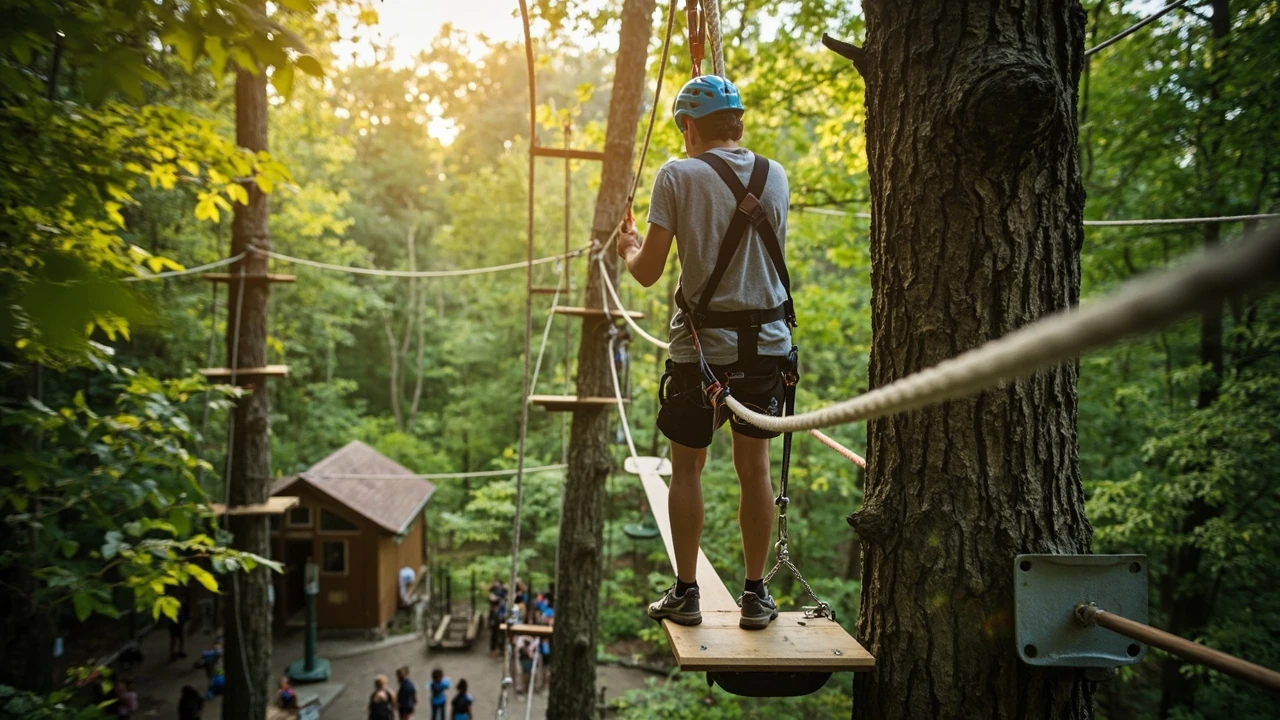
How long does a high ropes course usually take?
Most visitors spend between one and a half and three hours on a high ropes course, and the exact figure depends on the route you choose, how many people are in your group, and how comfortable you are with heights. A first-time climber tackling a single beginner loop should plan for around 90 minutes from check-in to the final platform, while a group working through several colour-graded routes can easily use half a day. Knowing the realistic range before you book saves you from a rushed visit or, just as often, from budgeting too little time and missing the last session of the day.
Because the timing question is less about a single number and more about the moving parts that fill it, the rest of this guide breaks the visit into stages, looks at the variables that stretch or compress each one, and gives planning ranges for families, first-timers, and groups. The figures reflect what most UK and European high ropes parks publish in their session windows and what visitors typically report after a full visit.
Why timing varies more than most park websites suggest
Park marketing pages often quote a single block, such as “2 hours on the course”, and that number is accurate for one specific scenario: an average adult on an average route, with a short queue and no equipment issues. Real visits rarely look like that average. Groups arrive together, younger participants move more slowly, and the harder loops add noticeable time. Once you understand which variables actually move the clock, the published time slots make much more sense.
The components of a high ropes visit
Every visit is a sequence of steps, and each step has its own typical duration. A realistic total is the sum of these parts, not a single number copied from a homepage.
- Travel to the park and arrival buffer: 15-30 minutes on top of the journey time, for parking, walking to reception, and using the facilities.
- Check-in and paperwork: 10-20 minutes per group, longer at peak times or when waivers need to be completed on-site.
- Kit-up and harness fitting: 10-15 minutes for an individual, 20-30 minutes for a family or small group of four to six.
- Safety briefing and practice loop: 15-25 minutes. This is a fixed cost, even for experienced climbers.
- Course time on the ropes: 30-90 minutes per route, depending on difficulty and group pace.
- Descent, de-kit, and debrief: 10-15 minutes, plus time for photos and a drink.
Add those together and a single beginner route visit lands around 90-120 minutes, while a multi-route session pushes toward three or four hours from car park to car park.
What “course time” actually means at a high ropes park
The phrase course time can be slippery, so it helps to define it before comparing parks. At most operators it refers to the period from the moment you leave the ground on the first element until you step off the final platform. It does not usually include check-in, harness fitting, or the safety briefing. When a park advertises a “2-hour high ropes experience”, the on-rope window is often closer to 60-75 minutes, with the rest absorbed by the fixed parts of the visit.
Two practical consequences follow from that definition. First, a park that promises 90 minutes of climbing may only guarantee 50-60 minutes of it if the safety briefing runs long or the harness queue is heavy. Second, if you are comparing two parks and one quotes session length while the other quotes course length, you need to convert both to the same measure before judging which is better value.
Typical time ranges by route type
Most high ropes parks run colour-graded routes that mirror ski piste systems, where green is the easiest and black the hardest. Each colour tends to come with its own timing profile, and that is where the widest swing in visit length comes from.
Beginner and family routes (green and blue)
Beginner loops are designed to be completed in 20-40 minutes of on-course time, including waits at busy elements. They use lower platforms, wider walkways, and forgiving features, so the physical pace is gentle and the bottlenecks are short. A family of four with two children aged 8-12 will usually spend 45-70 minutes on a single green or blue route, with another 20-30 minutes for the ground-based practice loop the park may require first-time visitors to complete.
Intermediate routes (red)
Red routes add height, longer traverses, and more challenging elements such as balance beams, swinging logs, and Tarzan-style jumps. A fit adult can move through a red route in 25-45 minutes of pure climbing time, but groups, especially those with mixed experience, often take 45-75 minutes because people pause more often and help each other through tricky sections.
Advanced and expert routes (black and double-black)
Black routes introduce longer physical demands, higher platforms, and elements that require more upper-body strength and balance. Even strong climbers should allow 40-75 minutes per black route. Some parks also offer “black plus” or “extreme” loops with jumps, free-fall features, and longer aerial sections that can take 60-90 minutes on their own. Doing a full top-to-bottom black in one go is genuinely tiring, and most visitors need a short break afterwards.
Multi-route sessions
Many parks price a session as “all routes, all day” or “three-hour climbing window”. A typical all-routes session breaks down like this:
- Arrive and kit up: 30-40 minutes.
- Briefing and practice: 20 minutes.
- First route (green or blue): 30-45 minutes.
- Second route (red): 40-60 minutes.
- Rest and drinks: 15-25 minutes.
- Third route (black): 50-75 minutes.
- De-kit and departure: 15-20 minutes.
That pattern lands at roughly three to four hours from arrival to departure, which matches what most multi-route parks plan for. A second black loop, or a long extreme route, adds another 45-90 minutes on top.
The variables that stretch or compress the time
Once you have a base estimate from the route type, the next step is to adjust for the factors that actually move the clock on the day. Most of them are predictable in advance, which is the whole point of timing the visit in the first place.
Group size and composition
Group size is the single biggest variable after route choice. A solo climber moves at their own pace, so the route time is essentially a personal fitness figure. A pair can usually stay close together, so the slower partner sets the pace but waits are short. A group of six to ten people is where queues start to form at popular elements, because many features only handle two or three climbers at once. Larger school, corporate, and birthday groups of 12 or more should expect the route to take roughly 1.4-1.8 times as long per person, because the slowest climber and the queue at the trickiest element both apply.
Age and experience of participants
Children between about 6 and 10 tend to move more cautiously on the course, especially on wobbly elements, and they take longer at transitions between features. Teenagers and young adults are usually the fastest cohort, particularly on red and black routes. First-time adult visitors, even confident ones, often take 10-20 percent longer than repeat visitors because they pause to look down, ask questions, and adjust their harness more often. Experienced climbers on a familiar course can sometimes halve the park’s stated route time.
Weather and seasonal conditions
Wind, rain, and cold all add time in different ways. A steady breeze at height can slow a route by 10-20 percent, because climbers hold longer at transitions and instructors may pause elements that move too much in gusts. Light rain usually has little effect, but heavy rain can close certain elements such as slippery logs or metal bridges, which either adds a waiting period or shortens the route. Cold weather makes grip and grip strength worse, so route times stretch even for fit adults. The park’s own weather and closure policy is worth a quick look before you travel.
Park rules and safety systems
The safety system a park uses affects timing more than most visitors realise. Parks that use a continuous belay system, where the climber’s two lanyards slide along a fixed cable and cannot both be detached at once, tend to move faster overall because there is less faffing with clips at each platform. Parks that use traditional double-clip systems, where the climber manually attaches and removes two carabiners at every transition, add 5-15 seconds per element, which compounds across a 30-element course. The safety briefing also varies: a short, well-rehearsed briefing can be 10 minutes, while a detailed walk-through of a more complex system can run to 25.
Time of day and day of week
Most parks run their quietest sessions early on weekday mornings and late on weekday afternoons. School holidays, weekends, and group bookings fill the middle of the day. Queueing at the most popular elements, the “hero” features such as a big jump or a long aerial bridge, can add 5-15 minutes per element at peak times, and that is on top of any queue at check-in or kit-up. Booking the first slot of the day is the single most reliable way to keep your total visit time close to the park’s advertised figure.
How to time a high ropes visit for different group types
The same course takes very different amounts of time depending on who is doing it. The estimates below combine the route, group, and park variables above into planning figures for the most common visitor types.
Solo adult, first visit
Allow 2 to 2.5 hours from arrival to departure for a single beginner or intermediate route. Most of that is fixed cost: 30 minutes to arrive and check in, 20 minutes for the briefing, 45-60 minutes on the rope, and 15 minutes to de-kit. If you intend to do a second, harder route, add 60-90 minutes.
Couple or two friends
Two adults on a single route usually need 90 minutes to 2 hours total. Two routes take 2.5 to 3.5 hours, because the second route benefits from a settled rhythm and confidence, but the first route still eats up the briefing and practice loop.
Family with children aged 6-10
This is the visit that surprises parents most. Plan for 2.5 to 3 hours on a single green or blue loop, with another hour added for a second, slightly harder route if the children are keen. A common mistake is to budget only the adult timing, which undercounts the slower pace of younger climbers and the extra time for harness fitting, encouragement at height, and the inevitable loo break mid-course.
Family with teenagers
Teenagers move quickly once they are on the rope, but a family of four with two teens should still allow 2 to 3 hours for a single route and 3 to 4 hours for two. The extra time is mostly transition: phones come out, photos are taken at the top, and a snack stop on the ground is almost guaranteed.
Group booking (school, corporate, stag or hen, birthday)
Group bookings are timed differently because the park usually allocates a fixed slot. A typical 2-hour group slot covers 60-75 minutes of actual climbing time, with the rest absorbed by a group briefing, harness distribution, and rotation between elements. For a 3-hour slot, expect 90-120 minutes of climbing, which is enough for one full route and a partial second for most groups. For more detail on what a group session usually involves, it is worth comparing the park’s group page with a first-timer’s guide to high ropes.
A simple timing framework you can use before booking
Once you have a sense of the variables, the visit time becomes a small calculation rather than a guess. The table below turns the figures above into a planning matrix you can use against any park’s advertised session length.
| Visit type | Group size | On-rope time | Total visit (arrival to departure) |
|---|---|---|---|
| Single green or blue route | 1-2 adults | 25-40 minutes | 1.5-2 hours |
| Single green or blue route | Family of 4 (young children) | 45-70 minutes | 2.5-3 hours |
| Single red route | 1-2 adults | 35-55 minutes | 2-2.5 hours |
| Single red route | Group of 6-10 | 60-90 minutes | 3-4 hours |
| Single black route | 1-2 fit adults | 50-75 minutes | 2.5-3 hours |
| Multi-route session (3 routes) | 2-4 adults | 2-3 hours | 3.5-4.5 hours |
| All-routes day pass | 1-2 adults | 3-4 hours | 4-6 hours |
Use the right-hand column to compare with the park’s advertised session length. If the park quotes a 2-hour session and your row says 2.5-3 hours, the park is either quoting on-rope time only or expecting a faster group than yours. Either is fine, but it is better to know in advance than to discover at 4pm that the briefing ate 30 minutes of your slot.
How check-in, briefing, and kit-up eat into the advertised time
The fixed parts of the visit are easy to overlook because they happen at ground level, but they are usually larger than visitors expect, especially for first-timers. The next table breaks the “off-rope” portion of a typical visit into its actual stages, with ranges rather than averages so you can plan for the slower case.
| Stage | What happens | Typical time | What makes it longer |
|---|---|---|---|
| Arrival and parking | Walk from car park or bus stop to reception | 10-20 minutes | Remote parking, large site, busy arrival slot |
| Check-in and paperwork | Waivers, payment, height and age checks | 10-20 minutes per group | Group bookings, on-site waivers, multiple payment methods |
| Kit-up | Harness, helmet, sometimes gloves | 10-15 minutes per person, 20-30 minutes per family | Children, first-timers, cold weather |
| Safety briefing | Instructor talk, demo of clips and lanyards | 15-25 minutes | Complex safety system, large group, language needs |
| Practice loop | Short ground-level course to test the system | 10-15 minutes | Younger children, nervous adults |
| De-kit and debrief | Harness return, locker collection, optional drink | 10-15 minutes | Group handover, queue at reception |
For most visitors, the off-rope stages add up to 60-90 minutes, which is why a “90-minute course” at a park usually means a 2.5-3 hour visit from the car park. If you are travelling with children or a large group, treat the upper end of each range as your planning figure.
Planning the rest of your day around the course
Once you have a realistic visit length, the next question is what to do with the time before and after. A few common patterns work well, and a few patterns almost always run over.
Pairing a high ropes course with a meal
Most visitors want lunch or an early dinner on the same day, and a high ropes session fits neatly before or after. The easiest pattern is to book the first morning slot, finish by early afternoon, and have a relaxed meal after. The harder pattern is to book a late-afternoon slot and then expect a sit-down meal at a fixed time afterwards, because de-kit, photos, and the walk back to the car eat 20-30 minutes that are easy to forget. If a restaurant booking matters, aim to be off the course at least 45 minutes before your table time.
Combining with other outdoor activities
It is tempting to stack a high ropes course with hiking, swimming, or another adventure activity, but the energy cost is higher than it looks. A full multi-route session uses similar leg, grip, and core effort to a moderate hike, and arms and shoulders take a real hit on the harder routes. If you want to combine, the safer plan is a high ropes session in the morning and a low-key activity such as a forest walk or a lake-side picnic afterwards. For a fuller day, a one-day forest escape plan is a more realistic template than a back-to-back adventure schedule.
Travel buffers and getting home
After a high ropes session, most visitors are more tired than they expected, particularly after a black route. Factor in a slower walk back to the car, a stop for water, and a less direct route home if the weather has worsened. If you are using public transport, the last service of the day is the one to protect, and an extra 30-60 minute buffer for the journey is worth the peace of mind, especially in winter when daylight fades early.
Special cases that change the timing calculation
A few situations do not fit the typical pattern, and they are worth understanding before you book, because they can add or save significant time.
Children below the minimum height or age
Most parks have a minimum height of around 1 metre, or a minimum age of about 6, for the lower routes, and higher thresholds for the harder routes. Younger children are usually offered a separate kids’ course, often ground-level or low-height, which takes 20-40 minutes and is priced separately. If you are planning a visit with mixed-age children, the time and cost of a separate kids’ loop is worth checking on the park’s age and height rules page before you book, because it is easy to misjudge who can do what.
Birthday and celebration bookings
Celebration packages often include food, a reserved area, and a set time on the course, usually one or two routes. The course time within these packages is typically 45-75 minutes, with the rest of the slot given to the meal, cake, and presents. If you are booking for a child’s birthday, the safest plan is to treat the advertised session as a hard end time and plan your celebration backwards from there.
Schools, scouts, and youth groups
These sessions are usually tightly timed because the park runs multiple groups through the same course in a day. A typical school slot is 2 hours total, with 60-75 minutes of climbing, and groups rotate between elements rather than running a single continuous route. The advantage is that no single element is too crowded, but the time on rope per child is shorter than it would be for a family visit, so expectations matter.
Corporate and team-building events
Corporate sessions are usually longer, often a half day, because the climbing itself is mixed with debriefs, challenges, and group activities between routes. A 3-4 hour corporate slot typically includes 90-120 minutes of climbing and the rest on exercises. If you are booking a team day, ask the park how the time is split so the climbing portion matches what your group actually wants.
How to read a park’s session description
Park websites use a small set of phrases, and each one implies a different timing model. Learning to read them saves you from booking the wrong slot.
- “X-hour experience”: Usually total visit time, including check-in, briefing, and de-kit.
- “X hours on the course”: On-rope time only. Add 60-90 minutes for the fixed parts.
- “All routes, all day”: A full-day ticket. Realistic climbing time is 3-5 hours for most adults, with breaks.
- “Discovery session” or “taster”: A short, fixed slot of 60-90 minutes total, usually one easy route. Good for nervous first-timers.
- “Group slot of X hours”: Block-booked time for a private group. Includes briefing and rotation, not just climbing.
When in doubt, ask the park directly what is included in the quoted time, and how much of it is on-rope. A good operator will answer without hesitation.
Common timing mistakes and how to avoid them
Most timing problems at high ropes parks come from a small set of predictable mistakes. None of them are hard to avoid once you know to look for them.
Booking the last session of the day
The last session often has a hard cut-off, and the park may shorten the briefing or skip the practice loop to keep the slot on time. If the day has been busy, elements may also be closed for maintenance at the end of the day. Booking the first or second slot avoids both problems.
Underestimating kit-up for children
Children’s harnesses take longer to fit correctly, and a thorough instructor will re-check the fit before the child goes up. Parents sometimes assume kit-up is 5 minutes when it is closer to 15 per child. Plan for the slower figure and you will not feel rushed.
Forgetting the drive home
After a long session, especially a black route, reaction times and focus dip, and the drive home can feel harder than expected. If the park is more than about 45 minutes from home, plan a short stop part-way. This is also a reason to be cautious about stacking a high ropes session with a late evening commitment.
Treating the park’s slot as a personal target
The park’s quoted time is a target, not a guarantee. Weather, queues, and group sizes can all push the slot longer. Build a 30-minute buffer into your day, particularly if you have a meal booked or a train to catch. A buffer is cheap; a missed booking is not.
Quick checklist before you book
Before you confirm a high ropes session, run through this short list. It captures the questions that most affect timing and that are easiest to answer in advance.
- How many routes do you realistically want to do, and what is the colour grade of each?
- Is the published session length total visit time or on-rope time?
- How many people are in your group, and what is the age range?
- Are there height or age minimums, and does anyone in the group fall on the boundary?
- What does the park do in bad weather, and how does that affect the session length?
- Is there a fixed meal, train, or event after the session, and is your buffer large enough?
- What time of day is the session, and how busy is that slot likely to be?
Answering these in advance turns the visit length from a guess into a planning figure, and it usually saves at least 30 minutes of stress on the day.
Putting it together: a realistic answer
If you came here for a single number, the honest answer is that a high ropes course usually takes between one and a half and three hours for a typical visitor, and three to four hours for a multi-route session. The lower end fits a solo adult or a pair on a single beginner or intermediate route with no queues. The upper end fits a family, a group, or anyone tackling a harder route on a busy day. Anything beyond four hours usually means a full-day pass, a celebration package, or a back-to-back session on a quiet weekday with no queues.
Those figures assume a normal park with standard kit-up, briefing, and practice loop. If your group is unusually large, unusually young, or unusually nervous, push your planning figure toward the upper end. If your group is small, experienced, and booking the first slot of the day, the lower end is realistic. The rest of the time on the day comes from the variables above, and they are the ones worth a few minutes of thought before you book.
For most visitors, the practical target is to allow about 2.5 hours for a single route and 3.5-4 hours for a two- or three-route session, then add a 30-minute buffer either side. That combination is generous enough to absorb the slow cases and tight enough to keep the day moving. If you want to dig into the wider planning, the park’s first-time visitor guide and the family age-and-height rules page are good companions to the timing numbers in this article, and the one-day forest escape planner is a useful template if you are building a full day around the course.
Frequently asked questions
How long does a single high ropes route take on its own?
A single beginner or intermediate route takes about 30-60 minutes of actual climbing time for most visitors. Add another 60-90 minutes for check-in, kit-up, the safety briefing, and de-kit, and a single-route visit lands at 1.5-2.5 hours from arrival to departure.
How long does a full high ropes session with multiple routes take?
A full multi-route session usually takes 3-4 hours from arrival to departure for a small group of two to four adults. Larger groups, families with younger children, and visits that include a black route often push the total to 4-5 hours. The on-rope portion is typically 2-3 hours, with the rest absorbed by the off-rope stages.
How long is the safety briefing at a high ropes course?
Most parks run a safety briefing of 15-25 minutes, regardless of the size of the course. Briefings are longer when the park uses a more complex safety system, when the group is large, or when translation is needed. First-time visitors should not skip or rush the briefing, because it covers the clip system that keeps them safe on every element.
How long does it take to kit up at a high ropes park?
Kit-up takes about 10-15 minutes per individual and 20-30 minutes for a family of four. The slower end is more accurate for children, first-time visitors, and groups in cold weather when layers need to be adjusted. Some parks include gloves in the kit, which adds a few more minutes.
How long do children usually take on a high ropes course?
Children aged 6-10 typically take 45-70 minutes on a single beginner route, including short waits at busy elements. Teenagers move faster and often complete a red or black route in 30-50 minutes, but they also take longer at the platforms for photos, which cancels out some of the speed advantage.
How long is a typical high ropes group booking?
A typical group booking is a 2-3 hour slot, which includes 60-120 minutes of climbing time and the rest on check-in, briefing, and rotation between elements. Corporate and team-building sessions are usually 3-4 hours to allow for exercises between routes. The park’s group coordinator can confirm the exact split before booking.
Does weather change how long a high ropes course takes?
Yes. Wind, rain, and cold all add time by slowing climbers and occasionally closing elements. A breezy day can add 10-20 percent to route time, and heavy rain can shorten a route or insert waiting periods while slippery elements are managed. The park’s weather and closure policy explains how specific conditions are handled on the day.
How long should I plan for a high ropes visit with a large family group?
For a group of 8-12 mixed ages, plan for 3.5-4.5 hours for a single route and 4-5 hours for two routes. Larger groups move at the pace of the slowest member and queue more at popular elements, so the upper end of the range is the safer planning figure. Booking a private slot or the first session of the day reduces the queue effect.
How long does a high ropes course take if I have never done one before?
First-time visitors should allow about 30 percent more time than the figures above. A typical first visit takes 2-2.5 hours for a single beginner route and 3-4 hours for a multi-route session. The extra time comes from a more detailed briefing, a longer practice loop, and more pauses on the course itself, all of which are normal and worth taking.
How early should I arrive before my booked high ropes session?
Arrive 20-30 minutes before your booked start time. This gives you time to park, walk to reception, complete any remaining paperwork, and use the facilities without rushing the briefing. Arriving much earlier does not usually move you onto the course sooner, because the safety briefing is run as a group at the session start time.
Related reading
Explore High Ropes Adventure
Trip tools
Essential adventure planning guides
Use these practical guides to compare rope park activities, prepare for a first high ropes day, check a booking, choose suitable footwear and contact the editorial team. Each page links to the relevant live tools and current planning sections.
Latest articles
- Tame Impala tickets: how to find them, what they cost, and what to know before you buy
- Outdoor pillows: how to choose the right ones for a deck or trail rest stop
- How to find Morgan Jay tickets without overpaying
- How to find national parks near me: a practical local search guide
- Paylater travel: how buy now, pay later works for trip bookings
- Bagsmart Blast Travel Backpack: A Practical Review for Day Trips and Adventure Days
- How to choose an outdoor rocking chair that actually lasts
- Indiana travel advisory map: how to read it before a day trip
- How to plan an outdoor day around a concert stop: a cardi b tickets field guide
- Outdoor sectional sofas: a practical buyer’s guide for patio living