Lows Adventure 2: Course Layout, Difficulty, and Practical Guide
Lows adventure 2: what this course actually is and who it suits
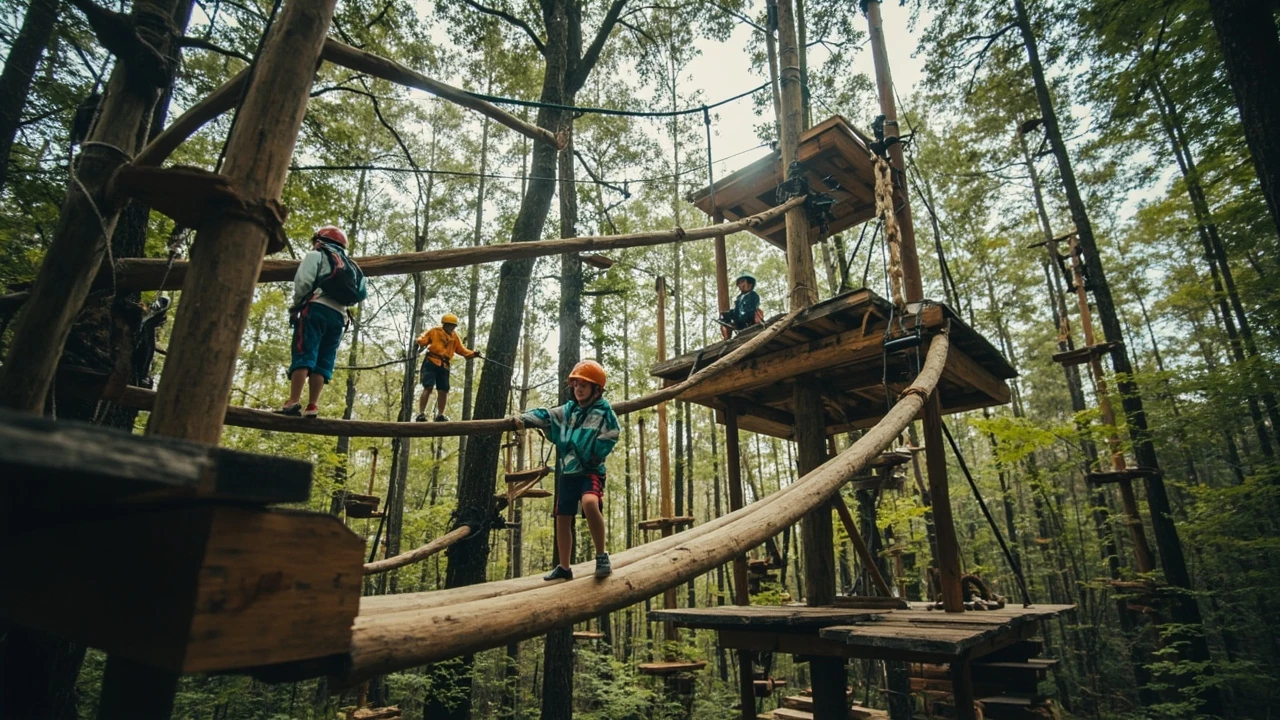
A Lows adventure 2 course is the second, slightly taller tier in a low-rope park layout, usually built between roughly 1.5 and 3 metres above the ground. It sits above the entry-level “Lows 1” loop and below the higher adult or advanced circuits, which is why operators list it as a stepping-stone level on their maps. The point of the level is to give younger children, first-time visitors, and cautious adults a circuit that feels more challenging than the easiest loops without asking them to commit to the higher adult courses.
For visitors who have never been to a rope park before, the Lows adventure 2 tier is often the first circuit that introduces obstacles beyond a single straight balance beam. Expect rope bridges, suspended logs, small cargo nets, and short climbing elements, all tied together by a continuous belay line that the visitor clips onto at the start platform and only unclips after stepping off the final platform. That continuous system is the main safety feature, and it is one reason families gravitate toward this level even when children are at the lower end of the height chart.
This guide explains the typical Lows adventure 2 layout, how its difficulty compares with other tiers, who it suits by age and height, and what to check on the day so the visit goes smoothly. If you are still deciding whether a rope park is right for your group, the broader first-time high ropes course overview is a useful starting point.
Where Lows adventure 2 sits in a typical park layout
Most modern rope parks arrange their courses in tiers that are easy to read from the ground. The lowest level, often labelled Lows 1 or Kids Loop, sits close to the ground with simple, wide obstacles for very young children. Lows adventure 2 is the next step up. Above it sit the adult circuits, sometimes called Mids or Highs, and at the very top an advanced or expert course with harder moves, longer spans, and sometimes free-fall elements.
| Tier | Typical height | Main audience | Belay style |
|---|---|---|---|
| Lows 1 / Kids Loop | 0.5 to 1.5 m | Youngest children, often with a parent on the course | Continuous belay or static handline |
| Lows adventure 2 | 1.5 to 3 m | Older children, first-time adults, mixed-ability groups | Continuous safety line with smart carabiner or similar |
| Mid / Adult standard | 4 to 8 m | Teens and adults with no major height concerns | Continuous belay, sometimes with a back-up system |
| High / Expert | 8 m and above | Experienced adults, often with stamina and grip demands | Continuous belay with higher physical requirements |
The reason parks group their courses this way is simple: most first-time visitors will not know what their own comfort level is until they are a few metres up. Lows adventure 2 acts as a test bed. If a visitor finds it easy and wants more, they can move up to a higher tier for a second round. If they find it challenging, they have still completed a real circuit rather than walking away disappointed.
Obstacles you can expect on Lows adventure 2
Although every operator builds their own route, the obstacles on a Lows adventure 2 loop tend to repeat a familiar set of features. Knowing them in advance helps families set expectations and lets nervous visitors picture each element before they reach it.
- Wobbly log or plank bridges that require careful foot placement and a steady pace.
- Suspended rope nets, either vertical for climbing or horizontal for crossing hand-over-hand.
- Crossed rope bridges where the visitor steps from one rope onto another, sometimes with a handrail rope above.
- Small cargo nets or tyre steps set at a slight angle.
- Tightrope-style walks with a higher handline for balance.
- Short climbing walls or angled ladders leading up to the next platform.
- One or two balance elements such as wobble bridges, springy step logs, or barrel crossings.
What these elements share is a low fall consequence. If a visitor slips, they are caught by the belay line well before they reach the ground. The actual difficulty is more about grip, balance, and the willingness to commit one foot in front of the other rather than about height itself. That is also why Lows adventure 2 is a popular choice for school groups and family events where members have mixed comfort levels with heights.
Height, age, and weight rules visitors usually see
Operators set their own rules and the exact numbers vary, but the Lows adventure 2 tier is almost always designed around a narrower age and height band than the adult courses. The reason is partly the reach required to clip carabiners, partly the leg length needed to bridge between ropes, and partly how the belay system is sized for a smaller harness.
| Rule | Typical Lows adventure 2 range | Why it exists |
|---|---|---|
| Minimum height | Around 1.10 to 1.20 m | Reach to clip and bridge between elements safely |
| Minimum age | Often 6 or 7 years | Grip strength, attention span, following instructions |
| Maximum weight | Usually 100 to 120 kg including harness | Belay line and harness load limits |
| Footwear rule | Closed-toe sports shoes only | Foot protection on rope and wood elements |
| Hair and clothing | Long hair tied back, no loose scarves | Prevent snagging in carabiners or pulleys |
If you are visiting with a child near the borderline, the safest approach is to call the park ahead of time. A short phone call can save a long drive and disappointment at the gate, especially during busy periods when staff have less flexibility to make exceptions on the day. For more on planning around age and height limits across a whole family group, the family rope park age and height rules guide walks through how parks apply these rules in practice.
How difficult Lows adventure 2 actually feels
The honest answer is that difficulty on Lows adventure 2 is less about raw physical challenge and more about how a visitor responds to the situation. The obstacles are designed so that an average adult can complete them without upper-body strength or training. Children often manage well because they are lighter and have a lower centre of gravity. What trips people up is usually one of three things: grip fatigue from squeezing the safety line too tightly, hesitation on a moving element that creates a swaying motion, and the mental load of looking down between platforms.
A useful way to think about Lows adventure 2 difficulty is to split it into three layers:
- Physical difficulty. Modest. Most visitors can complete the course without serious strain, although a weak or nervous grip on the upper handline can make forearms tired by the end.
- Coordination difficulty. Moderate. Balance elements and rope bridges require a steady pace and willingness to commit weight to one foot before lifting the other.
- Mental difficulty. This is the layer that varies the most. A confident first-time visitor may find the course almost relaxing, while someone who dislikes heights can find even a two-metre platform uncomfortable.
Operators know this is where most first-timers hesitate, which is why good parks brief visitors at the start, demonstrate the belay system, and run a short practice loop on the ground before anyone climbs up. The first few minutes on the course are almost always the hardest. Once a visitor has clipped in and moved past the first two elements, the rest of the loop usually feels easier than the entrance ramp made it seem.
Safety systems used on Lows adventure 2
The defining safety feature of Lows adventure 2 is the continuous belay line. Instead of clipping and unclipping at every obstacle, the visitor attaches one carabiner or hook at the start platform and keeps it attached until the end of the course. The line runs through each platform and the visitor simply moves the hook from one side of a platform to the other as they progress.
The point of the continuous system is to remove the most common user error on traditional ropes courses: forgetting to clip back in after an obstacle. As long as the hook is correctly attached at the start, the visitor is never unattached from a safety line while on the course. Different operators use different brands and mechanisms, but the principle is the same.
| System type | How it works | What the visitor notices |
|---|---|---|
| Smart carabiner continuous belay | A shaped hook that only opens at marked transfer points | Clear clicks when correctly attached, no opening mid-course |
| Magnetic or RFID-assisted belay | Line and hook communicate at platforms | Light or sound confirms correct clip |
| Static handline with back-up loop | A fixed rope above plus a short lanyard for clipping | Two attachments per platform, slightly more steps |
Independent of the system, three checks apply on every Lows adventure 2 visit. The harness must be fitted by a trained staff member, the hook must be tested by the visitor at the practice station, and the helmet must sit low on the forehead with the strap done up. Operators vary on whether helmets are required on the lower tiers, but many do require them, especially for children.
What to expect on the day, step by step
A typical Lows adventure 2 visit runs through a familiar sequence. Knowing the steps in advance removes a lot of the on-day uncertainty, especially for first-time families and groups visiting alongside more experienced members.
- Sign-in and briefing. Visitors sign a waiver, pay for their chosen circuits, and watch a short safety video or live briefing that explains the belay system.
- Harness fitting. A staff member checks height and weight, fits a harness, and double-checks buckles before the visitor leaves the fitting area.
- Practice loop. Most parks run visitors through a ground-level practice on a sample obstacle so they can feel the hook engage and learn the transfer motion.
- Climb to start platform. A short ladder, ramp, or staircase leads up to the first platform. Visitors attach the hook here and confirm it has clicked into place.
- Work through the circuit. The visitor moves from platform to platform, transferring the hook at each one, until they reach the end of the Lows adventure 2 loop.
- Descent or step-off. A short zip-style descent or a ladder brings the visitor back to the ground, where the hook is unclipped only after they are fully off the course.
The total time on the Lows adventure 2 circuit is usually between 20 and 40 minutes depending on group size and how busy the platforms are. Add time for harness fitting, briefing, and the queue at the start platform, and a realistic block for a single circuit is about 90 minutes. Families doing two circuits, or a low loop plus a higher adult course, should plan for half a day rather than a quick stop.
Common mistakes first-timers make on Lows adventure 2
Most problems on a Lows adventure 2 circuit are minor and easy to avoid with a small amount of preparation. The list below comes up again and again across operator debriefs and visitor reviews.
- Gripping the safety line too tightly. A death grip on the upper handline is tiring and pulls the visitor off balance. The line is there for safety, not for support.
- Rushing across moving elements. Cargo nets, wobble bridges, and rope spans feel worse when visitors try to sprint across them. A slow, deliberate pace is faster in practice.
- Skipping the harness double-check. Loose leg straps are the most common cause of mid-course discomfort. Ask the fitting staff to re-check before leaving the ground.
- Wearing the wrong shoes. Sandals, Crocs, or boots with deep treads make rope elements uncomfortable and sometimes unsafe.
- Looking straight down between platforms. The ground is closer than the next platform, which makes balance elements feel scarier than they are. Looking ahead keeps the body calmer.
These are not deal-breakers and instructors will gently correct them on the day, but visitors who arrive knowing about them tend to enjoy the circuit more and finish with less arm fatigue.
How Lows adventure 2 compares with the higher adult circuits
Once visitors have done a Lows adventure 2 circuit, the natural next question is how it compares with the higher loops. The two are different experiences rather than simply harder and easier versions of the same thing. Lows adventure 2 is mainly about balance, confidence, and getting used to the safety system. Higher adult circuits add real height, longer spans, and obstacles that demand a more deliberate technique.
| Aspect | Lows adventure 2 | Mid / adult circuits |
|---|---|---|
| Height | 1.5 to 3 m | 4 m and above |
| Span of rope bridges | Short, often under 4 m | Longer, sometimes 6 to 10 m |
| Stamina needed | Low to moderate | Moderate to high |
| Best for first-timers | Yes, very approachable | Possible, but check comfort with height |
| Re-ride value | High, often included in the entry price | High, but more physically demanding on repeat runs |
For groups with mixed comfort, a common pattern is to start together on Lows adventure 2, then split so that confident members move up to the higher circuits while others redo the lower loop at their own pace. Operators are used to this and will often let groups rejoin at the end without extra charges, although this depends on the specific park’s policy.
When weather changes the Lows adventure 2 experience
Outdoor rope parks operate in real weather, and Lows adventure 2 is no exception. Dry conditions are ideal. Wood and rope are grippier, platforms are quieter underfoot, and the descent at the end of the course feels predictable. Wet weather changes that picture. Rope bridges sway more, wood becomes slippery, and gloves are worth wearing if the operator allows them.
Most parks monitor a small set of weather rules:
- Light rain: usually open, with caution notices at the start platform.
- Heavy rain or thunderstorms: the course closes until the storm passes and staff re-inspect the lines.
- Strong wind: higher courses usually close first, while Lows adventure 2 may stay open but with slower traffic.
- Lightning within a defined radius: the whole park pauses for a set period, often 20 to 30 minutes after the last strike.
For visitors planning around the weather, it is worth checking how a park communicates closures on the day. Some post updates on social media, others send text messages to visitors who booked online. The general guidance is to assume a course can close in heavier weather and to build a buffer into the day’s plan rather than booking a tight connecting activity. A more detailed look at how parks handle weather decisions is in the rope park weather and closure guide.
Cost, group size, and value considerations
Lows adventure 2 is usually priced either as part of a multi-circuit entry ticket or as a stand-alone loop. The exact price depends on the country, the operator, and whether the park is in a city or a rural forest setting. What matters more for planning is the structure of the entry rather than the headline number.
- Per-circuit pricing. Some parks charge a single fee that covers all levels, including Lows adventure 2. Visitors can then re-ride the lower loop as many times as time allows.
- Tiered pricing. Other parks charge more for higher circuits. In that case, Lows adventure 2 is usually at the cheaper end of the scale.
- Group and school rates. Larger groups often receive a per-person discount, and many parks offer a supervising adult free for every set number of children on the lower tiers.
- Equipment hire. Harness and helmet are typically included, although some operators charge separately for gloves or for a locker.
When comparing two parks, it is worth weighing not only the price but also the time on course. A cheaper entry that only covers a single short loop is often less satisfying than a slightly higher-priced ticket that includes Lows adventure 2 plus a re-ride option. Operators are usually open about how long a circuit takes if you call ahead.
Who Lows adventure 2 is genuinely for
Once the layout, safety system, and difficulty are clear, the audience for Lows adventure 2 becomes easier to describe. It is built for people who want a real ropes-course experience without committing to a high adult circuit. That covers a wide range of visitors in practice.
- Families with children who meet the minimum height but are not yet ready for the higher loops.
- First-time adult visitors who are unsure how they will react to height.
- Mixed-ability groups such as friends, school classes, or team-building days where members want to stay together.
- Visitors who want a second or third ride after trying a higher circuit.
- Anyone returning to a rope park after a long break and looking to rebuild confidence.
It is also worth saying who Lows adventure 2 is not really for. Visitors who already know they are comfortable at height and who want a real physical workout will usually find the higher adult circuits more satisfying. The lowest kids loop, on the other hand, suits younger children better. Lows adventure 2 sits deliberately in the middle of that range, which is also why it is one of the most-used circuits at most parks.
How to plan a visit around Lows adventure 2
A smooth visit usually starts before leaving home. The list below is a short, practical version of a planning checklist that works for most parks and most groups.
- Check the operator’s height, age, and weight rules and confirm every group member qualifies for the lower tier.
- Book a start time if the park uses timed entries, especially during weekends and school holidays.
- Plan clothing for the forecast, including closed-toe shoes and a light layer if the day starts cool.
- Allow 2 to 3 hours for a single-circuit visit including travel, signing in, harness fitting, the course itself, and a short rest afterwards.
- Bring water, particularly for warmer days, and a small snack for after the circuit.
- If visiting with younger children, agree in advance which adult will stay on the lower tier with them while others go higher.
Visitors who want a longer day at the park can plan a Lows adventure 2 circuit in the morning, a break for lunch, and a second round on a higher circuit in the afternoon. Many parks will let visitors leave and re-enter on the same day as long as the harness tag is kept. For visitors combining a rope park with a wider forest day, a structured approach like the one in the one-day forest escape planner can help sequence travel, food, and the on-course time.
Frequently asked questions
What is a Lows adventure 2 course in a rope park?
A Lows adventure 2 course is the second, slightly taller tier in a low-rope park layout, usually built between 1.5 and 3 metres above the ground. It is designed for older children, first-time adults, and mixed-ability groups who want a real rope-course experience without committing to the higher adult circuits.
How high is Lows adventure 2 compared with other tiers?
Lows adventure 2 typically sits at 1.5 to 3 metres. The lower kids loop is closer to the ground, the standard adult mid-course usually starts around 4 metres, and the highest expert circuits are often above 8 metres. The exact heights depend on the individual operator.
What age and height does a child need for Lows adventure 2?
Most operators set a minimum height of around 1.10 to 1.20 metres and a minimum age of about 6 or 7 years. The numbers vary, so it is worth checking the specific park’s rules before travelling, especially if a child is near the lower end of the range.
Do you need a helmet on Lows adventure 2?
Many operators require helmets on the lower tiers and almost all require them on higher circuits. The park provides the helmet as part of the entry fee and fits it during the harness stage. Visitors should not bring their own climbing helmets unless the operator has approved them in advance.
Is Lows adventure 2 scary for someone who does not like heights?
It is a common entry point for visitors who are unsure about heights. The course is low enough that a slip is caught quickly by the safety line, and the obstacles are designed to feel like balance challenges rather than height challenges. Nervous visitors often find that the first two platforms are the hardest and that the rest of the loop feels easier once they settle into a rhythm.
How long does a Lows adventure 2 circuit take?
Time on the course itself is usually 20 to 40 minutes, depending on group size and platform traffic. With harness fitting, the safety briefing, and the practice loop, a realistic total for a single circuit is about 90 minutes from arrival to leaving the course area.
Can parents stay on the ground while children do Lows adventure 2?
Yes. Most parks welcome parents to watch from below. Staff are trained to supervise from the platforms and will assist children who hesitate. Parents of younger children often choose to climb up themselves so they can move alongside their child on the course, which is usually allowed within the lower tier’s rules.
What happens if it starts raining during the visit?
Light rain usually does not close a Lows adventure 2 circuit, although operators may add a caution notice at the start platform. Heavy rain, thunderstorms, or strong winds will close the course until conditions improve and staff have re-inspected the lines. Parks typically communicate closures by signage at the start platform and sometimes by text or social media updates.
Can you ride Lows adventure 2 more than once?
Many parks include re-rides in the entry price, particularly for the lower tiers. After completing the circuit, visitors can usually rejoin the queue and go through again. Some operators cap re-rides during peak periods to keep queues moving, so it is worth asking at sign-in.
Is Lows adventure 2 suitable for a team-building or school group?
Yes. The tier is widely used for school trips, youth groups, and team-building days because it accommodates mixed ability levels and gives the group a shared experience without requiring any prior climbing experience. Operators can usually arrange timed starts and a short debrief if the group is booking as a block.
Related reading
Explore High Ropes Adventure
Trip tools
Essential adventure planning guides
Use these practical guides to compare rope park activities, prepare for a first high ropes day, check a booking, choose suitable footwear and contact the editorial team. Each page links to the relevant live tools and current planning sections.
Latest articles
- Tame Impala tickets: how to find them, what they cost, and what to know before you buy
- Outdoor pillows: how to choose the right ones for a deck or trail rest stop
- How to find Morgan Jay tickets without overpaying
- How to find national parks near me: a practical local search guide
- Paylater travel: how buy now, pay later works for trip bookings
- Bagsmart Blast Travel Backpack: A Practical Review for Day Trips and Adventure Days
- How to choose an outdoor rocking chair that actually lasts
- Indiana travel advisory map: how to read it before a day trip
- How to plan an outdoor day around a concert stop: a cardi b tickets field guide
- Outdoor sectional sofas: a practical buyer’s guide for patio living