Outdoor Christmas lights: a practical guide for gardens, trees and facades
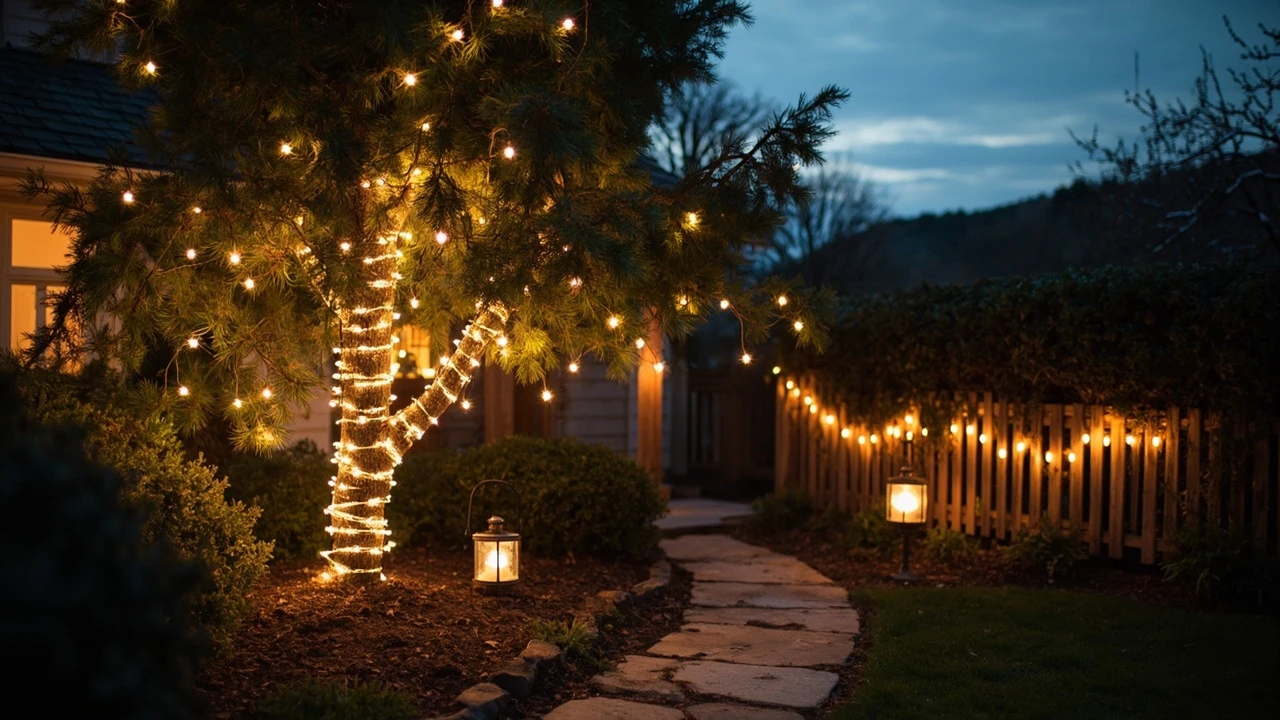
Outdoor Christmas lights: a practical guide for gardens, trees and facades
Stringing lights across a roofline on a cold December evening with a tangled pile of cable at your feet is the moment most people decide to plan the next year properly. The good news is that outdoor christmas lights have become more reliable, more efficient and easier to install than the sets of a decade ago, but the planning questions are the same: how many metres do you need, what colour temperature suits the house, can one outdoor socket run the whole display, and which lights are actually safe in rain or frost. This guide walks through those decisions in the order they actually happen, from measuring and choosing a style to checking the circuit, mounting the lights and storing them in January.
Why a short planning pass saves hours on installation day
Most frustration with outdoor christmas lights comes from under-measuring. A tree that looks modest in October looks bare in November, and a 6 m roofline measured from the ground usually turns out to be 9 m once you follow the gutter around the corners. Builders’ laser measures, a long tape, or simply walking the route with a piece of string and then measuring the string all work. The point is to record the length for each zone separately: front eaves, porch, path, shrubs, tree, fence. Once each zone has a number, you can match it to a specific product and reel length rather than buying one giant set and hoping it reaches.
It also helps to draw a rough plan on paper before buying anything. Mark the nearest outdoor socket, the route of any extension leads, and any obvious trip hazards such as steps or paths. Outdoor christmas lights draw far less current than older generations, but a long daisy-chain of LED sets still benefits from being split across two or three circuits if you can, because it reduces the load on any one plug and makes it easier to isolate a fault later.
Choosing a style that suits the building
Style is more than colour. Three choices shape the entire look: the colour temperature of the bulbs, the size and shape of the individual lights, and whether the display is static or animated. Warm white, around 2200 to 2700 Kelvin, reads as the classic filament look and tends to flatter brick, stone and timber. Cool white, around 4000 to 5000 Kelvin, looks crisper against modern render, metal cladding and concrete. Multicolour sets still have a place on family trees and children’s play areas but compete visually with anything else nearby, so it is usually better to keep one feature element colourful and the rest neutral.
Bulb shape is the second decision. The classic golf-ball or G45 shape suits close-up settings such as porch beams and balcony rails, because the small bulbs look delicate. Larger C9 or strawberry-shaped bulbs suit bigger rooflines, tall trees and long runs where the eye sees them from a distance. Mini lights, with small conical bulbs spaced every 5 to 10 cm, are the workhorse of the category and work well on shrubs, fences and tree wraps because the cable itself is easy to hide in foliage.
Common light types and where they work best
The phrase outdoor christmas lights covers several distinct products, and matching the product to the surface is the difference between a clean finish and a frustrating afternoon. The table below summarises the most common types and the surfaces they suit.
| Type | Typical use | Mounting method | Notes |
|---|---|---|---|
| String or fairy lights on green or dark cable | Shrubs, fences, tree wraps, balcony rails | Wrapped, clipped, or zip-tied | Most flexible; dark cable disappears in foliage |
| Icicle lights on a horizontal cable | Eaves, gutters, pergola beams | Clip hooks on gutter or fascia | Drops vary; check the spacing matches the building |
| Net lights | Box hedges, low shrubs, small bushes | Draped over the top | Fastest way to cover a regular shape evenly |
| Curtain or waterfall lights | Brick walls, large windows, fences | Screw-in hooks or rail | Best where you want a dense, even sheet of light |
| Projection lights | Front of house, side wall | Stake in ground or sit on a flat surface | Use sparingly; pattern overlap can look busy |
| Rope or tube lights | Handrails, architectural outlines, paths | Channel clips or adhesive mounts | Durable, but harder to repair if cut |
| Path and stake lights | Driveway edges, garden paths, steps | Ground stake or surface plate | Help with safe footing as much as decoration |
Choosing one or two of these types per property usually looks better than using all of them. A roofline of warm white icicle lights, a single tree wrapped in mini lights and a row of path lights is a more cohesive display than six different products fighting for attention.
Measuring, cable runs and how many sets you need
The fastest way to lose an afternoon is to buy one long set and discover it falls 2 m short. Measure each zone in metres, then add roughly 10 percent for slack, sag and the way cable falls between anchor points. For trees, a useful rule is 6 m of light per metre of tree height for a moderate wrap, and 10 to 12 m per metre for a denser look. A 2 m tree therefore takes 12 to 24 m of string lights, depending on the desired density.
Modern LED sets allow a long chain from a single plug. A typical 31 V low-voltage string draws only a few watts per metre, and the power supply or rectifier is the only item that needs a proper outdoor connection. The strings themselves can often be linked end to end up to a manufacturer-stated maximum, which is usually around 8 to 12 sets for mini lights. Read the packaging for the exact figure, because exceeding it is one of the common causes of dimming at the far end of a long run.
For mains-voltage outdoor christmas lights, the same principle applies but the limits are lower. Mains sets typically have a maximum chain length of 2 to 4 sets, and total wattage is the real constraint. A 230 V outdoor socket on a 10 A breaker can supply roughly 2,300 W in theory, but realistic continuous load should stay well below that. Treat 1,500 W as a sensible working ceiling per circuit and split the display across circuits where possible.
Power, sockets and circuit basics
Most installation problems at home come down to three power issues: not enough outdoor sockets, cheap extension leads, and daisy-chained multi-way blocks. A single outdoor IP-rated socket is rarely enough for a full display, so plan to add at least one weatherproof outdoor socket on its own RCBO or RCD-protected circuit if you are starting from scratch. Residual current devices trip fast when water gets into a damaged cable, and that fast trip is exactly what you want.
For a temporary display, a good-quality outdoor extension lead on a reel is acceptable. The lead should be marked for outdoor use, have a sealed plug and socket, and be fully unwound if it is on a reel. Coiled cable traps heat and a high load can damage the insulation over a long evening. Multi-way blocks should be weatherproof, mounted off the ground, and never stacked. If a block is sitting in a puddle, it will eventually let water in regardless of its IP rating.
Smart plugs and timers designed for outdoor use are a sensible addition. They let you schedule the display for the hours you actually want it on, which reduces both energy use and wear on the lights. Most modern timers keep their schedule through a brief power cut, which matters more than people expect on windy December nights.
Safety checks before you switch on
Outdoor christmas lights are electrical equipment, and the small cost of a careful check is much less than the cost of a fire or a trip to the emergency department. Run through this short list every year before the first switch-on.
- Inspect every cable, plug and socket for cracks, exposed copper, brittle insulation or signs of rodent damage.
- Replace any set that flickers, smells hot, or has bulbs that drop out as soon as it is moved.
- Check that every connector outside is fully engaged and that any cover caps are screwed down over unused ports.
- Confirm that all transformers and power supplies are mounted off the ground, ideally under an eave or in an IP-rated enclosure.
- Test the RCD on the outdoor circuit before plugging the display in. The test button should trip the breaker instantly.
- Keep low-voltage cabling separated from mains cabling at any junction, and never bury a mains connector directly in soil or mulch.
Most product recalls in this category trace back to cable damage or to a previous year’s set being stored damp and then deployed. A dry plastic storage box with a lid, kept in a shed or garage, dramatically extends the life of a set and removes one of the main causes of mid-season failure.
Mounting on common surfaces
How you fix the lights matters almost as much as which lights you choose, because a poorly anchored cable sags, traps water, and pulls on the socket. The right fixing depends on the surface, and the rule of thumb is to spread the load across many small fixings rather than a few large ones. A list of common surfaces and the fixings that work well:
- Plastic or aluminium gutters: dedicated gutter clips that snap over the lip. They are cheap, removable and do not puncture anything.
- Tiled or slate roofs: avoid drilling. Use eaves hooks that slide under the bottom row of tiles, or adhesive clips rated for cold and damp.
- Brick or render: plastic anchor hooks in pre-drilled holes, or removable adhesive hooks on smooth render. Both should be removed at the end of the season to avoid freeze-thaw damage to the surface.
- Wooden fences and pergolas: small stainless screws or staples with a plastic saddle. Staples alone bite into the cable insulation over time.
- Living trees: never staple into bark. Use soft tree wraps, fabric ties or purpose-made clips, and leave enough slack for the branch to grow and move in the wind.
- Metal handrails and posts: magnetic clips or zip ties, both of which are easy to remove and leave no mark.
For any of these surfaces, a quick mock-up with a 2 m test strip is worth doing before you commit to a full run. It tells you whether the colour temperature suits the wall, whether the cable lies flat, and whether the chosen clip is strong enough to hold it in a December wind. To place this section in context, the lights overview offers a concise background reference.
Designing the look: layered lighting rather than a single feature
The most successful displays tend to follow a layered structure: a primary layer that defines the building, a secondary layer that adds depth, and a tertiary layer that adds atmosphere at ground level. The primary layer is usually the roofline or a single statement tree, because that is what neighbours and visitors see first. The secondary layer is the porch, a window frame or a wall plane that ties the building together. The tertiary layer is path lights, stake lights and a feature shrub, which guide the eye through the garden rather than just across the front of the house.
Colour is easier to control when the layers stay in the same family. Warm white on the roofline, warm white icicle lights on the porch, warm white stake lights along the path, and one contrasting feature on a single tree keeps the display coherent. Mixing colour temperatures, even by a few hundred Kelvin, is the most common reason a display looks untidy even when every individual set is high quality.
Working out how much it costs to run
LED outdoor christmas lights are cheap to run compared with older filament sets, but it is still worth checking before you leave them on every night. The formula is straightforward: watts times hours divided by 1,000 gives kilowatt-hours, and the electricity bill is kilowatt-hours times your tariff. A 100-LED string of modern warm white mini lights draws around 6 W. Run for six hours a night across the whole of December, that is roughly 1.1 kWh, which on a typical domestic tariff is a small fraction of a pound or dollar. Multiply by the number of strings and the cost is still modest.
| Display size | Approx. LED wattage | Hours per night | Monthly kWh (30 nights) |
|---|---|---|---|
| Small: 1 tree, 2 short strings | 12 W | 6 h | 2.2 kWh |
| Medium: roofline, porch, small tree | 45 W | 6 h | 8.1 kWh |
| Large: full eaves, two trees, path lights | 120 W | 6 h | 21.6 kWh |
| Very large: full property, several features | 300 W | 6 h | 54 kWh |
Timers and smart plugs that switch off at a sensible hour, say midnight or 23:00, can cut that cost significantly. They also reduce light pollution, which matters in areas where neighbours have asked for darker skies or where the local council has a specific policy. A useful general rule is to keep the display on for the hours you are most likely to be enjoying it, rather than letting it run from dusk to dawn.
Smart features that change the experience
Smart outdoor christmas lights are no longer the preserve of professional installers. Wi-Fi and Bluetooth controllers can run an entire display from a phone, and the same controllers often handle scheduling, dimming and simple animations. The real value of a smart controller is not the animations, though those are fun for a single tree, but the ability to switch the entire display off from inside the house when the weather turns, or to put a whole zone on a separate schedule from the rest.
For anyone with a string of older sets, a smart outdoor plug is the easiest first step. It does not change the lights themselves but lets them join the same schedule as any newer smart sets, and it adds a remote off-switch in case the display is left on during a storm. A handful of platforms also support sunrise and sunset triggers, so the display comes on at the right time every evening without manual adjustment after the clocks change.
Storage, repair and how to make sets last
The first question to ask when taking the display down is whether each set worked as expected. Sets that flickered, dropped bulbs or ran hot are candidates for the bin, because the fault usually returns the following year. Sets that performed well should be cleaned gently, allowed to dry fully and wound onto a reel or a piece of stiff card to prevent tangling. Wrapping sets around a flat object without a centre spool is the fastest way to end up with a knotted mess in November.
Repairs are worth attempting on a quality string with a single dead section. Many mini light sets allow a single bulb to be replaced with a tool included in the box, and replacement bulbs are widely available. A dark section with the rest of the string working is often a single failed bulb that has taken the rest of the section with it. For rope lights and curtain lights, repairs are less practical, and replacement is usually the better option once the set is more than three or four seasons old.
Storage conditions matter more than people expect. A dry shed, garage or loft space keeps the rubber and plastic in good condition. A damp garden storehouse, by contrast, slowly degrades the insulation, especially on cheaper cables, and that is one of the main reasons a set that worked last year fails this year.
Outdoor christmas lights and shared spaces
Flats, terraces and shared driveways have their own considerations. A single set of lights across a balcony is rarely a problem, but a long run of lights on a shared facade is worth discussing with neighbours and, where applicable, the managing agent or residents’ association. Most are happy to agree on a common switch-on date and a common switch-off date, which makes the whole street look better and avoids the patchwork effect of one house blazing while the next is dark.
For public-facing displays, such as those at a venue or a community site, the planning is closer to a small event. Cable routes have to be planned around foot traffic, fixings need to be reversible, and the display usually has to be inspected rather than just visually checked. A useful rule is to treat any display that visitors walk through or under as a public installation, even if it is on private land, because the same duty of care applies.
Common mistakes and how to avoid them
Most problems with outdoor christmas lights come from a small number of recurring mistakes. The table below lists the ones that show up most often and what to do instead.
| Mistake | Why it goes wrong | Better approach |
|---|---|---|
| Buying one long set and hoping it fits | Often falls short, or leaves an awkward coiled tail | Measure each zone separately and match to a specific reel |
| Mixing warm and cool white on the same house | Reads as a mistake rather than a design choice | Pick one colour temperature and keep it consistent |
| Running every set from a single socket | Overloads the socket, makes fault-finding harder | Split the display across two or three outdoor sockets |
| Stapling cable into wood | Slowly cuts through the insulation over a season | Use plastic saddles, clips or soft ties instead |
| Leaving the display on all night | Wastes energy and shortens the life of the lights | Use a timer or smart plug to switch off at a set hour |
| Storing sets damp in a garden box | Traps moisture, corrodes contacts, ruins the cable | Dry sets thoroughly before storing them indoors |
The interesting thing about this list is that none of the items are technical. They are all small planning and habit changes, and they are the difference between a display that gets easier every year and one that gets harder. For an independent reference, the untangling the history of christmas provides additional context for this point.
Planning the display around a specific event
Not every display is a free-standing piece of decoration. Christmas markets, tree-lighting ceremonies and community switch-on events all need an outdoor lighting plan that fits around foot traffic, sound stages and vendor stalls. A useful starting point is to decide what visitors see first, what they see as they move, and what they see when they leave. Outdoor christmas lights contribute most to the second of those, because they shape the route as much as the photo opportunity.
For a market or event, lighting is usually a mix of overhead string lights between buildings or trees, stake lights along walking routes, and one or two feature elements such as a wrapped tree or a lit archway. The overhead lights do the most work for the smallest wattage, because they cast useful light onto stalls and paths. A feature element near the entrance gives visitors a clear photograph and a sense of arrival. For more on how a planned outdoor day can fit around a venue, see this piece on what makes an outdoor event worth travelling for.
Outdoor lights at a private venue or attraction
For a venue that runs an outdoor season, the lighting plan is closer to commercial installation than to a home display. Cable routes need to be planned against foot traffic, fixings need to be reversible, and the whole installation has to be inspected and tested as a temporary electrical system. A rope course, a forest walk or a zipline landing is the kind of setting where a small lighting display adds a great deal of atmosphere for relatively little energy, especially in the hours when visitors are still arriving but the natural light is fading.
Anyone running a public-facing display should keep a written record of what was installed, where the cables run, and where the connections sit. That record makes it easier to service the display the following year, and it is the kind of evidence an insurer or local authority will ask for if something goes wrong. If you are planning a one-day outing to such a venue, the practical side of transport and timing is covered in this one-day forest escape planner.
Troubleshooting when something goes wrong
Most faults with outdoor christmas lights fall into one of three groups: a single dead section, the whole set dead, or a section that flickers in rain. The first is usually a single failed bulb that has taken its section with it, especially on older mini light strings. Many of these sets include a replacement bulb and a small removal tool. Replace the suspect bulb first and check the inline fuse on the plug before assuming the set is dead.
A whole set that is dead is almost always either a tripped RCD, a blown plug fuse, or water in a connector. Start with the plug fuse, then reset the RCD, and only then look at the cable and connections. A section that flickers in rain is usually a connector that has worked loose or a cover cap that was not fully closed. Tightening the cap and reseating the connector is enough in most cases, and dielectric grease on the contacts helps to keep water out for the rest of the season.
It is worth keeping one or two spare sets of the same type in storage. Replacing a failed set with a near-identical one keeps the display looking even and avoids the patchwork effect of mismatched colour temperatures or bulb sizes. The same logic applies to spare extension leads, spare smart plugs and a small pack of replacement bulbs.
Frequently asked questions
What is the difference between indoor and outdoor Christmas lights?
Outdoor Christmas lights are built to a higher IP rating, which means the seals around bulbs, cables and connectors are designed to keep out rain and moisture. Indoor sets are not. Using an indoor set outside is a common cause of mid-season failure, and in a heavy frost it can be a safety issue. The packaging and any printed rating on the transformer or plug should say “outdoor” or carry an IP44 or higher rating before the set is used outside.
How many outdoor Christmas lights can I plug into one socket?
That depends on the wattage of each set and the rating of the socket and its circuit. A safe working approach is to keep total load on a single outdoor socket below around 1,500 W, and to use the manufacturer-stated maximum chain length rather than chaining sets by feel. LED sets are forgiving because each one is low wattage, but the limit is real and worth respecting.
Can outdoor Christmas lights stay out all winter?
Most modern LED sets are designed to be left out for the full festive season. They are not designed to be left out for the rest of the year, because UV, summer heat and damp all shorten the life of the cable. A common routine is to leave the display up from mid-November to early January, then take it down, dry it and store it indoors for the rest of the year.
Are solar outdoor Christmas lights any good?
Solar sets have improved a lot, and the better ones are genuinely useful for fences, shrubs and paths where running a cable is awkward. They are not as bright as mains-powered sets on a tree, and they depend on a clear daytime charge, so they perform poorly in shaded gardens or during long cloudy spells. They are best treated as a complement to a mains display rather than a replacement for it.
How do I stop squirrels and birds from chewing the cable?
Cable damage from animals is more common than people expect, especially on accessible runs along fences or low branches. The simplest fix is to run the cable through a section of flexible conduit or split tubing, which the animals cannot get a grip on. Bitter-tasting deterrent sprays designed for garden cable are also available, though the effect varies and the spray may need to be reapplied after wet weather.
What colour temperature is best for a brick house?
Warm white, around 2200 to 2700 Kelvin, flatters most red brick, stone and timber. It also reads as the classic festive look against traditional architecture. Cool white looks crisper on modern render, metal cladding and concrete. The safest choice if you are unsure is warm white, because it suits both traditional and contemporary settings without looking harsh.
How do I hide extension leads and connectors?
Low-voltage cables are easy to hide along fence lines, behind shrubs and under eaves. For mains leads, the simplest approach is to run them along a wall behind planters or outdoor furniture, with the connector raised off the ground and protected by a weatherproof cover. Cable covers designed for outdoor use are available at most hardware stores and can be painted to match the wall.
Do LED outdoor Christmas lights really save energy?
Yes. A typical LED mini light set uses around 80 to 90 percent less electricity than the same length of filament set, and it also runs cooler, which is safer in contact with foliage and timber. The upfront cost of LED is higher, but the energy saving usually pays back the difference within a couple of seasons and the lights last much longer.
What is a sensible budget for a first outdoor display?
That depends entirely on the size of the property, but a useful starting point for a typical suburban home is a roofline set, a tree set and a short path set, plus a weatherproof extension lead and a smart plug. The total is modest compared with the cost of replacing failed sets every other year, because the better-quality equipment pays for itself in reliability and lifespan.
How do I take the display down without damaging the house?
The trick is to remove fixings as you go and not to pull on the cable. Start with the last zone installed and work backwards, taking down clips and hooks as you reach them. Coil each set around a reel or piece of card as soon as it is down, label the reel with the zone it came from, and store everything indoors once it is dry. That habit turns a two-hour January job into a 30-minute job every year.
Related reading
Explore High Ropes Adventure
Trip tools
Essential adventure planning guides
Use these practical guides to compare rope park activities, prepare for a first high ropes day, check a booking, choose suitable footwear and contact the editorial team. Each page links to the relevant live tools and current planning sections.
Latest articles
- Outdoor Christmas lights: a practical guide for gardens, trees and facades
- Asap tickets: what they are and how to use them for last-minute day trips
- Outdoor shower ideas, plumbing and etiquette for adventure parks and cabins
- Travel clipart: where to find it and how to use it well
- Outdoor table guide: choosing, placing, and using one well
- Viator travel agent: how the booking platform actually works
- Sweet tart ropes: what the flavour means in a ropes course
- Demon Slayer movie tickets: how to find a screening and prepare for a day out
- How to choose NBA tickets without overpaying
- Time travel movies worth watching on a slow weekend