Ropes courses explained: types, safety systems, and who they suit
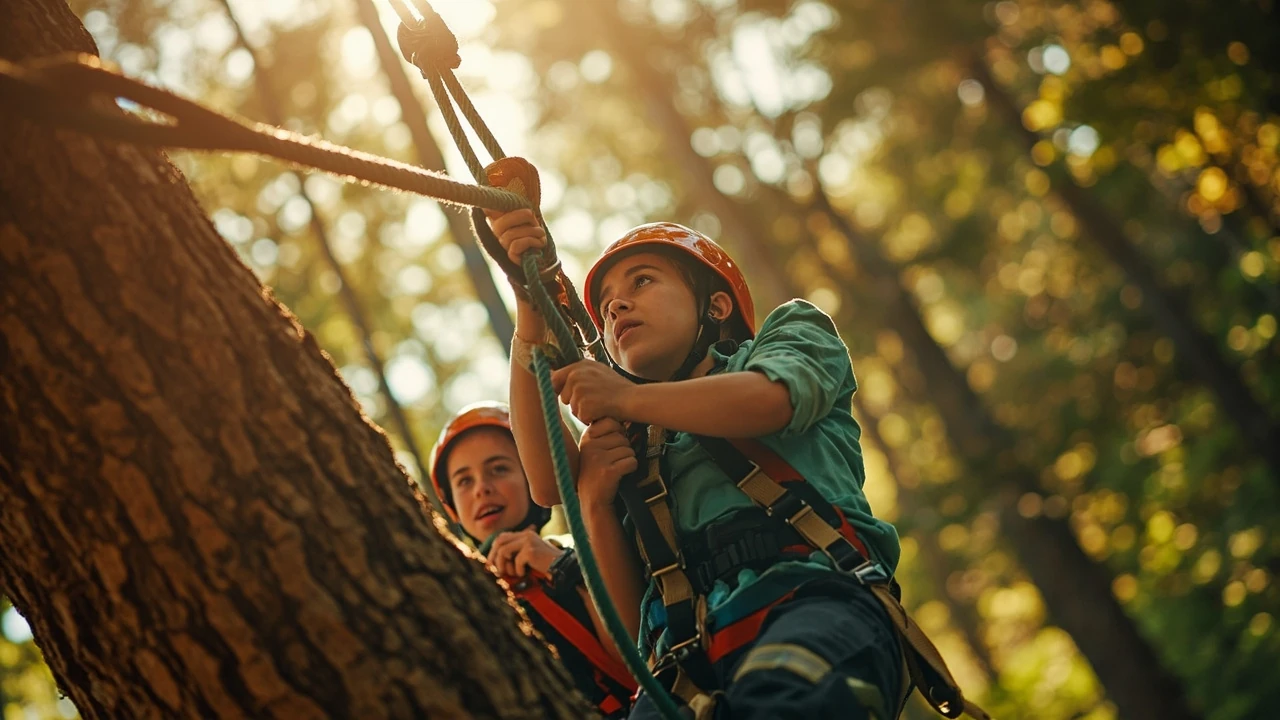
Ropes courses explained: what they are and how the day actually works
A ropes course is a structured challenge system built from wooden platforms, cables, ropes, and obstacles suspended above the ground. Participants clip onto a safety line, work through a sequence of elements, and usually finish back where they started. The combination of height, balance, and decision making is what makes a ropes course feel different from a simple climbing wall or zip line.
Most visitors meet a ropes course for the first time at a forest park, a resort activity centre, or a school camp. The format looks simple, but the equipment, course design, and supervision rules vary a lot between sites. This guide explains the main types of ropes courses, how the safety systems work, who each format is designed for, and what to check before you book. If you have never been on one, the practical walkthrough in your first high ropes course covers the visitor experience step by step.
The main types of ropes courses you will come across
Parks and activity centres describe their courses in slightly different ways, but almost every ropes course fits into one of three broad categories. The category changes how high you go, how much instruction you receive, and how independent you can be on the course.
| Type | Typical height | Best suited for | Supervision style |
|---|---|---|---|
| Low ropes course | Knee to shoulder height | Team building, school groups, nervous first-timers | Facilitator-led, group-based challenges |
| High ropes course | 6 to 15 metres above ground | Adventure seekers, families with older children, corporate groups | Briefing, then self-paced with safety checks |
| Continuous belay / aerial adventure park | 3 to 12 metres, often many parallel lines | Drop-in visitors, mixed age groups, large parties | Self-briefing, automated or guided clip systems |
Low courses sit close to the ground and are usually used for team problem-solving rather than adrenaline. A high ropes course lifts the same ideas higher and adds real height, so the focus shifts from group decisions to individual balance and confidence. Aerial adventure parks combine the height of high courses with a continuous belay system that lets visitors move between elements without instructor handling, which suits casual drop-in visitors and busy weekends.
How high ropes courses are actually built
Although no two parks look the same, the engineering behind a modern ropes course follows a clear logic. Understanding it helps you judge whether a site has invested in the basics.
- Support trees or poles: mature living trees or engineered timber or steel poles carry the load. Living tree courses usually use tree-friendly attachment systems to avoid strangling growth.
- Anchor points: steel rings, plates, or sling systems fixed into the support structure, designed and tested for the rated load of each element.
- Element cables and ropes: the working cables you walk, balance, or swing on, plus handrails and guide ropes that assist movement.
- Safety line and belay system: a separate overhead cable that catches the participant if they fall, connected to the harness through lanyards, cowstails, or a continuous belay device.
- Platforms and transitions: wooden or composite platforms at the start and end of each element, with safe access between them.
- Rescue and access infrastructure: ground ladders, rescue kits, and clear paths so staff can reach a participant quickly if needed.
When you visit a site, you do not need to inspect every bolt, but you can look for visible signs of care. Frayed rope, rusted metal, slack handrails, or a forest floor littered with debris under the course can all suggest poor maintenance. A site that takes ropes courses seriously will also keep its hardware, harnesses, and helmets out of direct sunlight when not in use.
Belay systems on ropes courses, in plain English
The belay system is the part that catches you if you slip. The two systems visitors meet most often are traditional lanyard setups and modern continuous belay setups. The differences matter for safety and for how the course feels.
| System | How it works | Visitor experience | Common at |
|---|---|---|---|
| Traditional double lanyard | Two clipped lanyards, one always attached while the other is moved between elements | Slower, requires attention to clip order, more instructor coaching | Older high ropes courses, team-building venues |
| Smart belay / self-clipping trolley | A trolley rides the safety line and cannot be removed except at dedicated transition points | Smoother flow, fewer clipping mistakes, easier for first-timers | Newer aerial adventure parks, family centres |
| Static line with cowstails | A fixed overhead line, two short tethers connect the harness to the line at all times | Very simple, often used on higher or more committing elements | Some high courses, training facilities |
If the system feels unfamiliar, the dedicated guide on high ropes belay systems walks through the mechanics in more detail and explains what staff should be checking before you leave the briefing area.
Who ropes courses are designed for
Not every course is aimed at the same visitor. A family with a nervous nine-year-old has very different needs from a corporate group looking for a shared challenge, and a course designed for adults may not suit younger children at all. Age, height, and weight rules are there for real engineering reasons, not just red tape.
- Young children (roughly 4 to 7): low ropes courses with parental participation, often on a separate mini track, with a low minimum height and very close supervision.
- Older children and teens: junior high ropes courses, sometimes with a slightly different layout, lower upper height limits, and lighter harnesses designed for smaller frames.
- Adults and mixed groups: the full high course, with the full range of elements and a higher physical demand.
- Corporate or school groups: facilitator-led programmes that combine low elements for trust and communication with selected high elements for confidence.
Most parks publish minimum and maximum height and weight limits for each course. A minimum height of around 1.10 to 1.20 metres is common for junior high courses, with around 1.30 metres or more for the most demanding tracks. Weight limits usually cap at around 120 kilograms because of harness sizing and anchor ratings. If a participant falls outside those limits, staff should redirect them to a suitable course rather than improvise. For families planning around a mixed-age group, the planning advice in family rope park age and height rules is a useful starting point.
What a typical session looks like, start to finish
The structure of a visit is fairly consistent across well-run parks, even if the details vary. Knowing the shape of a session makes it easier to plan your day.
- Arrival and check-in: sign the waiver, confirm the booking, and collect any wristbands or tickets for the courses you have selected.
- Equipment fitting: a harness is adjusted to your body, a helmet is sized to your head, and staff check that buckles are doubled back and snug.
- Ground school: a short briefing on the belay system, the clip order, what to do if you freeze on an element, and the rules for moving around the course.
- Practice element: most parks run a low practice loop so you can clip and unclip with staff watching before you go up.
- Course time: you work through the elements at your own pace, with staff on the ground or on the course able to assist or coach.
- Debrief and return: harnesses and helmets are returned, and you can usually review the course from the ground if a friend is still up there.
Plan on roughly two to three hours total for a single high course including briefing, especially if you want time on a low course as well. If you are stacking activities into a larger day, the practical checklist in the one-day forest escape planner is worth a look.
What to wear and what to bring
Clothing choices make a real difference on a ropes course, mostly because of comfort, weather, and how the harness sits. There is no need for specialist outdoor gear, but a few simple choices will save you trouble.
- Footwear: closed-toe shoes with grippy soles. Trainers, light hiking shoes, or approach shoes all work. Sandals, flip-flops, and slip-ons will usually be turned away at check-in.
- Layers: even in summer, the canopy can be cooler and breezier than the car park. A light long-sleeve layer is useful in the morning and on shaded courses.
- Hair and loose items: long hair tied back, no loose scarves, and phones, keys, and cameras either left on the ground or in a securely zipped pocket. Many parks ask you to empty your pockets before clipping on.
- Weather protection: if rain is forecast, a thin waterproof jacket is much easier to move in than a heavy coat. The wet-weather packing advice in the wet-weather trail packing list works well for forest parks too.
How weather affects ropes courses
Wind, rain, and lightning all change the risk profile of an aerial course, which is why most parks publish clear weather policies. Closure thresholds are set by the course operator and reviewed by their insurer and equipment supplier, so they are not arbitrary.
| Condition | Typical impact | What to ask the operator |
|---|---|---|
| Light to moderate rain | Courses usually stay open, grip may feel slipperier, harness buckles can stiffen in cold rain | Whether grips and ropes are checked during the session, and where to shelter |
| Strong wind | Upper courses and exposed elements may close, especially anything involving swings or long traverses | Their specific wind speed threshold and how it is measured |
| Lightning or thunderstorms | Full closure with evacuation of the course, sometimes the whole site | Where to take shelter and how the all-clear is communicated |
| Heat | Courses usually stay open, but staff may shorten sessions or rotate groups more often | Whether water is provided and how shaded the queue area is |
If you have a fixed date in mind, the rope park weather guide covers what to ask when you phone ahead and how to read the conditions yourself.
How to judge whether a ropes course operator is safe
Most operators are professional, but the gap between a well-run site and a poorly run one is wider than visitors often realise. A few simple checks help you separate them.
- Independent inspection records: reputable sites are inspected annually by an external body, often a manufacturer or a third-party inspector. The report should be available on request.
- Staff training and ratios: ask how many staff are on the course for a given number of visitors and what training they have. A typical ratio is one course supervisor for every eight to twelve participants on the course at a time.
- Rescue plan: a serious site can describe, in plain language, how they would rescue someone who is stuck or unable to move past an element.
- Equipment condition: harnesses and helmets should look clean, stored out of direct sun, and free of frayed webbing or cracked buckles.
- Briefing quality: a rushed, casual briefing is a warning sign. A good briefing covers the system, the rules, and a practice element before anyone goes high.
If a site is vague on inspection records or pushes you past a thorough briefing, treat that as information. The detailed checklist in how to find a safe adventure park goes deeper into what to look for in person.
Cost, value, and what you actually pay for
Ropes courses usually price per person, with discounts for groups, children, and combined tickets. A single high ropes session typically costs more than a low ropes session because the equipment load, inspection regime, and staffing requirements are higher. A continuous belay aerial park sometimes works out cheaper per element because the throughput is faster and the supervision model is lighter, but the experience is also more self-directed.
Look at the price in the context of session length, course length, and what is included. A two-hour briefing followed by 45 minutes of climbing is poor value, regardless of the headline price. A 90-minute session with a full briefing, a practice element, and unrestricted time on the course is a different proposition. For visitors balancing a ropes course against other activities in a day, the practical approach in the realistic day trip budget guide helps put the cost in context.
Ropes courses for team building and group programmes
Many parks sell ropes courses primarily as a team-building or school programme rather than a casual drop-in activity. The format is similar to a recreational visit, but the structure of the day is designed to surface specific behaviours, such as communication, trust, and shared problem solving.
- School groups: usually a low ropes session for younger pupils and a junior high ropes session for older ones, with a debrief led by the school staff rather than the park.
- Corporate groups: often a facilitated programme that mixes low elements for ice-breaking with selected high elements for a shared peak experience.
- Sports teams and clubs: use ropes courses to build trust and shared vocabulary, often off-season, sometimes as a reward at the end of a season.
If you are weighing up a ropes course against another type of group activity, the comparison in what makes an outdoor event worth travelling for sets out the questions to ask before booking.
Common mistakes first-time visitors make
Most problems on a ropes course are predictable, and most of them come down to a small number of recurring mistakes. Knowing them in advance makes the day smoother.
- Skipping the practice element. the practice loop is where mistakes are cheap. Skipping it because you feel confident is how people get stuck at height.
- Wearing the wrong shoes. smooth-soled shoes, sandals, or boots with thick treads can all make cables and platforms harder to walk on.
- Carrying too much. loose phones, water bottles in hand, and shoulder bags are awkward on the course and a real risk on a swing element.
- Ignoring weather rules. if staff close an element, the reason is usually the wind or a recent inspection, not a casual decision.
- Underestimating time. a full session, including check-in, briefing, and gear return, takes longer than people expect, especially for a first visit.
What to do if you are afraid of heights
Fear of heights is extremely common and is not a reason to avoid a ropes course, but it is a reason to plan your visit carefully. Most parks are used to working with nervous visitors and have a clear set of options for them.
- Start low. a low ropes course gives you the equipment experience and group dynamic without the height, which is often enough to build confidence for a high course later.
- Go with a supportive group. solo nervous visitors tend to feel more pressure than those who arrive with friends or family willing to wait at each platform.
- Tell the staff. a quick word at check-in lets the briefing focus on the parts that matter for you, and staff can pace the climb more gently.
- Use the rest points. every element has a stable platform before and after, and you can stand on it as long as you need before moving on.
- Know your exit. a serious operator will let you come down at any point without pressure to finish, and a sensible visitor knows that is a valid option.
Ropes courses in the wider adventure activity market
Ropes courses sit alongside climbing walls, zip lines, via ferratas, and adventure parks as part of a broader family of aerial activities. Comparing them is reasonable when you are choosing how to spend a day, but the comparisons are not always fair because the experiences are designed for different outcomes.
| Activity | Height range | Skill needed | Best for |
|---|---|---|---|
| Ropes course (high) | 6 to 15 m | Basic balance and willingness to clip | Groups, families, first-time aerial visitors |
| Climbing wall (outdoor) | 5 to 30 m | Belay training or auto-belay familiarity | Focused climbing, technique development |
| Zip line / canopy tour | 5 to 40 m above ground, distance varies | Minimal, mostly listening to the briefing | Pure thrill, scenic tours, younger children on shorter lines |
| Via ferrata | Cliffside, often significant height | Confidence on vertical rock, route-finding | More athletic visitors, mountain settings |
If you are weighing a ropes course against a climbing wall or zip line for a group, the most useful question is whether the group wants a shared route with multiple challenges, or a single repeated action. Ropes courses win on variety, climbing walls win on skill development, and zip lines win on pure speed.
Accessibility, inclusion, and adapted courses
Most ropes courses are designed around able-bodied adults, but an increasing number of operators are investing in adapted sessions, wheelchair-accessible platforms, and ground-level low ropes elements for visitors with disabilities. The practical reality varies a lot between sites, and the only reliable way to know is to phone ahead and ask specific questions.
- Whether the harness system can be fitted to a wheelchair user, a person with limited grip strength, or a child with sensory needs.
- Whether quiet sessions are available for visitors who find busy periods overwhelming.
- Whether the ground between elements is firm and accessible for visitors who use mobility aids or need to walk with a stick.
- Whether staff have specific training in adapted sessions, and how many support staff can be present.
When a site cannot accommodate a particular need, the better operators will say so clearly and suggest an alternative on or off site. That kind of honesty is usually a sign of a serious programme.
How ropes courses are regulated in different regions
Regulation of ropes courses depends on the country and the operator model. Some regions have specific adventure activity regulations that govern inspection, staffing, and equipment standards, while others leave it to the operator to follow industry codes. In most cases, the practical effect is similar: a published inspection regime, documented staff training, and a clear rescue plan.
For visitors, the regulatory question is less important than the operational one. A site that can show its most recent inspection report, name its inspector, and describe its training programme is operating to a recognised standard regardless of the local rule book. International standards bodies such as the Adventure Travel Trade Association and standards like the IRATA International framework for rope access work have shaped how professional operators think about risk, even where they are not directly referenced in local law.
Frequently asked questions
What is the difference between a ropes course and a rope park?
In everyday use the two terms describe the same kind of activity. Rope park is more common in Europe, while ropes course is the broader English term that covers everything from low team-building circuits to high aerial adventure parks. The equipment, supervision, and course logic are essentially the same.
How high is a typical high ropes course?
Most high ropes courses are between 6 and 15 metres above the ground, which is roughly two to five storeys. Some specialist courses go higher, and some aerial adventure parks keep their elements under 10 metres to suit families and mixed groups.
What age can a child start on a ropes course?
It depends on the course and the operator. Many parks offer a low ropes course from around age 4 with a parent, and a junior high ropes course from about age 7 to 8, usually with a minimum height of around 1.10 to 1.30 metres. Always check the specific rules before booking.
Do I need to be fit to do a ropes course?
You need a reasonable baseline of balance and the ability to grip with both hands, but ropes courses are designed for general visitors rather than athletes. The biggest physical demand is usually sustained grip on the safety line and the confidence to commit to each element.
Are ropes courses safe in the rain?
Most well-built courses are designed to operate in light to moderate rain, and the safety systems perform the same in wet weather. Strong wind, lightning, or icy conditions are different matters, and a responsible site will close affected elements or the whole course. Check the operator’s weather policy before you travel.
How long does a ropes course session take?
Plan on two to three hours for a single high ropes session including check-in, harness fitting, briefing, and practice. A combined low and high session can run to four hours, especially with a group or a longer debrief.
Can I do a ropes course if I am afraid of heights?
Yes, with planning. Start with a low ropes course to learn the equipment, go with a supportive group, and tell the staff so the briefing can be paced. Most parks will let you come down at any point without pressure to finish, and many nervous first-timers end up completing more of the course than they expected.
What should I wear on a ropes course?
Closed-toe shoes with grippy soles, comfortable clothing you can move in, and a light layer for the canopy. Avoid loose scarves, sandals, and anything that dangles from the harness. Long hair should be tied back, and pockets should be empty or zipped.
Do ropes courses have weight limits?
Most do, typically up to around 120 kilograms for the standard harness, with separate junior harnesses for smaller visitors. The exact limit depends on the harness model and the rated load of the anchor points, so check with the operator if you are close to the limit.
How do I know if a ropes course operator is reputable?
Look for an external inspection report you can see, a clear briefing routine, harnesses and helmets stored out of direct sun, and a rescue plan the staff can describe in plain language. Reputable operators are happy to answer questions about training, ratios, and recent closures for weather.
Related reading
Explore High Ropes Adventure
Trip tools
Essential adventure planning guides
Use these practical guides to compare rope park activities, prepare for a first high ropes day, check a booking, choose suitable footwear and contact the editorial team. Each page links to the relevant live tools and current planning sections.
Latest articles
- Outdoor pillows: how to choose the right ones for a deck or trail rest stop
- How to find Morgan Jay tickets without overpaying
- How to find national parks near me: a practical local search guide
- Paylater travel: how buy now, pay later works for trip bookings
- Bagsmart Blast Travel Backpack: A Practical Review for Day Trips and Adventure Days
- How to choose an outdoor rocking chair that actually lasts
- Indiana travel advisory map: how to read it before a day trip
- How to plan an outdoor day around a concert stop: a cardi b tickets field guide
- Outdoor sectional sofas: a practical buyer’s guide for patio living
- How amusement parks actually work: rides, safety, and what to expect