Urban air adventure park: what it is and how to plan a visit
Urban air adventure park: what it is and how to plan a visit
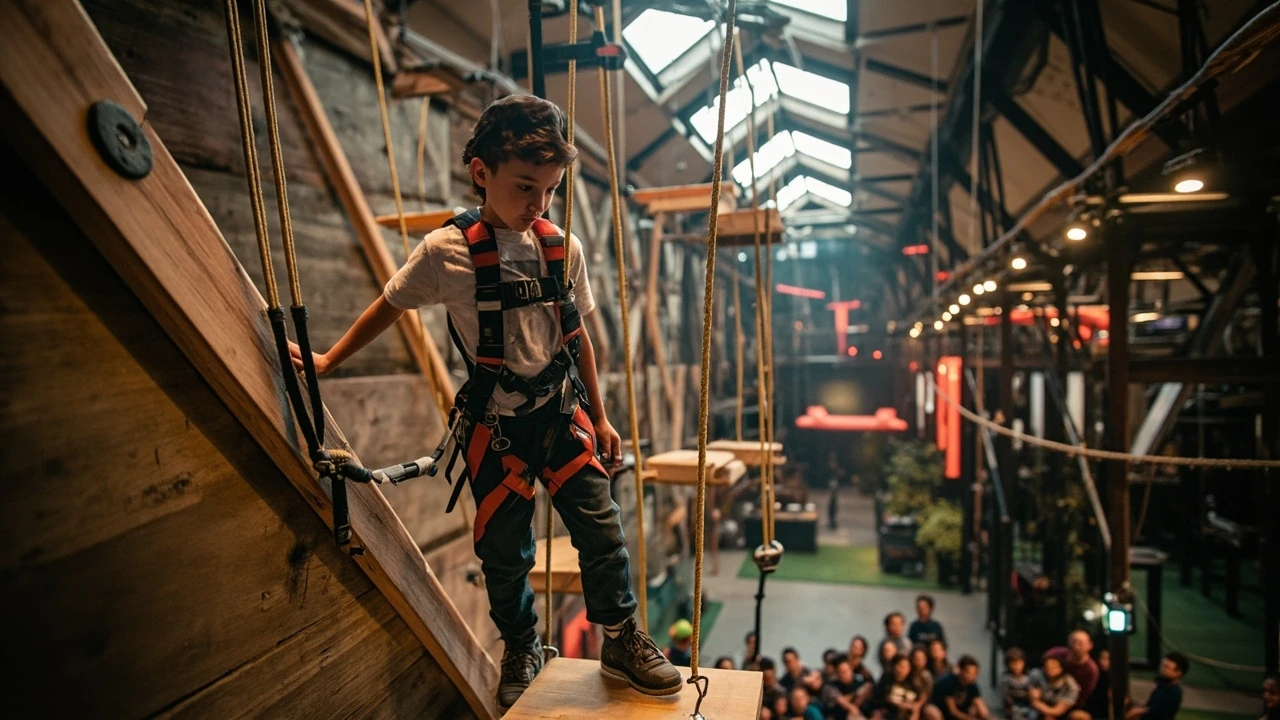
An urban air adventure park is a climbing and aerial attractions venue built inside a tall building, usually a converted warehouse or retail shell, where the ceiling rather than the trees sets the height limit. Instead of a forest canopy, the route runs across steel beams, suspended timber platforms, cargo nets, and climbing walls, with the whole structure engineered to be climbed indoors in any weather. The format has spread quickly because it solves a problem that outdoor rope parks cannot: it gives a city the same aerial experience without needing a forest, a hill, or a long drive out of town.
This guide explains what an urban air adventure park actually contains, how the safety and harness systems work indoors, who the attractions are designed for, what the realistic price and time commitment looks like, and what to check before you book. It is written for first-time visitors, parents arranging a group outing, and event planners weighing the venue against an outdoor alternative.
How an urban air adventure park is different from a traditional rope park
The name gets used loosely, so it helps to start with a clear picture. An urban air adventure park takes the core idea of an outdoor ropes course and rebuilds it for an interior volume. The footprint is often the same as a big-box store or a logistics warehouse, but the ceiling is taller and the walls are stronger, because the structures hang from above rather than relying on natural trees for anchors.
In practice, the difference shows up in three places: the anchoring, the route layout, and the way the venue handles weather. Outdoor rope parks depend on live trees or engineered poles rooted in soil, which sets a hard limit on where they can exist. An urban air adventure park anchors to the building’s steel frame, so it can sit in a city centre, inside a retail park, or next to a transport hub. That single change is what makes the format a city amenity rather than a destination day trip.
Route layout also shifts. Outdoor courses usually follow a single path through the trees with discrete levels of difficulty. Indoor parks tend to run a more modular setup, with parallel stations that guests move between, plus a separate climbing and bouldering zone. The harness and belay systems are drawn from the same industry standards, but the inspection routine runs on a building maintenance schedule rather than a forestry one, which is useful background for visitors who want to know how safety is managed indoors.
What attractions you will usually find inside
Most parks in this category follow a similar template, although the mix varies by floor area and target audience. The core attractions are the high-ropes obstacles, the climbing zone, and the freer or lower-stakes elements that let nervous first-timers warm up.
- High ropes obstacles: suspended bridges, swinging logs, cargo nets, plank walks, and balance beams strung between steel towers or beams at roughly 4 to 12 metres.
- Climbing walls and auto-belay routes: vertical or overhanging walls with automatic descender devices, so a single climber can clip in and climb without a human belay partner.
- Zip lines: often a short indoor zip running from a tower to a landing platform, used as a finish element rather than a long traverse.
- Ninja or freerun courses: lower obstacles such as warped walls, peg boards, and floating steps that test grip and coordination without the height exposure of the high ropes.
- Dedicated junior zone: a lower-level mini course for younger children, with the same harness rules but smaller obstacles and lower fall height.
- Briefing and gear-up area: where the harness fitting, safety briefing, and route demonstration take place before guests are allowed on the equipment.
Not every urban air adventure park carries every one of these. Some focus almost entirely on the high ropes and climbing walls, while a few lean further into the freerun and obstacle-course style. The key is to check the venue’s own page before booking, because the proportion of time you will spend at height versus on the ground changes the experience noticeably.
How the safety systems work indoors
Safety is usually the first question parents and group organisers ask, and it is also the area where an indoor venue is often stricter than an outdoor one, because the building owner and the local authority both have a say. Three systems tend to come up in any conversation with the operator.
The first is the continuous belay system that runs along the high ropes route. In an urban air adventure park this is almost always a self-clipping lanyard setup, similar to what you would find at a modern outdoor course. The guest clips onto a track at the start of the route and the carabiner or trolley stays connected until the end. There is no point on the route where a guest is unattached above the fall line. This is a deliberate design choice, and it is the single biggest reason the format works for first-time climbers.
The second system is the auto-belay used on the climbing walls. Each climber wears a harness clipped to a retractable lanyard mounted at the top of the wall. If the climber lets go, falls, or simply sits back, the device catches and lowers them slowly to the mat. Auto-belays are inspected daily and recertified on a manufacturer schedule, and the operator should be able to tell you the last inspection date for the device you will be using.
The third is the building-side safety layer: edge protection, padded flooring in the landing zones, clear sight lines from the staff observation positions, and emergency lighting for power cuts. This is where an indoor venue differs most from an outdoor one. The fall zones are measured against the building’s floor, the structural anchors are part of the building’s own engineering, and the operator is usually required to coordinate with the landlord’s facilities team for any work above the course.
A good test before booking is to ask the venue three questions: what continuous belay system do you use and who certifies it, how often are auto-belays inspected and by whom, and can I see the last independent safety audit. A reputable urban air adventure park will answer without hesitation.
Who an urban air adventure park is for
The short answer is that it is designed for a wider age range than most people expect, but with clearer height and weight limits than an outdoor course, because the building’s own structure sets those limits. Most operators work to a typical profile.
- Families with children aged 6 to 14: the junior zone and the lower-level obstacles are built around this group, and the harness setup is sized down to fit.
- Teen and adult first-time climbers: the high ropes obstacles, climbing walls, and zip line finish are the core draw.
- Friends and small groups: birthday-style visits, stag and hen groups, and after-work team sessions.
- Corporate and school bookings: larger groups that need a controlled environment, easy transport access, and a venue that is unaffected by weather.
What it is not designed for is unsupervised climbing. The harness and lanyard system requires the briefing, and most operators will not allow a guest on the equipment without a completed check by a trained staff member. Visitors who want a more independent, less structured climbing session are usually pointed towards a dedicated bouldering gym or a traditional outdoor course.
Price, time, and what is usually included
Pricing for an urban air adventure park varies by city and by session length, but the structure is consistent. The most common model is a timed session of 60 to 120 minutes on the high ropes and climbing walls, with the briefing and gear-up time added on top. The session usually includes the harness, helmet, and a safety briefing, and the price is set per person with a small group discount.
| Item | What is typically included | What is usually extra |
|---|---|---|
| Session length | 60 to 120 minutes on the equipment | Extended time slots on some venues |
| Gear | Harness, helmet, lanyard briefing | Own climbing shoes or gloves on some venues |
| Briefing | Mandatory 15 to 25 minute safety talk | One-to-one coaching for nervous climbers |
| Junior zone | Included for children within the height range | Reserved junior-only sessions at peak times |
| Zip line and freerun zone | Usually included in the main ticket | Specialty sessions on a few venues |
| Food and drink | Not included | On-site cafe or vending at most venues |
For a rough planning figure, plan for the equivalent of a mid-range family attraction ticket per person, with a small uplift for the auto-belay climbing walls if the venue charges per route rather than per session. Treat any precise number you see online as a starting point, not a quote, because pricing changes by season and by demand.
How to plan a realistic day
Most people underestimate how much of the visit is spent off the equipment. A well-paced evening or afternoon usually breaks down into arrival, gear-up, briefing, active climbing, and recovery, and each of those takes longer than first-timers expect.
- Arrive 15 to 20 minutes before the booked slot. Late arrivals often lose climbing time, because the briefing runs on a fixed schedule.
- Allow 20 to 30 minutes for gear-up and briefing. This includes the harness fitting, the route demonstration, and the safety quiz that some venues run for juniors.
- Plan for 60 to 90 minutes of active climbing per person. The pace on the high ropes is set by the slowest climber in the group, and rest breaks are common.
- Build in 15 to 20 minutes at the end to recover. Coming down from height is a real physiological shift, and most people want a drink and a quiet minute before leaving.
- Add travel time around the slot. Urban venues sit on city transport routes, but they are not always next to the station, so leave a margin.
For a family, a realistic two-hour block in the venue plus travel is a sensible minimum. For a corporate or school group, a half-day block with the briefing and a short lunch break is the safer planning unit.
What to wear and what to leave at home
Clothing matters more than people expect, because loose items catch on equipment and the harness has to sit correctly over what you are wearing. A few practical rules cover most situations.
- Wear close-fitting layers. A fitted t-shirt or base layer and leggings or tracksuit bottoms work well. Loose shirts, scarves, and baggy hoodies can catch on lanyards and carabiners.
- Use lace-up or strap-on sports shoes. Open sandals, slip-ons, and chunky hiking boots are usually refused at the gear-up point. The venue can refuse entry on the day for unsuitable footwear, so this is the single most common reason for a wasted booking.
- Tie back long hair and remove dangling jewellery. Necklaces, hoop earrings, and loose bracelets all get caught in the harness and the equipment.
- Bring water and a small snack for afterwards. Most venues do not allow food on the equipment, and the effort is more tiring than it looks.
- Leave phones in a pocket that zips closed, or in a locker. A dropped phone from 8 metres is not recoverable, and many venues ask for phones to be left behind entirely.
Booking, group size, and quiet times
Booking is usually required for the main session slots, with walk-in availability only at quiet times. Group size is the other variable that shapes the experience. A small group of four to six moves through the high ropes quickly, because the route runs in one direction and the slowest climber sets the pace. A larger group of 15 to 20 will queue at obstacles and spend more time waiting than climbing, so it is worth asking the venue how they handle larger groups before you book.
| Visit type | Best time to book | Why this slot tends to work |
|---|---|---|
| First family visit | Late morning on a weekday | Shorter queues, calmer briefing, more staff attention for juniors |
| Teen group | Afternoon on a weekend | Energy levels match the obstacle pace, peers keep motivation high |
| Corporate or team session | Late afternoon on a weekday | Commute-friendly, easier to fill a private session, fewer families on the course |
| School or youth group | Morning on a weekday during term time | Full venue control, staff ratios are easier to manage, transport is cheaper |
| Nervous adult first-timer | Early evening on a weekday | Quieter course, more space to repeat an obstacle without holding anyone up |
Quiet times also help nervous first-timers more than any coaching. A half-empty course lets you repeat an obstacle, take a break on a platform, and step off the route without feeling watched, which is often the difference between enjoying the visit and avoiding the high ropes entirely.
Common mistakes first-time visitors make
Most problems on a first visit come from a small set of predictable oversights. Skipping any of them tends to make the day harder than it needs to be.
- Underestimating the briefing time. The safety talk is not optional and it is not short. Build it into the schedule, especially with children in the group.
- Wearing the wrong shoes. The single most common reason for a refused entry, and an easy one to fix in advance.
- Booking the shortest session. A 60-minute slot on a first visit feels generous in the booking email and tight on the day. First-timers usually want 90 minutes at minimum.
- Forgetting the height and weight rules. Junior harnesses have a minimum and maximum, and the auto-belay has its own weight range. Check before you travel.
- Treating it as a passive day out. It is active, and arms and shoulders will be sore the next day. Plan a quieter evening afterwards rather than a long dinner out.
How to check that the venue is reputable
Reputation matters more in this category than in many other attractions, because the equipment is high and the harness system is the entire safety story. A few checks are worth doing before you book, and they do not take long.
- Look for an independent safety audit on the venue’s own page. A serious operator publishes the auditor and the date. A missing audit is a reason to ask questions, not necessarily to walk away.
- Check the staff training statement. Continuous belay and auto-belay instructors should hold a recognised qualification, and the venue should be able to name the awarding body.
- Read recent reviews with weight on the safety comments. A queue complaint is one thing. A comment about loose harnesses, inattentive staff, or unclear briefings is a different signal.
- Ask about the daily inspection routine. The harness, lanyard, and auto-belay inspection should happen at the start of every session, and the inspection record should be visible to staff on the day.
- Confirm the insurance and emergency procedures. The operator should carry public liability cover appropriate to the activity, and staff should be able to describe the rescue plan for a climber who is stuck on the course.
None of these checks are invasive, and a well-run urban air adventure park will not find them odd. If a venue resists simple questions about its safety system, that resistance is itself the answer.
What to expect on the day, in order
The visit usually follows a predictable rhythm, and knowing it in advance removes most of the first-visit anxiety. A typical session runs something like the table below, with the exact times set by the venue.
| Step | What happens | Typical duration |
|---|---|---|
| Check-in | Booking confirmed, waivers signed, group divided into climbing slots | 10 to 15 minutes |
| Gear-up | Harness fitted, helmet issued, lanyard explained | 10 to 15 minutes |
| Safety briefing | Continuous belay demonstration, route rules, emergency signals | 10 to 15 minutes |
| Climb | High ropes route, climbing walls, freerun zone in any order | 60 to 90 minutes |
| Descent and recovery | Gear returned, water, optional food stop | 10 to 15 minutes |
Group bookings, school sessions, and corporate events usually extend the briefing and add a structured team challenge, but the basic shape is the same.
Frequently asked questions
What is an urban air adventure park?
An urban air adventure park is an indoor climbing and aerial attractions venue built inside a tall building. It uses the same harness and continuous belay systems as an outdoor rope park, but the obstacles are anchored to the building’s steel structure rather than to trees, which is what allows the venue to sit in a city rather than a forest.
How old do you have to be to climb at an urban air adventure park?
Most venues allow children from around 6 years old on the junior zone, with the main high ropes route open to children who meet the height and weight requirements, usually set by the harness manufacturer. Check the venue’s own page for the exact limits, because they vary slightly by operator and by equipment.
Do I need any climbing experience to visit?
No prior experience is needed. The safety briefing covers the harness, the continuous belay system, and the route rules, and the staff will check your setup before you leave the ground. The format is built around first-time climbers, and a large share of any session is made up of people on their first visit.
How safe is an indoor aerial adventure park compared to an outdoor one?
Indoor and outdoor parks run to similar harness and belay standards, and the same continuous belay system is used in both. The indoor setting removes weather, tree health, and wildlife as variables, which simplifies the inspection routine. The trade-off is that the building’s own structure has to be part of the safety case, so it is worth asking how the anchors and the fall zones are engineered before you book.
What should I wear to an urban air adventure park?
Close-fitting layers and lace-up sports shoes are the safe choice. Loose clothing, jewellery, and open sandals are usually refused at gear-up, and many venues ask for phones to be left in a locker or a zipped pocket. Bring water for afterwards, because the effort is harder work than it looks.
How long does a typical session last?
A standard session is 60 to 120 minutes of climbing time, with an additional 20 to 30 minutes for check-in, gear-up, and the safety briefing. First-time visitors usually want the longer slot, because the pace on the high ropes is set by the slowest climber in the group.
Can I book an urban air adventure park for a private group?
Most venues offer private slots for birthdays, school groups, and corporate bookings, usually at off-peak times. A private slot gives you the course to yourselves and lets the staff pace the briefing to your group, which is the main reason event planners choose it over a general admission ticket.
What is the difference between an urban air adventure park and a trampoline park?
Trampoline parks focus on floor-level bouncing with padded zones and dodgeball courts, while an urban air adventure park focuses on height-based obstacles, climbing walls, and aerial routes. The harness and belay system is the clearest marker: a trampoline park does not need one, and an urban air adventure park is built around it.
What happens if it rains or there is a power cut?
An indoor venue is unaffected by rain, which is one of the format’s main advantages over an outdoor course. A power cut is a real but rare event, and serious venues carry backup lighting and a manual descent procedure for climbers on the course. Ask the operator how they handle a power cut before you book, because the answer tells you a lot about the rest of the safety setup.
Is an urban air adventure park a good choice for a first climbing experience?
Yes, and it is usually the easiest way to try climbing with the harness already managed for you. The continuous belay means there is no point on the route where you are unattached, the briefing covers everything you need to know before you leave the ground, and the staff stay on observation throughout the session. If you are not sure whether you will enjoy it, a quiet weekday slot is the lowest-pressure way to find out.
Internal links
Related reading
Explore High Ropes Adventure
Trip tools
Essential adventure planning guides
Use these practical guides to compare rope park activities, prepare for a first high ropes day, check a booking, choose suitable footwear and contact the editorial team. Each page links to the relevant live tools and current planning sections.
Latest articles
- Tame Impala tickets: how to find them, what they cost, and what to know before you buy
- Outdoor pillows: how to choose the right ones for a deck or trail rest stop
- How to find Morgan Jay tickets without overpaying
- How to find national parks near me: a practical local search guide
- Paylater travel: how buy now, pay later works for trip bookings
- Bagsmart Blast Travel Backpack: A Practical Review for Day Trips and Adventure Days
- How to choose an outdoor rocking chair that actually lasts
- Indiana travel advisory map: how to read it before a day trip
- How to plan an outdoor day around a concert stop: a cardi b tickets field guide
- Outdoor sectional sofas: a practical buyer’s guide for patio living