What Is a Challenge Course Facilitator? Roles, Skills, and Training
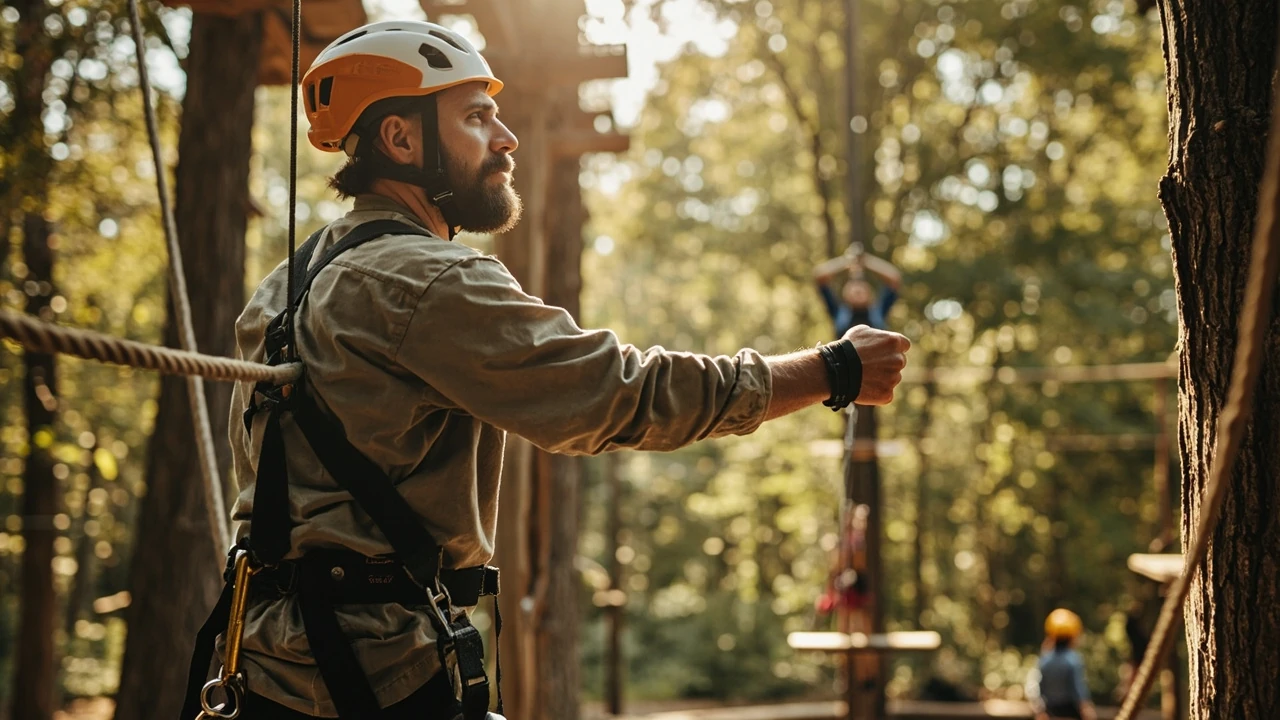
What is a challenge course facilitator
A challenge course facilitator is the trained staff member who plans, runs, and supervises group activities on a ropes course, zip line, or team-building challenge course. They combine the technical skills of a belayer and rigger with the softer skills of a coach, group leader, and risk manager. In a typical day they may brief a corporate group, spot a participant crossing a high wire, debrief a leadership exercise, and reset an element between rotations.
If you have ever watched a school or corporate group cycle through a high ropes park and wondered who is actually running the show, it is almost always a facilitator. The role sits at the intersection of outdoor recreation, experiential education, and safety management, and it looks very different from a casual adventure guide or a self-belaying guest.
The core responsibilities of a challenge course facilitator
The job description for a challenge course facilitator changes depending on the site, the audience, and the program length, but most roles share a common set of duties.
- Running pre-activity safety briefings and equipment checks
- Spotting participants on low and high elements and managing backup safety systems
- Coaching groups through problem-solving initiatives and ground-based challenges
- Debriefing experiences so that lessons transfer back to work, school, or sport
- Inspecting elements, ropes, harnesses, and hardware before and after sessions
- Responding to incidents, near misses, and participant anxiety in a calm and structured way
- Communicating with group leaders, teachers, or HR partners about goals and outcomes
On a small course a facilitator may run everything from rigging checks to debrief. On a larger site the role is often split between a lead facilitator, who owns the program design and group outcomes, and one or more element facilitators, who manage the technical side of spotting, belaying, and resetting. The terms facilitator, instructor, and guide are sometimes used loosely, but the industry generally reserves facilitator for the person who is responsible for both safety and group learning, not just the physical direction of the activity.
Where challenge course facilitators work
Facilitators are employed across a wide range of settings, and the work environment shapes the skills they need to develop.
| Setting | Typical audience | Program focus |
|---|---|---|
| Outdoor adventure parks | Families, school groups, tourists | Recreational climbing, zip lines, high ropes circuits |
| Corporate team-building retreats | Work teams, leadership cohorts | Communication, trust, and decision-making exercises |
| Schools and universities | Students, sports teams, orientation groups | Character education, resilience, group bonding |
| Therapeutic and adaptive programs | At-risk youth, people with disabilities | Social-emotional goals, confidence building |
| Military and first-responder training | Cadets, search and rescue teams | Stress exposure, leadership under pressure |
| Faith-based and youth camps | Children, teens, mixed-ability groups | Community and personal growth outcomes |
Each setting comes with its own risk profile and group dynamic. A facilitator working with a corporate team is usually steering a structured agenda that is tied to specific business goals, while a facilitator at an outdoor adventure park spends more time managing the flow of one-time visitors and keeping the experience moving. Many facilitators rotate between several of these environments across a single season.
What a typical session looks like
Most challenge course sessions follow a similar arc, even if the details change. Understanding the structure helps clarify what the role actually involves on the ground.
- Welcome and goal setting. The facilitator meets the group, sets expectations, and aligns on the purpose of the day, whether that is pure fun, leadership development, or something in between.
- Equipment fitting and safety briefing. Harnesses, helmets, and lanyards are checked, and the group is taught the basics of the safety system they will use.
- Warm-up and ground initiatives. Short, low-stakes activities prepare the group mentally and physically for higher elements.
- High element rotations. Participants move through climbing, traversing, and jumping elements while the facilitator spots, belays, and coaches.
- Debrief and take-home framing. The facilitator draws out the lessons from the day and ties them to the group’s stated goals.
The ratio of facilitation to physical safety work shifts during each stage. Warm-ups and debriefs lean heavily on group facilitation, while high element rotations demand focused technical attention. Skilled facilitators learn to switch modes without losing track of either side of the role.
Key skills a challenge course facilitator needs
The role draws on a broader skill set than many people expect. Strong technical ability is necessary but not sufficient on its own.
- Technical rope skills. Knots, harness fitting, belay technique, equipment inspection, and rescue basics.
- Risk assessment. Reading weather, group mood, and equipment condition in real time, and adjusting plans accordingly.
- Group facilitation. Asking the right questions, listening actively, and managing conflict without taking over.
- Communication. Clear instructions under stress, age-appropriate language, and a tone that builds confidence rather than fear.
- Emotional regulation. Staying calm when a participant freezes on an element, when the weather turns, or when a group is resistant to the program.
- Physical fitness. Comfort with heights, the ability to climb, spot, and reset elements, and the stamina to work outdoors all day.
For a sense of how the technical and facilitation sides fit into a wider outdoor program, the High Ropes Adventure guide on planning a high ropes day for groups gives a useful overview of how facilitators think about pacing, goals, and group composition. For visitors who want a quick primer on the actual equipment, the article on high ropes belay systems describes the kind of safety setups a facilitator is responsible for managing in real time.
Training, certification, and career pathways
There is no single license that makes someone a challenge course facilitator, but the industry has converged on a layered set of credentials that most employers expect.
| Credential | Issued by | Typical focus |
|---|---|---|
| Level 1 or Practitioner certification | Professional Ropes Course Association (PRCA) or equivalent national body | Entry-level facilitator skills, group management, basic rescues |
| Level 2 or Advanced Practitioner | PRCA or equivalent | Higher-level facilitation, program design, advanced rescue |
| Rigging and inspector training | Specialist providers, sometimes manufacturer-led | Equipment inspection, course installation, structural checks |
| First aid and wilderness first aid | Red Cross, Wilderness Medical Associates, similar bodies | Scene management, CPR, common outdoor injuries |
| Belay and climbing instructor certs | National climbing federations, AMGA affiliates | Formal climbing instruction, top-rope and lead systems |
| Safeguarding and child protection | National or regional safeguarding bodies | Working with minors and vulnerable adults |
A new facilitator usually starts with a multi-day practical course that combines technical rope work, group facilitation, and rescue scenarios. Many people then work a full season at a single site before pursuing advanced credentials, and some move into site management, program design, or training the next cohort of facilitators. Pay varies widely by region, sector, and season, with school and camp roles often seasonal and corporate or year-round outdoor education programs more likely to offer full-time contracts.
How facilitators keep participants safe
Safety is the non-negotiable foundation of the job, and most courses use a layered approach that a facilitator is responsible for maintaining throughout the day.
- Equipment checks. Harnesses, helmets, lanyards, carabiners, and ropes are inspected visually and tactilely before each session, and any worn or questionable gear is pulled from service.
- Redundant safety systems. Many high elements use a continuous belay or smart belay system that keeps participants attached at all times, and facilitators are trained in how the system is supposed to behave.
- Spotting and backup. On lower elements and in dynamic situations, facilitators physically spot participants to control falls and reduce the risk of injury.
- Weather and environmental monitoring. Lightning, high winds, wet wood, and extreme heat all have defined stop rules, and facilitators are typically the ones calling the program.
- Clear escalation paths. When something does not look right, from a participant’s fear response to a frayed sling, facilitators are expected to stop the activity rather than push through.
It is worth noting that facilitators are not the only safety layer. Inspectors, course managers, and equipment manufacturers all play a role, and most reputable sites follow a written operations manual with documented daily, weekly, and annual checks. If you want to understand how the gear and systems are designed in the first place, the broader explanation of ropes course types and safety systems gives a helpful technical foundation.
Facilitation style and group outcomes
Beyond the safety work, a big part of the role is shaping the experience so that a group leaves with something more than a photo. Two facilitators running the same element can produce very different outcomes depending on how they frame and debrief the activity.
| Facilitation style | What it sounds like | Typical group outcome |
|---|---|---|
| Directive | “Clip in here, step on that plank, keep moving.” | Safe completion, limited reflection |
| Coaching | “What’s your plan? Who in your group needs support?” | Improved problem solving, stronger communication |
| Experiential | “Notice how you decided that. How does that show up at work?” | Transferable insights, behavior change |
| Therapeutic | “You said no out loud. What did that feel like?” | Emotional growth, self-awareness |
Most experienced facilitators blend these styles depending on the audience. A group of sixth graders usually benefits from clear, energetic direction. A leadership team tackling a complex decision exercise usually gets more out of open-ended questions. Choosing the right style in the moment is one of the harder skills to develop, and it is often the difference between a forgettable day and one that a group talks about for months.
Common misconceptions about the role
Because the job sits at the edge of several industries, there are a few persistent myths that are worth clearing up.
- “It’s just a climbing instructor.” Climbing instructors focus on technical skill development. Facilitators focus on the group process, with climbing as the medium rather than the goal.
- “Anyone who likes heights can do it.” Comfort with heights is helpful, but group management, communication, and risk judgment matter far more in day-to-day work.
- “The course runs itself once it is built.” A well-designed course still depends on facilitator decisions about group composition, sequencing, weather, and emotional safety.
- “It’s all adrenaline and cheerleading.” A surprising amount of the job is paperwork, inspection, debrief planning, and quiet one-on-one conversations with nervous participants.
These misconceptions sometimes lead to under-resourced programs or undertrained staff, which is one reason industry associations put so much emphasis on formal certification and ongoing supervision.
What to look for when choosing a course run by facilitators
For visitors, parents, or group leaders booking a challenge course experience, a few quick checks will tell you a lot about the quality of the facilitation team.
- Ask about staff certification. Look for current industry credentials and ask when they were last refreshed.
- Watch the briefing. A confident facilitator will explain the safety system clearly without rushing the group.
- Notice the spotting. On lower elements, staff should be actively positioned and focused rather than chatting at the side of the platform.
- Listen to the debrief language. Skilled facilitators ask open questions rather than just telling participants what they learned.
- Check the gear. Worn harnesses, tangled lanyards, or dusty helmets are red flags for the wider operation.
If the site is willing to talk openly about its training, inspection schedule, and incident history, that is usually a good sign that the facilitation team is taken seriously as professionals rather than seasonal extras.
Why the role continues to grow
Interest in structured outdoor experiences has expanded steadily over the past decade, from corporate offsites looking for genuine team development to schools re-emphasizing outdoor education. That demand has created a more consistent career path for facilitators, with year-round roles, clearer pay scales, and more formalized training routes than existed a generation ago.
At the same time, the role itself is becoming more specialized. Some facilitators focus on adaptive and therapeutic programs, others on leadership pipelines for specific industries, and others on the technical side of rigging and inspection. As long as organizations keep looking for ways to build trust, communication, and resilience in groups, the challenge course facilitator will remain a quietly important profession at the intersection of outdoor recreation and human development.
Frequently asked questions
What is a challenge course facilitator in simple terms?
A challenge course facilitator is the staff member who runs group activities on a ropes course or adventure program. They keep participants safe on the equipment and help the group get the most out of the experience through briefings, coaching, and structured debriefs.
Is a challenge course facilitator the same as a climbing instructor?
Not exactly. A climbing instructor usually teaches technical climbing skills, while a facilitator focuses on the group’s experience, communication, and learning outcomes. Many facilitators can climb, but the day-to-day work is more about people than about technical climbing progression.
What qualifications do you need to become a challenge course facilitator?
Most employers expect a recognized entry-level certification from a body such as the Professional Ropes Course Association, current first aid training, and on-site practical assessment. Additional credentials in rigging, safeguarding, or wilderness first aid open up more advanced roles.
How long does it take to train as a challenge course facilitator?
A basic certification course usually runs several days of intensive training, followed by supervised hours on site. Many people work a full season before they feel confident across the full range of groups and conditions they are likely to encounter.
Do challenge course facilitators need to be good at heights?
Comfort with heights helps, but it is not the most important skill. Group management, communication, and calm decision-making matter more in day-to-day work, since facilitators are often the steady presence for participants who are far more afraid than the staff are.
How many participants can one facilitator manage at a time?
Ratios depend on the element, the group, and local rules, but a common range is one facilitator for every eight to twelve participants on high elements, with tighter ratios for younger children or more challenging exercises. The site’s operating manual and the certification body’s guidance set the actual numbers.
What is the difference between a high ropes facilitator and a low ropes facilitator?
Low ropes facilitators usually work closer to the ground on team-based problem-solving activities, with a stronger focus on group dynamics. High ropes facilitators work at height with harness-based safety systems, blending technical belay and spotting work with on-platform coaching.
How do facilitators handle participants who are too scared to continue?
Trained facilitators do not push or shame. They lower the challenge, offer physical and emotional support, and respect the participant’s decision. Many programs design elements so that participants can opt out at any point while still staying engaged with the group.
Are challenge course facilitators in demand?
Yes. Demand has grown alongside the wider interest in outdoor education, corporate team development, and experiential learning. Year-round roles exist at outdoor education centers, while seasonal roles are common at summer camps, resorts, and adventure parks.
What is the most important quality in a challenge course facilitator?
Most experienced facilitators point to the ability to read a group and respond in the moment. Technical skills can be trained and certified, but the judgment to decide when to push, when to slow down, and when to step back is what separates a good facilitator from a great one.
Related reading
Explore High Ropes Adventure
Trip tools
Essential adventure planning guides
Use these practical guides to compare rope park activities, prepare for a first high ropes day, check a booking, choose suitable footwear and contact the editorial team. Each page links to the relevant live tools and current planning sections.
Latest articles
- Outdoor pillows: how to choose the right ones for a deck or trail rest stop
- How to find Morgan Jay tickets without overpaying
- How to find national parks near me: a practical local search guide
- Paylater travel: how buy now, pay later works for trip bookings
- Bagsmart Blast Travel Backpack: A Practical Review for Day Trips and Adventure Days
- How to choose an outdoor rocking chair that actually lasts
- Indiana travel advisory map: how to read it before a day trip
- How to plan an outdoor day around a concert stop: a cardi b tickets field guide
- Outdoor sectional sofas: a practical buyer’s guide for patio living
- How amusement parks actually work: rides, safety, and what to expect