How adventure park staff perform pre opening checks
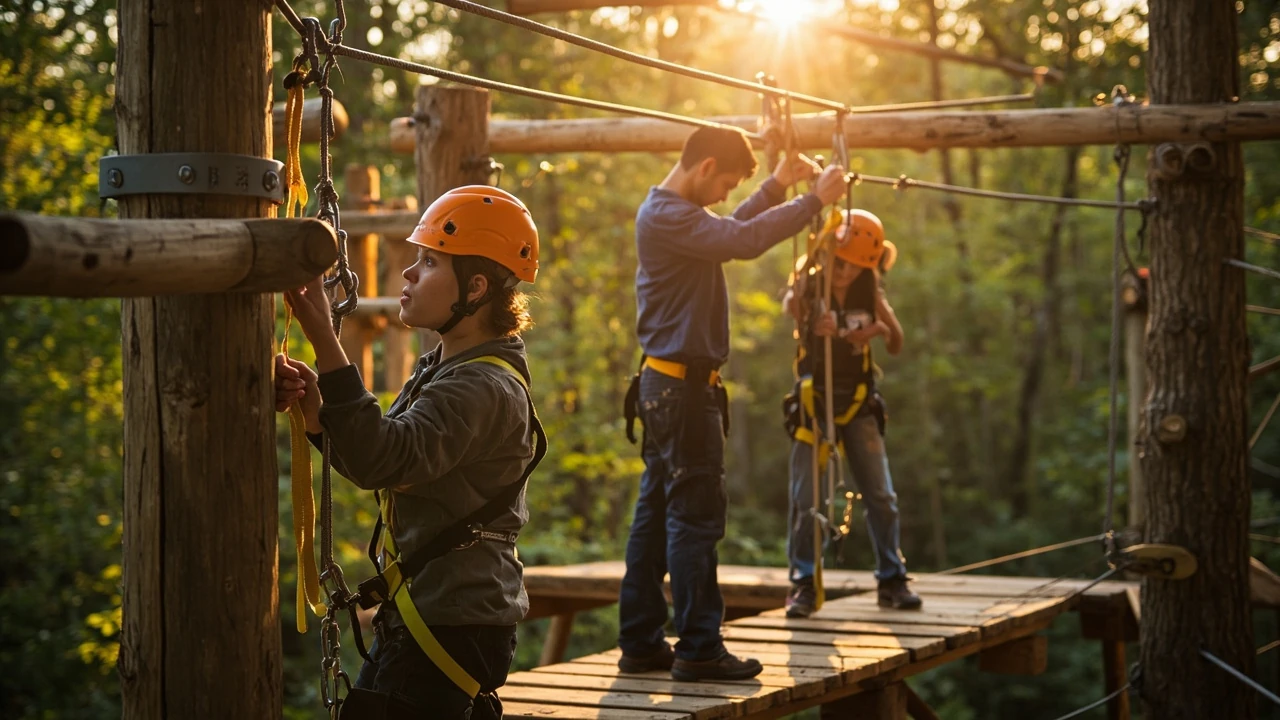
Walk onto any well-run high ropes or aerial adventure course a half hour before opening and the gates are not yet open, but the work has already started. Two or three staff members are on the ground with clipboards, radios, and torque wrenches. Someone is crouched beside a platform, turning a bolt by hand. Someone else is pulling a belay lanyard through a sequence of test loads. The first guest in line cannot see any of this, yet the entire day of that adventure park depends on it.
Understanding how adventure park staff perform pre opening checks explains a process that is usually hidden from visitors. It also helps operators, aspiring staff, and curious guests know what a responsible opening routine looks like, what questions to ask on arrival, and where shortcuts tend to show up. This guide walks through the full sequence, from the first walk-around of the property to the moment the first guest clips in.
How adventure park staff perform pre opening checks
Pre opening checks are a structured sequence of inspections, tests, and small repairs that adventure park staff complete before any guest is allowed on the course. The order is deliberate, because earlier checks confirm the conditions needed for later ones. A typical routine follows a clear path:
- Site walk and weather review
- Ground and structure inspection of each element
- Hardware and personal protective equipment checks
- Test loads on critical components
- Rescue kit and communication checks
- Briefing and staff assignment
- Final go-or-no-go decision before gates open
The same shape appears at small zip-line parks, large aerial adventure parks, and family rope courses. The size of the team and the time needed scale with the number of elements, the height of the structures, and the operating model. A two-hour open course with one route may need 30 to 45 minutes of checks. A multi-course park with zip lines, climbing walls, and team-building elements may need two hours or more, with several staff working in parallel.
Why pre opening checks exist
Pre opening checks exist because ropes courses are physical systems that change between operating days. Timber swells and shrinks. Bolts settle. Cables stretch. Carabiners take wear. A site that was safe at closing last night may have a small fault this morning that only a deliberate check will catch.
Most modern adventure parks follow a manufacturer or industry standard for inspections. The two most common reference points are the European Ropes Course Association standard for construction and operation of ropes courses, often called ERCA, and the Association for Challenge Course Technology standards used widely in North America. Both treat pre opening checks as a daily minimum, not a substitute for deeper periodic inspections. Daily checks catch the small, time-dependent issues. Periodic inspections by qualified inspectors catch structural and long-term wear. Both are needed, and pre opening checks are the daily link in that chain.
For readers planning a day out, knowing the difference helps. A course that has a calm, repeatable opening routine is more likely to be run by people who take the deeper inspections seriously too. You can read more about the visitor experience on a first visit in Your First High Ropes Course: What to Expect.
The pre opening sequence, step by step
Although every park adapts the routine to its own course, the structure stays similar. The following sequence reflects a common adult aerial adventure park with continuous belay systems, plus notes for family courses and zip lines where the routine differs.
1. Site walk and overnight review
The first staff member on site, often the duty manager, walks the property before any tools come out. They check for storm damage, fallen trees, animal interference, vandalism, and anything that has changed since the previous day. This walk also gives a quick read of ground conditions: soft soil after rain, leaf fall in autumn, ice in winter, and any new trip hazards near the queue area.
Alongside the walk, the team reviews the weather. Wind, lightning risk, rain totals, and temperature all influence the day. Many parks use a documented go-or-no-go matrix, for example closing above a certain wind speed, suspending operations during lightning within a set radius, or adjusting for heat at climbing elements. The exact numbers vary by operator and insurance, but the principle is the same: the day starts with a written record of conditions.
2. Structural and ground inspection
Next, staff move along the course on the ground, looking up. Each pole, platform, ladder, and step is checked for cracks, splits, rot, corrosion, loose fixings, and movement. This is a hands-on check, not a glance from a distance. A loose bolt may be silent under a static load but move when a guest runs across a platform, so the inspector physically tests handholds, steps, and railings.
Where the course uses timber, the inspection looks for new splits, fungal staining, and insect damage. Where it uses steel, the inspection focuses on weld lines, base plates, and corrosion at ground level. Concrete footings are checked for cracking or washout after heavy rain. A small soil scour around a base plate can change the way forces move through the structure, so the ground around each pole gets attention too.
| Element | What staff look for | Common action if found |
|---|---|---|
| Timber poles | New cracks, splits, rot at ground line | Mark element, restrict or close that section |
| Steel poles | Weld cracks, base plate corrosion, bent sections | Close element, call periodic inspector |
| Platforms and steps | Loose boards, protruding screws, flex under load | Replace board, tighten fixings, recheck |
| Foundations and ground | Soil erosion, cracking, exposed anchors | Backfill, restrict access, escalate |
3. Cable and lifeline inspection
After the structure passes, the cables and lifelines get individual attention. Staff walk the length of each main cable, looking for fraying, kinks, broken strands, and damaged thimbles or terminations. Where the cable passes through a pulley or redirect, the inspector checks that the hardware still moves freely and shows no unusual wear.
For continuous belay systems, the track that the lanyard trolley follows also gets attention. The trolley must run smoothly, the gate must close fully under spring tension, and the connection point must be intact. A trolley that hangs up partway through an element is both a frustration and a safety problem, because guests can end up stranded in awkward positions.
4. Hardware and PPE checks
Pre opening checks are also when the personal protective equipment is prepared. Staff pull helmets, harnesses, lanyards, and gloves, and inspect each one before it is issued to a guest. The harness is checked for cut webbing, chemical damage, frayed stitching, and broken buckles. Lanyards and cowstails are checked terminator to terminator, including the energy absorber on shock packs. Carabiners are checked for smooth gate action, locked sleeves, and readable identification marks.
| Item | Pre opening check | Out-of-service trigger |
|---|---|---|
| Full-body harness | Webbing, buckles, stitching, label legibility | Any cut, burn, chemical stain, or failed buckle |
| Helmet | Shell, chin strap, foam, date mark | Crack, expired date mark, or broken strap |
| Lanyard with shock pack | Webbing, terminations, fall indicator | Deployed shock pack, torn webbing, illegible label |
| Carabiner or hook | Gate action, lock, identification | Stiff or sticky gate, unreadable ID, surface damage |
| Gloves and small items | Fit, condition, clean state | Torn palm, contamination, missing items |
Most operators use a log or tick sheet for this stage. Some parks rotate harnesses so that the same guest does not get the same harness on every visit, and others assign harnesses by size group. Either way, the morning check is when worn items are pulled out of service and replaced. A useful way to think about it is that staff are not just preparing equipment for today. They are filtering out items that should never go out again.
5. Test loads on critical components
Some elements, especially zip lines, rescue points, and main anchor points, are tested with a known load each morning. The test load is usually a calibrated weight, a water bag, or a measured force applied with a hand pull. The aim is to confirm that the system can hold a load above normal use without unusual movement, and to verify that the rescue and retrieval points function.
The exact test method depends on the design. A zip line trolley might be run across the line with a sandbag to confirm smooth travel and braking. An anchor point might be loaded to a documented force while staff watch for slip or rotation. The values used are set by the manufacturer or the periodic inspector, and the result is recorded. If the element does not behave as expected, it stays closed until the cause is found.
6. Rescue kit, first aid, and communications
Even on a calm day, a guest can become unwell, freeze on an element, or need help lowering. Pre opening checks cover the equipment and procedures for those situations. Rescue kits are laid out so that any staff member can identify the right rope, descender, and casualty bag. First aid kits are checked against a content list, and any out-of-date item is replaced. Radios are tested from end to end of the course, including blind spots under heavy canopy.
Many parks also confirm staff-to-guest ratios at this point, using the booking sheet for the day. Ratios matter because rescue and assistance depend on having enough qualified staff on the ground, not just on the platform. A busy Saturday with school groups needs a different assignment from a quiet Tuesday morning. This is also when the duty manager decides who is in the tower, who is on the ground, and who carries the radio at the briefing area.
7. Staff briefing and final go-or-no-go
Once the technical checks are complete, the team gathers for a short briefing. Conditions are restated. Any element still restricted is named. Roles for the day are confirmed. The briefing is also a chance to flag a guest who has booked and may need extra support, for example a nervous adult, a child who is at the lower end of the height range, or a group with a participant who uses a wheelchair. Family-friendly parks often have specific decision points for younger visitors, and you can compare those in How to Plan a Family Rope Park Day Around Age and Height Rules.
After the briefing, the duty manager makes a final go-or-no-go call. If anything remains unresolved, the park either opens later, opens with a reduced course, or does not open at all. The decision is recorded, and only then are guests allowed through the gate.
Common shortcuts and how to spot them
Even well-trained teams develop habits, and pre opening checks are where those habits can drift. A few shortcuts appear often enough to be worth naming.
- Visual-only checks: a quick look from the ground instead of a hands-on inspection. Catching a loose bolt or a hairline crack in a weld usually requires touching the equipment.
- Skipping the test load on quiet days. A quiet day is exactly when test loads matter, because the system has been static for longer.
- Reusing damaged PPE because it still works. Webbing can hold after a near-miss event, but the fall indicator on a shock pack is a one-use item.
- Running opening checks while the first guests are already arriving. Once the queue is forming, the team feels pressure to cut the routine short.
- Not recording the result. A check that is not logged is hard to review when an incident happens, and harder still to learn from.
None of these shortcuts are obvious to a guest standing at the gate. The first warning sign is usually how staff react to a small question. Operators who run a tight pre opening routine are usually comfortable answering practical questions about harness fit, height rules, and what to do if someone freezes on an element. Operators who look unsettled or rush the answer may be working around a problem that morning.
What pre opening checks mean for guests
Most guests will never see the full pre opening routine, but a few habits on the visitor side make those checks more effective and the day safer.
Arrive early enough to listen to the safety briefing. The briefing builds on the checks already done. It is also the moment when staff confirm that the harness actually fits you, not just that one is on you. Speak up if a buckle pinches, a strap twists, or a chest strap sits awkwardly. A correctly fitted harness is part of the system the morning checks prepared, and a small adjustment now avoids a larger problem on the course.
Keep personal items secure. Loose phones, key rings, and water bottles can interfere with the trolley or fall onto people below. Many parks require phones to be in zipped pockets, and staff will remind you, but checking before you clip in is faster than being sent back to the start.
Pay attention to staff on the course, not just to your own group. If a staff member asks you to pause on a platform, the request is almost always part of a recovery or a recheck that began during pre opening. A short stop is usually safer than pressing on.
For families, it also helps to set expectations with children the night before. Knowing the height rules, the harness fit, and the fact that staff may ask them to wait, helps children cooperate with the briefing and reduces the chance of a meltdown at the start. Best places to travel with kids: a practical shortlist for active families has more context for that planning side.
Frequently asked questions
How long do pre opening checks take at a typical adventure park?
For a small family course, 30 to 45 minutes is common. For a larger aerial adventure park with several elements, two to three hours of preparation before the first guest is normal. Multi-activity parks with zip lines and climbing walls often start earlier to allow the full sequence.
Who is responsible for pre opening checks?
A duty manager or senior instructor usually owns the routine, with the actual checks shared across the opening team. Each staff member inspects a defined area, and the duty manager signs off the full course before guests are admitted.
Are pre opening checks the same as a full inspection?
No. Pre opening checks are a daily minimum, focused on condition changes since the last operating day. A full inspection is a deeper periodic review carried out by a qualified inspector, often annually, and covers structural wear, hardware retirement schedules, and design changes.
What happens if a check fails on the morning of a session?
The affected element is closed or the entire park delays opening. Staff identify the cause, repair where they are qualified to do so, or call the periodic inspector if the issue is structural. The decision and the action taken are recorded.
Do family rope courses follow the same pre opening routine?
Yes, scaled down. Family courses still inspect structure, cables, and PPE, and they still test critical components. The routine is usually shorter and may be led by a single trained staff member for a small site, but the underlying logic is the same.
Can guests ask to see the pre opening log?
Many parks will show a completed opening sheet on request, because it reassures visitors and confirms that checks happened that day. Some operators publish summary safety information online instead. Either is reasonable, and either is a good sign.
How are weather changes handled after opening?
Staff monitor conditions throughout the day. Wind, lightning, and temperature thresholds trigger partial closure, full closure, or evacuation. The thresholds used at opening are the same ones used mid-day, so the pre opening review sets the rule of thumb for the rest of the day.
Are pre opening checks enough on their own?
No. They are the daily layer in a wider safety system that includes periodic inspections, staff training, manufacturer guidance, and group briefings. Removing any one layer increases risk, which is why serious operators treat all of them as non-negotiable.
What standards do adventure parks follow for pre opening checks?
Many follow ERCA standards in Europe or Association for Challenge Course Technology standards in North America. Local regulators may also set requirements. The exact wording differs, but the daily check requirement is consistent across these frameworks.
How can I tell if a park takes pre opening checks seriously?
Look for visible signs: a calm, unhurried opening, staff who answer harness and height questions without irritation, recorded signage about weather thresholds, and clean, well-stored equipment. The park does not need to broadcast its routine, but the results are usually easy to read on arrival.
Related reading
Explore High Ropes Adventure
Trip tools
Essential adventure planning guides
Use these practical guides to compare rope park activities, prepare for a first high ropes day, check a booking, choose suitable footwear and contact the editorial team. Each page links to the relevant live tools and current planning sections.
Latest articles
- Sweet tart ropes: what the flavour means in a ropes course
- Demon Slayer movie tickets: how to find a screening and prepare for a day out
- How to choose NBA tickets without overpaying
- Time travel movies worth watching on a slow weekend
- Overseas adventure travel: how to plan a trip that actually works
- Choosing an outdoor bench that actually lasts
- Lows adventure: how low-ropes courses work and who they suit
- outdoor couch
- United travel bank: how prepaid travel money cards actually work
- National parks in California: a practical guide to choosing your trip