How fast do ziplines go? Real speeds and what to expect
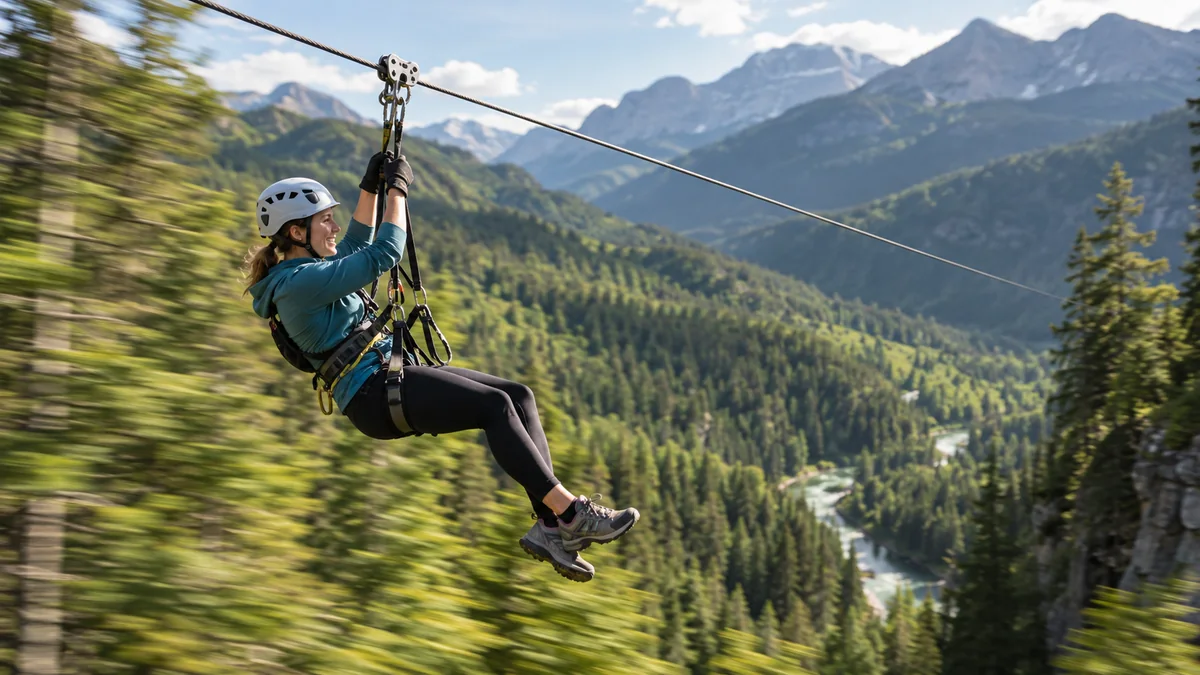
How fast do ziplines go
A rider crouches on a small wooden platform, a guide double-checks the trolley, and the line is finally clear. The release is gentle, but the rush is sudden: within a second or two, the trees begin to blur and the wind noise rises. That gap between expectation and sensation is exactly why people ask how fast ziplines go before they book their first ride.
There is no reliable universal average for commercial ziplines. Operator-published figures range from roughly 30 to 40 mph on an introductory line to about 100 mph on an extreme destination ride. Cable profile, rider position, weather, trolley design, and braking system all change the result, so the useful number is the speed published for the specific line you plan to ride.
This guide explains the real numbers behind how fast ziplines go, why speeds vary so much, what affects your personal top speed on any given ride, and how to read the difference between a tame park course and a record-breaking line. It also covers what riders actually feel at different speeds, the safety gear that makes high speeds manageable, and the practical limits set by weather, weight, and cable design.
Typical zipline speeds by setting
Speed is not one number, because ziplines are built for very different purposes. The table below uses published examples from one operator to show how dramatically two lines at the same destination can differ. These figures are examples, not industry-wide averages.
| Published example | Operator-published speed | How to read it |
|---|---|---|
| Zip World Velocity, introductory line | About 30-40 mph | A shorter warm-up line before the main ride |
| Zip World Velocity, main line | Up to 100 mph or more | An extreme, purpose-built destination attraction |
The operator’s Velocity ride description publishes both figures on the same page. That contrast is more useful than a made-up global average: it shows why riders should compare the exact line, not the word “zipline” on a booking page.
What actually changes zipline speed
Two ziplines of the same length can produce completely different speeds. The number that ultimately matters is the rider’s speed at the bottom of the line, and that is set by a handful of physical and design variables that ride operators tune carefully.
Cable angle and total drop
Steepness is a major factor. A zipline is a controlled gravity ride, and the difference in elevation between launch and landing helps determine how much potential energy becomes forward motion. The full cable curve matters more than one headline angle, because sag changes the slope throughout the ride.
Longer drops allow riders to accelerate for longer, but only if the cable angle stays meaningful. A cable that is mostly flat will not generate much speed no matter how long it is, which is why canopy tours in flat forests often use multiple short lines instead of one long one.
Cable length and sag
Longer cables give more time to accelerate, but they also sag more under their own weight, which changes the shape of the ride. A long, heavily sagging cable creates a parabolic profile: riders accelerate hard at the top, then feel a noticeable slowdown as the cable flattens near the end.
Operators compensate for this by setting the anchor points far apart, pre-tensioning the cable, or using braking systems. The result is a smoother but slightly slower experience than a short, steep, straight line.
Rider weight and posture
Rider mass can affect the speed reached on a real line because aerodynamic drag and trolley friction do not scale in exactly the same way as weight. That does not mean a heavier rider is automatically faster on every course. Operators test a defined rider range and set minimum and maximum weights for that particular installation.
Posture changes aerodynamic drag, but riders should never invent a faster position. The correct body position depends on the harness, trolley, brake, and instructions for the line. Use the position demonstrated in the briefing and keep it until the guide says otherwise.
Trolley and pulley friction
The hardware running along the cable is a major hidden variable. Wheel material, bearing condition, alignment, and contact with the cable all affect friction. Commercial systems are selected as a complete package, so a trolley cannot be judged separately from the line and its brake.
Marketing terms such as “high-speed” or “racing” do not explain how a line achieves its speed. Ask for the published operating figure and restrictions instead of inferring performance from the trolley name.
Wind, air density, and weather
Headwinds can slow riders, tailwinds can increase speed, and crosswinds can change how the ride behaves. Operators monitor conditions against limits set for their own course. Those limits are site-specific; exposed mountain lines, sheltered forest lines, and short park lines cannot safely share one universal wind cutoff.
Braking systems and their trade-offs
Every rider has to stop, and the way a line handles that final phase is part of the “speed experience.” Common systems include:
- Magnetic or eddy-current braking systems designed for a specified range of arrival speeds.
- Spring-loaded catch blocks near the end platform that absorb the rider’s momentum.
- Active hand brakes on the trolley that let trained riders control their own deceleration.
- Netted landing zones with shock-absorbing padding for very short, slow lines.
The brake is designed together with the cable profile, trolley, rider range, and arrival zone. It is not a universal speed cap that can be compared across parks. That is one reason a line may feel fast at the midpoint and then slow noticeably before the platform.
How riders experience speed vs. actual numbers
Numbers tell only part of the story. Two riders on the same line can describe the experience very differently, and the gap between perceived and measured speed is something engineers and guides have to manage.
Why 30 mph can feel like 60 mph
Without a frame of reference, the human brain relies on visual cues to estimate speed. Trees, branches, and platforms flash past the peripheral vision much faster than a rider expects, especially on the first run. The absence of an enclosure and the direct exposure to wind on the face amplify the sensation, so a 35 mph descent in a forest can feel more intense than 45 mph in a car with the windows up.
Why 60 mph can feel calm
Once riders are familiar with the format, the novelty wears off and the same speed feels more controlled. Smooth trolley hardware, consistent wind, and a predictable cable profile all make a fast line feel easier than a choppier, slower one. This is one reason why canopy tour operators often build several lines in a row: the first line feels wild, the third feels almost relaxed.
The role of noise and harness tension
The loud rushing sound of wind past the ears and the pressure of the harness straps pulling upward are both cues the body reads as “fast.” A well-fitted harness system that supports the rider’s weight evenly lets them relax into the ride, while a loose or poorly adjusted harness adds a distracting pull that makes the same speed feel more chaotic.
Published speeds on extreme ziplines
Extreme destination lines publish unusually high figures, but the claims are not directly comparable unless the measurement method, rider conditions, and operating limits are also known.
| Line | Published speed | Context |
|---|---|---|
| Zip World Velocity, little zip | About 30-40 mph | Introductory run at the same attraction |
| Zip World Velocity, big zip | Up to 100 mph or more | Operator-published maximum; actual rider speed varies |
The general zip line overview lists other notable long and fast installations, but a record or marketing claim should not be treated as the speed every rider will reach. Operators publish their own weight, health, clothing, and weather restrictions, and those rules take priority over a comparison table.
Safety limits and operating speed
A commercial zipline is designed and operated around a defined range of rider weights, cable conditions, trolley behavior, and braking performance. The safe operating envelope belongs to that installation. A faster-than-expected run is not a bonus; it is a reason for the operator to follow the course’s inspection and operating procedures.
Common safety limits and standards include:
- Manufacturer ratings and engineering limits for the trolley, cable, braking system, and complete installation.
- Daily inspections of cable tension, trolley bearings, and harness webbing before opening.
- Weather and wind limits documented for that specific course.
- Maximum combined rider weight (especially for tandem riders) to avoid over-tensioning the cable.
- Lightning and storm protocols that close courses well before guests feel unsafe.
Reputable parks document all of this in their operating procedures. The high ropes safety briefing process that runs before most courses covers the same core ideas: how the gear is checked, what the weather limits are, and what the rider’s role is in staying within those limits.
How zipline speed is measured
A visible speedometer is not standard on every attraction. Designers and operators may use calculations, commissioning tests, inspection records, and sensors appropriate to the installation to confirm that the line performs as intended.
Calculated speed range
Design calculations consider the cable profile, launch and landing elevations, rider mass range, aerodynamic drag, trolley behavior, and braking system. Operators then verify the installation under controlled conditions and continue monitoring it through their documented inspection and maintenance program. A visitor cannot calculate a trustworthy top speed from cable length alone.
Sensor and radar checks
Some operators use timing gates, radar, or instrumented test equipment. Those measurements can help verify performance, but maintenance decisions still depend on the manufacturer’s procedures and the operator’s documented inspection program.
Rider-reported speeds
Some parks display or sell a recorded rider speed measured at a fixed point. That number describes one run in one set of conditions. It should not be confused with the line’s design limit or with a universal speed for similar attractions.
Choosing a zipline based on the speed you want
Not every rider wants the same thing, and a good booking decision starts with matching your comfort level to the line’s design.
For first-time or nervous riders
Look for courses labeled as “beginner,” “family,” or “discovery,” then ask the operator for the published speed, ride position, braking method, and physical restrictions. A short introductory line before the main attraction can also help a nervous rider understand the sensation before committing to a faster run.
For active families and groups with mixed ages
For mixed-age groups, compare the minimum and maximum rider measurements, whether adults must accompany minors, and whether the course offers alternate lines. A family-friendly label does not guarantee that every person in the group meets the harness or weight criteria.
For riders chasing speed
Look for parks that advertise specific top speeds, list the cable length and vertical drop, and show their braking technology. Honest operators publish all three. If the marketing only says “extreme” or “fastest” without numbers, ask directly: how fast do ziplines go on this course, in what conditions, and at what rider weight.
Weight, age, and health considerations at higher speeds
Higher speeds mean higher forces on the body, and operators apply stricter rules the faster the line is designed to go. The limits are not arbitrary; they are tied directly to the equipment ratings and the stress the rider experiences on the brake.
- Minimum weights are set so the trolley does not move too slowly and stall on a low spot in the cable.
- Maximum weights protect the cable from over-tensioning and keep braking distances predictable.
- Age limits often correlate with harness sizing and the rider’s ability to follow braking instructions.
- Health conditions such as back or neck issues, pregnancy, and certain heart conditions are common reasons for restrictions on faster lines.
Always read the medical and physical requirements for a specific course before booking. The same park may have a gentle line that welcomes most riders and a high-speed feature that does not.
How weather changes the speed you actually feel
A published maximum is not a promise for every run. Weather is one of several reasons actual speed and operating decisions may differ on the day.
Wind
Headwinds, tailwinds, and gusts can change a rider’s motion. Operators compare live conditions with course-specific limits and may pause a line when wind makes operation unpredictable.
Temperature and humidity
Air density changes with temperature and humidity, but its practical effect is small beside cable profile, wind, rider position, trolley behavior, and the operator’s procedures. Visitors should not use the forecast to predict their own speed.
Rain
Rain can change surface conditions, visibility, braking behavior, and evacuation decisions. Some courses operate in light rain and others suspend activity. Follow the operator’s live weather decision rather than assuming that every wet cable behaves the same way.
Common myths about zipline speed
Misinformation around how fast ziplines go circulates easily, partly because the experience is unfamiliar to many people and partly because marketing often exaggerates. A few myths are worth clearing up.
Myth 1: All ziplines are extremely fast. In reality, published speeds vary widely even between two lines at the same attraction.
Myth 2: A longer line is always a faster line. Length only helps if the cable drops meaningfully over that distance. A long, flat line can be slower than a short, steep one.
Myth 3: Heavier riders are always safer. Weight helps acceleration but increases braking loads, which is why maximum weights exist alongside minimums.
Myth 4: Speed is the only thing that makes a zipline thrilling. Height, exposure, view, and duration all shape the perceived intensity. A 35 mph line over a deep gorge often feels more dramatic than a 60 mph line over a gentle slope.
Practical checklist before your first fast zipline
If you are planning a trip that includes a high-speed line, a short pre-visit routine helps avoid surprises.
- Check the operator’s published top speed and length for the specific line you want to ride.
- Read the weight, height, and age limits before you book, especially for younger or older family members.
- Wear closed-toe shoes with laces or straps and avoid loose clothing that can flap in the wind.
- Tie back long hair and empty pockets of anything you do not want to lose at speed.
- Ask about photo packages so you do not have to hand a phone to a stranger mid-ride.
- Arrive early enough to read the rules, complete the fitting, and listen to the full briefing without rushing.
The same logic applies to building a full adventure day. If you are combining ziplines with other activities like hiking or ropes courses, sequence them so the highest-intensity items sit in the middle of the day, with calmer warm-ups and cool-downs around them. Planning a broader day like this is much easier when you have a realistic sense of how long each activity takes, which is where a good day trip budget and timeline helps keep the schedule honest.
What to do if you want to go even faster
For riders who decide that standard park lines are not enough, there are a few legitimate ways to chase more speed.
- Travel to a destination known for extreme lines, such as mountainous regions with built courses.
- Choose an operator that publishes a specific maximum speed for its purpose-built extreme attraction.
- Compare the ride position, braking method, restrictions, and total duration as well as the headline speed.
- Use only the body position and braking technique taught for that exact line.
None of these replace the basics: certified gear, trained guides, and a course that is being operated within its design envelope. Going faster only makes sense when the entire safety system is built for it.
Where zipline technology is heading
The basic physics of a zipline have not changed in decades: a trolley on a cable, gravity doing the work, and a brake at the end. What has changed is the supporting technology, and that has a direct effect on how fast ziplines go in commercial settings.
Current commercial systems can combine engineered cable profiles, purpose-built trolleys, and several kinds of passive or active braking. The exact combination depends on the installation. Better measurement and inspection tools can improve consistency, but the operator’s published rules remain the useful information for a visitor.
For visitors, the practical takeaway is simple: a newer system is not automatically faster, and speed alone does not indicate quality. Consistent operation, clear restrictions, a careful briefing, and a braking system matched to the line matter more than a record claim.
Final thoughts on choosing the right speed for you
The answer to how fast do ziplines go is a site-specific figure, not a universal average. Published examples can differ by more than 60 mph even within one operator’s attraction. The sensible comparison is the speed and restrictions for the exact line you are booking, plus the rider position, duration, and braking system that shape how that speed feels.
Pick the line that matches the experience you actually want: a calm first ride, a family-friendly mix of speeds, or a full-throttle adrenaline feature. Read the published details, respect the weight and health limits, and trust the briefing. The right line at the right speed is one of the most memorable things an adventure park can offer, and you do not need a record-breaking number to make it count.
Frequently asked questions
How fast do ziplines go on average?
There is no dependable global average. Published commercial examples range from roughly 30-40 mph on an introductory line to about 100 mph on an extreme destination line. Check the operator’s figure for the exact course.
How fast do ziplines go at the world’s fastest lines?
Some extreme commercial operators publish top speeds around 90-100 mph. Actual rider speed varies with conditions and rider characteristics, and the operator’s current restrictions are more important than the headline maximum.
Does a longer zipline mean a faster ride?
Not necessarily. Length gives the rider more time to accelerate, but only if the cable drops meaningfully over that length. A long, nearly flat line can be slower than a short, steep one.
How does rider weight affect zipline speed?
Rider mass can affect real-world speed because drag and trolley friction do not scale exactly with weight, but the result depends on the installation. Follow the operator’s minimum and maximum weight limits rather than trying to predict an individual top speed.
Are tandem riders faster than solo riders?
Not necessarily. A tandem attraction may use different equipment, limits, cable geometry, and braking from a solo line. Use the speed and restrictions published for that exact experience.
Can wind make a zipline unsafe?
Strong or gusty wind can change speed and rider behavior, so operators apply course-specific weather limits. There is no single wind cutoff that safely covers every installation.
How do ziplines stop you at the end?
Courses may use magnetic or eddy-current systems, spring or friction devices, guide-operated braking, rider braking, or a combination. The method is chosen as part of the complete line design, so follow the briefing for that attraction.
Is a faster zipline more dangerous?
Higher speeds mean higher forces on the rider, trolley, cable, and brake, which is why faster lines have stricter weight and health rules. A well-designed fast line is engineered for its top speed, but the margin for error is smaller.
Do ziplines feel faster than they are?
Yes, especially for first-time riders. The combination of wind, peripheral motion, and exposure tends to make the experience feel more intense than the actual speed number suggests.
What should I wear on a fast zipline?
Closed-toe shoes with secure laces or straps, comfortable clothing that will not flap, and hair tied back. Avoid loose items in pockets and anything bulky around the harness area.
Related reading
Explore High Ropes Adventure
Trip tools
Essential adventure planning guides
Use these practical guides to compare rope park activities, prepare for a first high ropes day, check a booking, choose suitable footwear and contact the editorial team. Each page links to the relevant live tools and current planning sections.
Latest articles
- Outdoor pillows: how to choose the right ones for a deck or trail rest stop
- How to find Morgan Jay tickets without overpaying
- How to find national parks near me: a practical local search guide
- Paylater travel: how buy now, pay later works for trip bookings
- Bagsmart Blast Travel Backpack: A Practical Review for Day Trips and Adventure Days
- How to choose an outdoor rocking chair that actually lasts
- Indiana travel advisory map: how to read it before a day trip
- How to plan an outdoor day around a concert stop: a cardi b tickets field guide
- Outdoor sectional sofas: a practical buyer’s guide for patio living
- How amusement parks actually work: rides, safety, and what to expect