Outdoor fan guide: how to stay cool at adventure parks and on the trail
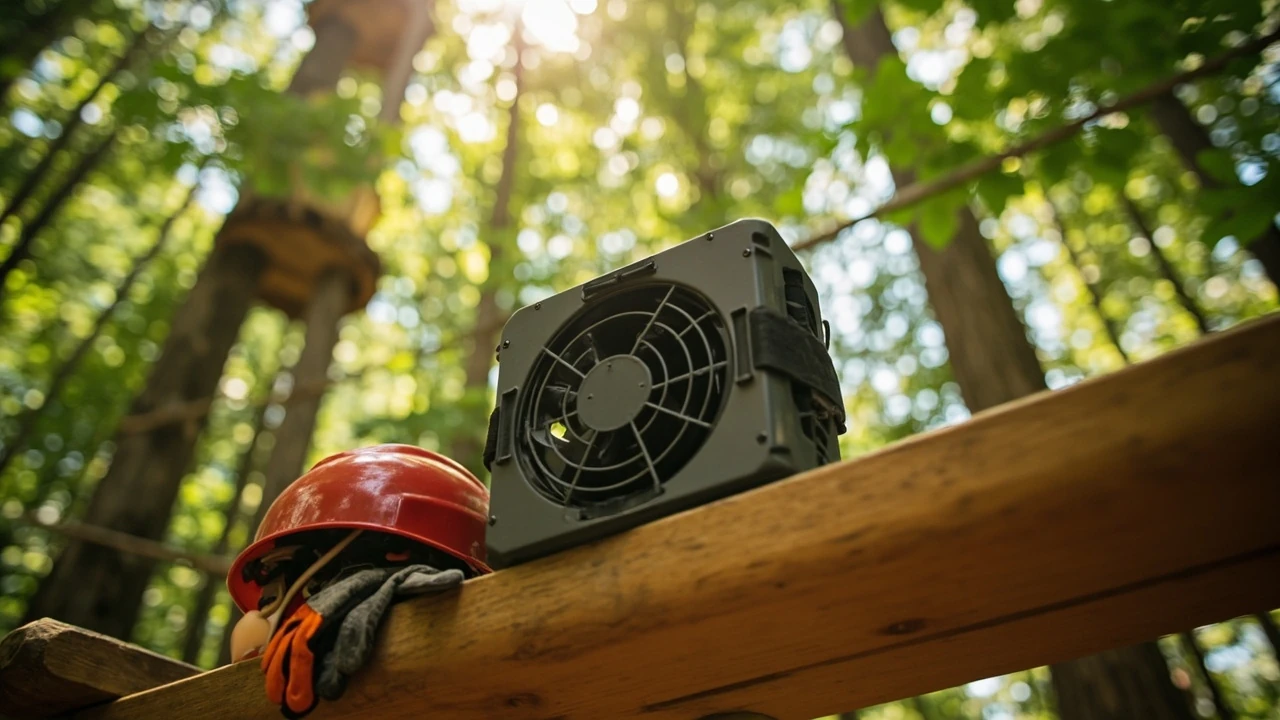
Outdoor fan guide: how to stay cool at adventure parks and on the trail
A summer rope course, a long zip line queue, or a forested trail on a still afternoon can feel ten degrees warmer than the forecast promises. The right outdoor fan turns those sticky, slow-moving moments into something you can actually enjoy, and the wrong one ends up dead in a backpack by lunchtime. This guide focuses on portable fans that hold up around adventure parks, picnic areas, and trail rest stops, where dust, sweat, and a wobbly table are the rule rather than the exception.
An outdoor fan for this kind of day has to do four things at once: move enough air to feel useful, survive bumps and dust, run long enough between charges to cover a full activity day, and stay stable when placed on a wooden deck, a picnic table, or a car seat. Those constraints shape the buying decisions below, from blade type to battery capacity to IP rating. If you already own a desk fan, the comparison in the first table will help you see which features actually transfer outdoors and which do not.
What counts as an outdoor fan
The phrase outdoor fan covers a wide range of products. A clear definition helps separate the useful tools from the patio decorations that look similar but do not perform.
An outdoor fan, in the practical sense used on this site, is a portable electric fan built to operate in non-conditioned environments. It may be battery powered, USB powered, or plugged into a 12 V or 230 V outlet, and it is usually small enough to carry in a backpack or clip to a belt. Patio ceiling fans and whole-home outdoor ceiling fans are a different product category aimed at permanent installation, and the buying logic for them is not what adventure visitors need.
For adventure park and trail use, the working definition narrows further:
- portable enough to fit in a daypack or clip to a harness strap
- powered independently from mains power for at least a few hours
- resistant to dust, light splashes, and the occasional drop from a low table
- stable on uneven surfaces such as wooden platforms, grass, and stone benches
Where a portable outdoor fan actually helps
Before listing features, it helps to picture the moments when air movement matters. Adventure days are not a uniform stream of activity. They have a specific rhythm, and a fan earns its place at the slow points.
At most rope parks, the hottest stretches are the ones that feel like nothing is happening: the belay lesson at the base, the queue for the next element, the picnic table after lunch when the group finally sits down. A small fan on the table or clipped to a bag is welcome there in a way that matters more than another sip of water.
Trail use follows a different pattern. Rest breaks at a viewpoint, a shaded lunch spot, or a long downhill section on a hot day all benefit from a few minutes of moving air. A fan in the car park after a hike is also useful, especially if you have a long drive home and do not want to start the journey soaked in sweat.
Other situations where a portable outdoor fan earns its weight:
- spectator seating at an outdoor event, especially standing crowds in summer
- camping evenings when the temperature stays high after sunset
- small market stalls, food trucks, and volunteer tents that need personal cooling
- photography sessions on still, humid days when the photographer needs to stay functional
Types of portable outdoor fans
Not every fan handles the same job. The table below compares the main formats you will see in outdoor gear shops and online marketplaces, with a focus on how each behaves in an adventure park setting.
| Fan type | Typical power source | Airflow at 1 m | Best fit | Main limitation |
|---|---|---|---|---|
| Handheld mini fan | Rechargeable 2,000-4,000 mAh | Low to medium | Queue lines, short breaks | Battery life under 4 hours on high |
| Clip-on personal fan | USB or built-in battery | Medium | Strollers, harnesses, backpack straps | Clip can slip on smooth webbing |
| Tabletop desk-style fan | USB-C, 12 V, or mains | Medium to high | Picnic tables, rest shelters | Larger size in a daypack |
| Pedestal tower fan (portable) | Mains, sometimes battery | High | Campsite shade tents, small group areas | Heavy, usually needs mains |
| Misting fan | Mains, 12 V pump, or large battery | High plus droplets | Dry climates, very hot days | Needs a water reservoir and more care |
| Solar-assisted fan | Solar panel plus small battery | Low to medium | Long days in direct sun | Output drops in cloud or shade |
The formats that come up most often at an adventure park are the handheld, clip-on, and tabletop styles. A pedestal tower fan only makes sense if you are running a small event shelter; a misting fan is more relevant on dry, hot trails than in a humid forest. The buying advice below focuses mostly on the first three, because that is what fits a normal visitor’s day.
Airflow, noise, and what actually feels cool
Cooling from a fan is not the same as the temperature of the air. The body responds to the rate at which heat and moisture are removed from the skin, which is why a small but well-placed fan can feel more effective than a larger one pointed the wrong way.
Two technical numbers matter for outdoor use. CFM, or cubic feet per minute, is the volume of air the fan moves. Sound level, measured in decibels, tells you how intrusive the fan will be in a quiet forest or a conversation at a table.
| Use case | Useful airflow | Comfortable sound level | Notes |
|---|---|---|---|
| Personal cooling at a queue | 40-90 CFM | Up to about 45 dB | Directional airflow is enough |
| Picnic table with two to four people | 120-250 CFM | Up to about 50 dB | Wider spread, stable base |
| Small shelter or group of six | 300 CFM and up | Up to about 55 dB | Often mains or dual battery |
| Quiet photography session | 30-60 CFM | Below about 35 dB | Lowest speed setting only |
A noisy fan in a quiet pine forest is more annoying than no fan at all. If the destination is a peaceful place, look for a model that keeps its lowest setting at or under about 35 dB and lets you step up only when needed. Most modern brushless DC motor fans do this well. For a busy rope park with music playing and groups cheering, that constraint is much less important.
Power and battery expectations
Battery life is the single most common reason people feel let down by a portable outdoor fan. Manufacturers tend to publish run times on the lowest setting with a fully charged, new battery, in a cool room. Real life on a hot day with the fan on medium is shorter, sometimes by half. Plan for that gap.
For a typical adventure park day, count on a fan running in short bursts at medium power rather than continuous use at full power. A 4,000 mAh battery at medium speed usually covers a full day if you switch the fan off during climbs and turn it back on at the platform or bench. A 2,000 mAh battery rarely does.
Useful ways to extend runtime on a single charge:
- turn the fan off during movement and switch it on at rest stops
- use the lowest setting that still feels effective, then step up only on still afternoons
- keep the battery out of direct sun, because high cell temperature shortens runtime
- carry a small USB-C power bank sized to the fan, and treat it as a backup rather than the primary source
Charging time matters as well. A fan that takes six hours to charge is awkward if you only have an evening at home between two activity days. A USB-C input that supports standard phone chargers is the most flexible option, because you can use the same cable and charger for a phone, a headlamp, and the fan.
Durability, water resistance, and dust
An outdoor fan has to survive more than a desk fan. The air at a forest adventure park carries pollen, fine dust from wood-chipped paths, and occasional drizzle. The fan may slide off a wooden bench, get splashed at a picnic table, or sit in a hot car between events. Look for these features in order of importance.
- A solid base or a clip that grips the surface it is meant for. A flat rubber foot stays put on a wooden deck; a wide clip holds a stroller frame better than a backpack strap.
- An IP rating, which is the international code for dust and water resistance. An outdoor fan rated IPX4 resists splashes from any direction. IP5X or higher means dust is unlikely to reach the motor. A fan with no rating can still work, but you will need to be more careful with it.
- Drop resistance expressed in metres or a stated drop test. Small fans are often rated for one to one and a half metres onto hard ground, which matches a low table or a car seat.
- UV-stable plastics for the housing, because a white shell left in the sun for a season can turn brittle and discoloured on cheaper models.
Brushless motors, increasingly common in this category, handle dust and small bumps better than older brushed designs, and they tend to be quieter at the same airflow. The fan does not need to be rugged in a military sense, but it should not feel fragile when you pick it up with sandy hands after a long day.
Features worth paying for and features to skip
Marketing for portable fans often lists long feature lists that do not change the user experience. A few features really matter in an outdoor setting, and a few are almost always noise.
Features that earn their place on a fan for adventure days:
- multiple speed settings, because the gap between low and high is large on a hot afternoon
- a removable, washable grille, which keeps dust from clogging the blades
- a stable base or a wide clip, which prevents the fan from being knocked over
- USB-C charging that accepts common phone chargers
- a battery level indicator, even a simple three-LED design
Features that look good in a listing but rarely matter outdoors:
- RGB lighting or colour-changing effects, which only drain the battery
- Bluetooth speakers, which add weight and rarely match a real portable speaker
- app control, because you do not want to unlock a phone to change a fan setting
- integrated power banks large enough to charge a phone, which usually means a heavier fan with shorter cooling time
How to place and use a portable outdoor fan
How you set up a small fan changes how well it works. A few placement habits cover most situations at an adventure park, on a trail, or at an outdoor event.
Keep the fan at roughly face height when you are seated. This sounds obvious, but many people set a fan on a low bench and then lean forward to feel the air, which moves the airstream away from the face and neck. Raising the fan on a small stuff sack, a folded jacket, or a car cup holder mount solves the problem in seconds.
Aim the airflow at the neck, the inner wrist, or the back of the knees. These areas have a lot of surface blood flow and respond strongly to evaporative cooling. A fan pointed at the chest helps less than a fan angled at the side of the neck on a still afternoon.
For groups at a picnic table, set the fan at one end and let the moving air create a slow cross-breeze rather than aiming it at one person. People at the far end still feel a useful effect, and the conversation is easier when the fan is not blowing directly across the table.
Useful placement checklist:
- face height when seated
- stable surface, with a non-slip foot or a small cloth under the base
- shade for the body of the fan to keep the battery cool
- a clear path for the intake grille, so the fan does not pull in dust from the ground
- one metre of clear space in front of the fan for the airstream to develop
Safety and etiquette around adventure parks
Most adventure parks ask visitors to keep loose items secured on the course, including on belay lessons and high ropes elements. A handheld fan in a pocket is fine, but a tabletop fan has to stay at the base area, on a bench, or in a car. Climbing with a fan is not a real option, and trying to clip one to a harness adds snag risk that operators do not want to manage.
It is also worth being considerate of other visitors. A fan pointed across a packed queue is not pleasant for the people behind you, and a noisy fan under a forest canopy can disrupt the quiet atmosphere a park is trying to maintain. If you plan to use a fan in a shared area, set it to the lowest speed that feels useful and aim it at yourself rather than at the group.
Simple etiquette points to keep in mind:
- keep fans out of active climbing and zip line areas
- do not block walkways or platform edges with a fan on the ground
- avoid aiming strong airflow at other visitors in a queue
- switch the fan off when an instructor is talking, so briefings remain audible
Care, cleaning, and storage between seasons
A small amount of care extends the life of a portable fan a lot. Dust is the most common cause of reduced airflow and extra noise. The grilles on most models are designed to be removed with a simple twist or a small screwdriver. A soft brush, a dry cloth, and a little patience are usually enough.
If the fan has been near water, dry it before charging. Lithium batteries and moisture do not mix well, and a damp USB-C port is a common cause of charging failure. A quick wipe and ten minutes in moving air is enough in most cases.
Long-term storage checklist:
- charge the battery to roughly 40-60 percent, which is the healthiest storage level for lithium cells
- store the fan in a dry place at room temperature, away from direct sun
- remove the fan from a hot car, because cabin temperatures in summer shorten battery life
- check the grille and the blade for dust before packing the fan away for the season
How an outdoor fan fits into a wider comfort kit
An outdoor fan works best as part of a small comfort kit rather than a single hero item. On a hot day, the fan is most useful when paired with a wide-brim hat, a damp neck cloth, a refillable water bottle, and a shaded rest plan. The right combination lets you stay on a high ropes course or a long trail for longer than you could with any one tool alone.
If you are planning a longer visit to a forest park, the One-Day Forest Escape Planner walks through how to structure a hot day in the woods, including rest stops and water timing. For visitors who want to compare travel options to a park, the practical Train or Car for an Outdoor Day Trip piece covers how different transport choices affect what you can carry, including a fan and a power bank.
Outdoor fan vs. misting bottle vs. neck cooler
Many visitors use a squeeze misting bottle, a phase-change neck cooler, or a damp bandana instead of a fan. Each tool works in a different way, and the right pick depends on the day.
| Tool | How it cools | Best conditions | Main limit |
|---|---|---|---|
| Portable outdoor fan | Air movement over skin | Humid or still days | Needs charge and a stable spot |
| Squeeze misting bottle | Evaporation from the skin | Dry, breezy days | Limited water supply |
| Phase-change neck cooler | Conduction from a cold pack | Short, very hot blocks | Activates only when cold |
| Damp cotton bandana | Evaporation plus slight conduction | Long, low-intensity days | Stops cooling once dry |
| Handheld paper fan | Brief burst of moving air | Short queues | Needs one hand to use |
For most adventure park days, a small fan plus a refillable water bottle covers the cooling need. On dry, breezy trails, a misting bottle is often the better tool. A neck cooler works for short, intense blocks such as the first hour of a high ropes course, when the body has not yet adapted to the heat.
What to check before you buy
A short checklist helps compare models in a shop or on a listing page. Run through these points before you commit.
- battery size and the manufacturer’s stated runtime at medium speed, not just the maximum figure
- USB-C charging that works with a standard phone charger
- an IP rating, ideally IPX4 or better for splash resistance
- stable base or a clip that suits the surface you will use most
- noise level at the lowest speed, in decibels if the listing states it
- removable grille for cleaning, plus spare parts availability from the manufacturer
- warranty length and what it covers, especially for the battery
If a model is missing two or more of these points, it is usually worth paying a little more for one that has them. The difference in price is small, and the difference in frustration on a hot day is large.
Common mistakes when choosing an outdoor fan
Most disappointing purchases come from a small set of recurring mistakes. None of them is hard to avoid once they are visible.
- chasing the highest CFM number, which usually means a louder fan and a shorter battery life
- trusting maximum runtime figures without checking the speed they refer to
- picking a fan with no IP rating for an outdoor setting, then being surprised when a light shower ends it
- buying a clip-on fan for a wide wooden bench, where a small base model works much better
- leaving a fan in a hot car between events, which shortens the battery over a single summer
Avoiding these mistakes costs nothing and saves you from buying a second fan the following year.
Frequently asked questions
How long does a portable outdoor fan usually run on a full charge?
Run time varies widely by model and speed. A typical 4,000 mAh handheld fan runs for about six to ten hours on the lowest setting and roughly two to four hours on the highest setting. Tabletop fans with larger batteries can run for an entire day at low to medium speed. Always check the rated runtime at the speed you actually plan to use, because the maximum figure on the box is almost always measured at the lowest speed.
Can I leave a portable outdoor fan outside in the sun?
Brief exposure is fine, but leaving a fan in direct sun for hours shortens the battery life and can soften the plastic housing. The best practice is to keep the fan in shade, even if that means placing it under a jacket or a small bag on a sunny picnic table. If the fan has just been in the sun, let it cool down before charging, because hot batteries charge more slowly and age faster.
Are outdoor fans safe to use near children?
Most modern portable fans are safe to use around children when placed on a stable surface out of reach. The blade grilles are small enough that fingers do not reach the blades, and the motors are low voltage. The main precaution is to keep the fan on a surface where it cannot be pulled down by a cable, and to keep the USB-C cable itself tidy so there is no trip hazard in busy areas such as base camps and rest shelters.
Do outdoor fans help with insects?
A small fan creates enough moving air to discourage weak fliers such as small flies and gnats, which struggle to hover in a steady breeze. Stronger insects such as wasps and horseflies are less affected. A fan is a useful complement to repellent in a forest, but it is not a replacement for it on a long summer evening.
What is the difference between a battery fan and a USB fan?
A battery fan has its own rechargeable cell and can run without being plugged in. A USB fan draws power from another source, such as a power bank, a car socket, or a solar panel. Many modern fans combine both, with a built-in battery that can also be topped up through a USB-C cable. For adventure park use, a combined model gives the most flexibility, because you can run it from a power bank on a long day and from the battery during short breaks.
Is a misting fan worth the extra weight?
A misting fan is worth the extra weight in dry climates where evaporative cooling is efficient, especially on hot, breezeless days. In humid forest conditions, misting adds water to the air that the skin cannot evaporate easily, which can actually make the user feel warmer. For most European forest adventure parks, a plain fan is a better pick than a misting fan.
How do I clean a portable outdoor fan?
Switch the fan off and, if possible, remove the front grille by twisting it counter-clockwise or by undoing a small screw. Use a soft brush to remove dust from the blades and the inside of the housing, and a dry cloth to wipe the outside. Do not spray water into the motor. Reassemble the grille and run the fan on high for a minute to clear any remaining dust before packing it away.
Can I take a portable fan on a zip line or a high ropes course?
Operators generally ask visitors to keep loose items secured or left at the base. A small handheld fan in a zipped pocket is usually fine, but anything larger is not safe on a harness or in a helmet. The best practice is to leave the fan at the rest area, on a picnic table, or in a car, and pick it up again when you return to the ground.
What is the best way to store a portable fan in winter?
Clean the grille, dry the housing, and charge the battery to roughly 40 to 60 percent. Store the fan in a dry place at room temperature, away from direct sun and from any heat source such as a radiator. Check the battery once during the off-season and top it up gently if it has dropped below about 20 percent. A battery stored in this state keeps most of its capacity for two to three years.
Are outdoor fans allowed in every adventure park?
Most parks allow personal fans at the base area, on picnic tables, and inside rest shelters. A few parks ask visitors to keep all personal electronics off the active course and in marked storage areas for safety reasons. It is worth checking the specific park’s visitor information before bringing a fan, especially if the fan is larger than a small handheld model.
A practical last thought
An outdoor fan is a small item, but on a hot day at a rope park, a trailhead, or an outdoor event, it changes the way the day feels. The best choice is rarely the most powerful one. It is the fan that matches the way you actually spend your day, that charges from the cables you already carry, and that still works on the third afternoon of a long summer trip. Once those boxes are ticked, the rest of the comfort kit, the water bottle, the hat, the shaded rest plan, falls into place around it.
Related reading
Explore High Ropes Adventure
Trip tools
Essential adventure planning guides
Use these practical guides to compare rope park activities, prepare for a first high ropes day, check a booking, choose suitable footwear and contact the editorial team. Each page links to the relevant live tools and current planning sections.
Latest articles
- How to find national parks near me: a practical local search guide
- Paylater travel: how buy now, pay later works for trip bookings
- Bagsmart Blast Travel Backpack: A Practical Review for Day Trips and Adventure Days
- How to choose an outdoor rocking chair that actually lasts
- Indiana travel advisory map: how to read it before a day trip
- How to plan an outdoor day around a concert stop: a cardi b tickets field guide
- Outdoor sectional sofas: a practical buyer’s guide for patio living
- How amusement parks actually work: rides, safety, and what to expect
- Beis Travel: What the Bag Brand Offers for Outdoor Days
- Adventure park: what it is, what to expect, and how to plan a visit