Outdoor table guide: choosing, placing, and using one well
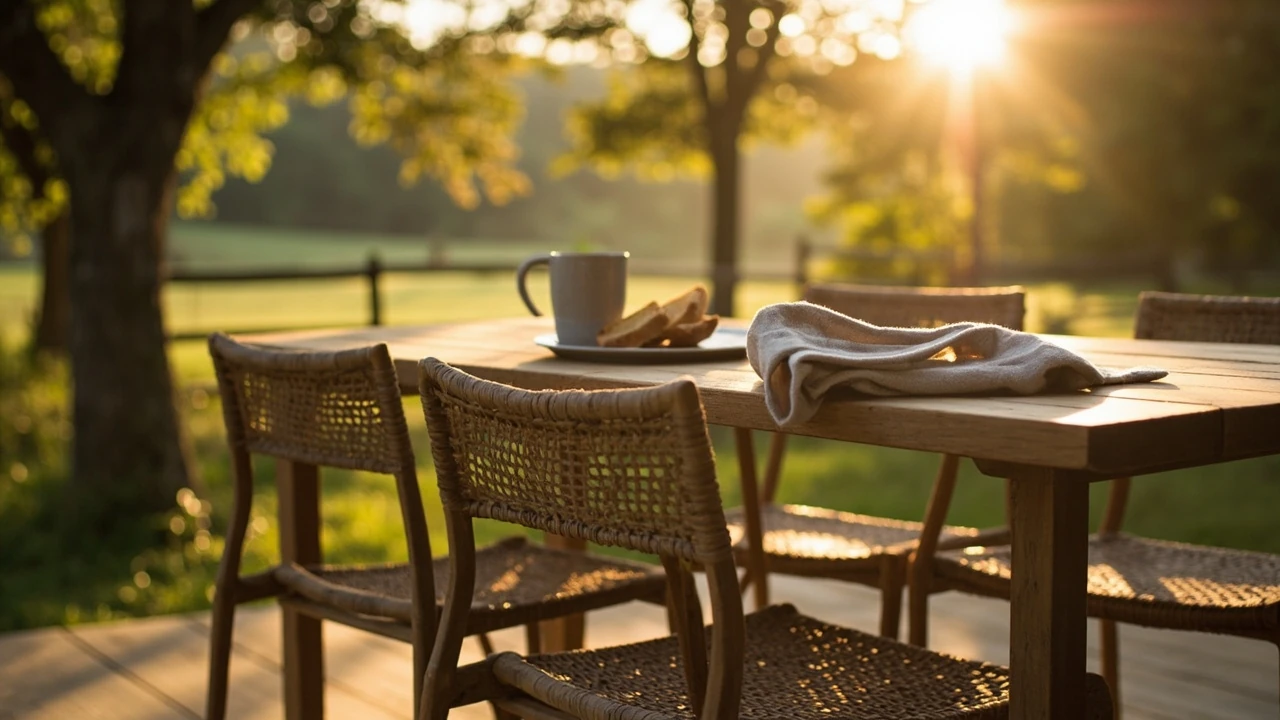
Outdoor table guide: choosing, placing, and using one well
A round wooden outdoor table under a pergola, a folding plastic one carried to a trailhead, a long teak family table under a string of bulbs on a lawn. The shape, material, and size of an outdoor table quietly shape how a garden, patio, deck, or event space actually gets used. Get the choice right and the table becomes a place where coffee, planning, card games, and after-dinner conversations happen without thinking. Get it wrong and it becomes the piece of furniture you keep walking past.
This guide is built around one practical question: how do you pick an outdoor table that fits the space you have, the way you use it, and the weather it has to survive. It draws on what outdoor hospitality venues, event planners, parks departments, and home gardeners have learned about materials, sizing, placement, and care. The aim is to help you decide with confidence, whether you are buying your first patio table or replacing a tired one that has finally warped, rusted, or faded beyond saving.
Why the right outdoor table changes how a space is used
An outdoor table is a stage as much as a piece of furniture. The height of the surface, the amount of shade covering it, the distance from the kitchen or grill, and the number of seats around it decide whether the space becomes a quiet reading nook, an active dining room, or a staging point for events. Many underused patios share the same problem: a table that is the wrong scale for the room and the wrong material for the climate, with no clear purpose attached to it.
Think of the table as the centre of a small system rather than a single purchase. The chairs must match the surface height, the umbrella or pergola must cover the right footprint, and the floor beneath it has to drain and clean easily. A table that looks beautiful in a showroom can quickly become a problem if the legs trap water on a wooden deck, if the top stains the first time a glass of red wine tips over, or if the chairs are too wide to push in fully when the table is not in use.
Working through the decision step by step is faster than improvising. The rest of this guide walks through the practical checks: where the table will sit, how many people it needs to seat, which material fits the climate, how to anchor it against wind, and how to keep it serviceable year after year.
Start with where the outdoor table will live
Before looking at styles, decide where the table will actually sit. Outdoor rooms behave very differently from indoor ones, and a table that thrives on a covered veranda may fail on a windy balcony. Walk the space, ideally at the times of day you expect to use the table, and look at four things.
- Sun and shade. A table that sits in full summer sun from noon to 4 pm needs an umbrella, a pergola, or a retractable canopy. A table under mature trees gets leaf litter and sap, which changes the cleaning routine.
- Wind exposure. Open rooftops, coastal sites, and exposed gardens funnel wind across the table. Light aluminium frames are easy to move but blow over; heavy timber or concrete tables stay put but are hard to reposition.
- Surface beneath. Decking, paving, gravel, and grass each demand different leg shapes. Wide feet spread weight on soft ground; narrow feet catch between deck boards; small wheels only work on hard, even surfaces.
- Access to power and water. A table near a kitchen or grill shortens the path for plates and drinks. A table near a hose simplifies cleaning. A table that needs a long extension cord for a lamp or speaker is a future tripping hazard.
These four factors will narrow the material and style choice quickly. A table in a sheltered courtyard with overhead cover and a stone floor can be a delicate hardwood with thin legs. A table on a windy rooftop with soft pavers needs weight, low profile, and feet that will not mark the surface.
Sizing the table to the space and the group
The most common mistake is buying a table that is too large for the room. A table should leave at least 90 centimetres of clearance on every side where people sit, so chairs can pull back and people can walk past without squeezing. On a small patio, a 90-centimetre round table with two chairs often works better than a rectangular table that blocks the path to the lawn.
For dining, allow 60 centimetres of edge per person, plus 30 centimetres at each end of a rectangular table for serving space. A 180-centimetre rectangular table comfortably seats six; the same length in a more generous 200-centimetre version seats six with elbow room or eight in a squeeze. Round tables seat more people than people expect because there is no head, but everyone shares a single central space for dishes, which is limiting for big meals.
| Table shape and size | Comfortable seats | Best for | Minimum room around it |
|---|---|---|---|
| Round, 80 cm diameter | 2 | Balcony breakfast, bistro nook | 2.5 m circle |
| Round, 120 cm diameter | 4 | Small family meals, card games | 3.0 m circle |
| Round, 150 cm diameter | 5–6 | Generous dining, shared platters | 3.5 m circle |
| Rectangular, 140 × 80 cm | 4 | Compact patio, narrow terrace | 2.5 m by 2.5 m |
| Rectangular, 180 × 90 cm | 6 | Family dining, small group events | 2.8 m by 2.8 m |
| Rectangular, 240 × 100 cm | 8 | Larger gatherings, outdoor workspace | 3.2 m by 3.2 m |
| Square, 90 × 90 cm | 4 | Even small patios, all-purpose | 2.6 m square |
Standard dining height is 72 to 76 centimetres with a chair seat around 45 centimetres. Counter-height tables at 90 to 95 centimetres feel more like a bar and suit standing-and-sitting mixes at events, but they require taller chairs and are harder for young children to use. Low coffee-style tables at 40 to 45 centimetres work for lounges and reading corners, but they are not dining tables and frustrate anyone who expects a full meal.
Choosing a material that fits your climate
The material of an outdoor table is the single biggest factor in how it ages. Each has strengths and trade-offs, and the right choice depends on the local climate, how much maintenance you will actually do, and how the table will be used. A hospitality setting needs something that survives a hundred wet wipe-downs a week; a quiet home patio has more flexibility.
Hardwood: teak, eucalyptus, acacia
Teak remains the benchmark for outdoor timber. Its natural oils resist rot and insects, so a teak outdoor table left bare will slowly silver and last for decades with only a brush-down. Plantation eucalyptus and acacia are cheaper hardwoods that perform well when oiled each year but are more prone to surface checks and mildew if neglected. Hardwood suits covered patios, verandas, and gardens with seasonal use. It is heavy, so plan its final position before delivery.
Softwood: pine, cedar, spruce
Softwoods are lighter, cheaper, and often delivered pre-treated. Pine outdoor tables are common at casual venues because they look friendly and accept a wide range of finishes. They need more frequent sealing, and a softwood table left in heavy rain will not last as long as a hardwood one. Softwood is sensible for covered decks and short-term event use, and for anyone who wants to refinish the table every couple of years.
Metal: aluminium, steel, wrought iron
Powder-coated aluminium is the workhorse of outdoor furniture: light, rust-resistant, easy to move, and available in many colours. It suits family homes, cafes, and rental properties. Steel is stronger and can support thinner, more elegant tops, but it rusts if the coating is breached. Wrought iron is heavy, classic, and almost impossible to blow over, but it needs cushions to soften the seat and diligent care to prevent rust at the joints.
Plastic, resin, and recycled composite
Modern plastic and resin tables have moved well beyond the flimsy white patio sets of past decades. Resin-wicker, recycled composite, and glass-reinforced plastic can look surprisingly close to timber or rattan while being genuinely weatherproof. They are the easiest material to live with: hose them down, stack them in winter, and forget about oiling. They are the obvious choice for families with children, rental properties, and anyone who dreads maintenance.
Concrete, stone, and ceramic
Concrete and stone tables are heavy, permanent, and tolerant of almost any climate. They are popular in Mediterranean and desert settings where heat and sun would punish other materials. They are cold to the touch, slow to warm in spring, and can crack if a hard frost gets into a hairline. Ceramic tops on aluminium or steel frames are a lighter way to get the look, but they still chip if a heavy pan is dropped on an edge.
Glass, acrylic, and mixed tops
Glass and clear acrylic tops brighten small spaces and make a tight balcony feel less crowded. They show fingerprints, dust, and water marks more than any other material, so they suit covered areas where a quick wipe is easy. Toughened glass is essential outdoors; standard glass is a hazard if it ever breaks. Mixed-material tables, such as a slatted timber top on a metal frame, are common because they balance warmth with structural strength.
| Material | Climate fit | Maintenance | Typical weight | Best use |
|---|---|---|---|---|
| Teak hardwood | Wet, coastal, variable | Annual oil or leave bare | Heavy | Long-life family dining |
| Pine softwood | Mild, covered | Annual sealing | Medium | Casual home use, short-term events |
| Powder-coated aluminium | All climates | Wipe clean, touch up chips | Light | Family patios, rentals, cafes |
| Steel (powder-coated) | All except salty coast | Touch up coating | Medium | Slender modern designs |
| Wrought iron | All climates | Rust checks, repaint joints | Very heavy | Traditional gardens, windy sites |
| Resin / composite | All climates | Wash and forget | Light | Low-maintenance family use |
| Concrete / stone | Hot, dry, exposed | Seal every few years | Very heavy | Permanent installations |
| Glass / acrylic | Covered patios | Frequent wiping | Medium | Small balconies, sunrooms |
Stability, anchors, and wind
An outdoor table that moves when someone leans on it is annoying. One that blows across a deck in a storm is dangerous. Stability comes from three things: the weight of the table, the spread of the legs, and the way it is anchored.
As a rough rule, a dining table for four needs to weigh at least 15 kilograms to feel planted. Tables for six typically need 25 to 35 kilograms. Anything lighter should be on a covered patio or be paired with a weighted base or a sand-filled parasol that sits through the table’s central hole. For windy sites, look for tables with crossbars between the legs, wide-set feet, or threaded adjusters that let you level the table on uneven paving.
Anchoring a table permanently is only sensible in a fixed location, such as a restaurant terrace or a rooftop deck. A simple stainless eye bolt screwed into a decking joist, with a soft strap over the table leg, keeps the table in place without damaging the frame. For movable tables, a pair of weighted planter boxes at the head and foot of a rectangular table solves the same problem without drilling.
Shade, umbrellas, and overhead cover
Direct sun on a dining table for two hours in midsummer is uncomfortable for almost everyone. Shade is not optional in many climates; it is the difference between a table people use and a table they avoid. There are four practical ways to shade an outdoor table.
- A centre-post umbrella. Simple, cheap, and portable. Choose a base that matches the table size: at least 10 kilograms for a 2-metre umbrella, 20 kilograms for a 3-metre one. Make sure the table has a hole if you want the umbrella to sit through the middle.
- A cantilever umbrella. The pole sits to the side, leaving the tabletop fully clear. Excellent for rectangular tables where a centre post would get in the way of serving.
- A pergola or shade sail. A permanent structure that defines an outdoor room. Best built around a known table position rather than added later.
- Natural shade. Mature trees are wonderful in summer and problematic in spring leaf-fall. Choose a table finish that tolerates sap, or sweep daily during heavy drop.
A common oversight is the umbrella’s footprint. A 2.5-metre round umbrella shades a 90-centimetre round table well, but barely covers a 180-centimetre rectangular one. Measure the table along its longest axis, then add at least 60 centimetres of overhang on each side for useful shade.
Floor protection: feet, glides, and ground surfaces
The point where a table meets the ground is where most outdoor damage starts. Hard plastic feet scratch timber decks. Narrow metal feet sink into soft ground. Flat wooden feet trap water and leave black marks on paving. The fix is small, cheap, and often overlooked: replace or add the right glides.
- On timber decking. Use felt or rubber glides sized to spread the load. Replace them each season; worn glides are the leading cause of scratched decks.
- On stone or concrete paving. Use nylon or polyethylene sliders. They glide when the table needs to move and protect the surface from grit grinding in.
- On grass or gravel. Choose wide flat feet, pavers under each leg, or a purpose-built base plate. Sinking legs are unstable and dangerous.
- On a balcony. Check the building’s load rules before placing a heavy stone table. Use rubber pads to prevent marking waterproof membranes.
If the table will live under a covered patio on a level surface, a thin outdoor rug under the table does two jobs: it stops the legs from sliding and it visually anchors the setting. Make sure the rug is rated for outdoor use, or it will mildew the first time it gets wet.
Care routines that actually work
The difference between an outdoor table that looks good after ten years and one that looks tired after three is rarely the material. It is the routine. A short, regular habit is more effective than an annual rescue mission.
| Task | How often | What to do | Why it matters |
|---|---|---|---|
| Wipe the surface | Weekly | Mild soapy water, soft cloth, rinse | Removes pollen, bird droppings, sticky residues |
| Check fasteners | Monthly | Tighten bolts, inspect wood joints | Prevents wobble and lost hardware |
| Inspect glides | Monthly | Replace worn felt or nylon feet | Protects deck and floor surfaces |
| Deep clean timber | Twice a year | Soft brush, wood cleaner, rinse, dry | Stops mildew and grey weathering patches |
| Oil hardwood | Once a year | Teak or danish oil, thin coat, wipe back | Preserves colour, slows surface checking |
| Treat metal | Twice a year | Touch up chips, wax joints | Stops rust at vulnerable welds |
| Winter storage | Seasonal | Cover, store, or flip and tie down | Extends life of every material |
One useful habit is to keep a small cleaning kit next to the table: a soft brush, a microfibre cloth, a squeeze bottle of mild soap, and a dry towel. Five minutes after the last guest leaves is easier to maintain than a Saturday morning restoration, and it stops stains from setting.
Outdoor tables for events and group use
The decision changes when an outdoor table has to host a steady flow of groups rather than a household. Adventure parks, wedding venues, food markets, and festival grounds run on tables that can be set, used, broken down, and cleaned dozens of times in a season. A few rules apply across the board.
- Standardise heights. A venue with a mix of 70-centimetre and 75-centimetre tables creates an awkward experience for guests moving between them. Pick one height and stick to it.
- Choose rounded corners. Sharp corners on long rectangular tables are a liability in crowded spaces. Slightly rounded ends reduce injuries and damage.
- Plan for covers. Tablecloths slip on smooth surfaces. A table with a lip, a clip-on edge, or a textured top keeps linens in place during wind.
- Allow storage space. Folding or stackable tables save hours of labour each week. A small trolley or wall rack pays for itself within a season.
At busy venues, a 180-centimetre rectangular table seats six comfortably and ten in a casual standing mix, which makes it the most flexible single choice. A handful of round 150-centimetre tables can be combined for shared platters and separated for smaller groups. Pairing these two shapes covers almost any event layout.
Matching chairs to the table
A table is only as comfortable as its chairs. Outdoor chairs should match the seat height, allow shoulders to pass without bumping, and store without damage. Stackable chairs, folding chairs, and chairs that slide fully under the table are all worth a premium when space is tight.
Seat height should sit 25 to 30 centimetres below the table surface. Armrests add comfort but prevent the chair from sliding under the table, which matters on small patios. For family use, chairs that recline slightly are more comfortable over a long meal than perfectly upright ones; for short event use, upright stackable chairs are faster to clear.
For a covered patio used year-round, a pair of armchairs with deep seats makes the table into a reading corner. For a deck used for ten-minute coffees, a couple of lightweight folding chairs are enough. Trying to do both with the same chair usually leads to a compromise that does neither well.
Common mistakes when buying an outdoor table
Most regrets about an outdoor table are predictable. A short list of the issues that come up again and again helps avoid them.
- Buying by look, not by use. A beautiful timber table that seats two is useless for a family of five. Decide on the function before the finish.
- Ignoring the climate. A softwood table on a windswept coastal site will not last. Match the material to the weather, not the photo.
- Forgetting the umbrella hole. Some tables are sold without one, and retrofitting a hole is messy and weakens the top.
- Skipping the glides. The cheapest fix on this list, and the most overlooked.
- Underestimating weight. A heavy table is a two-person job. A light table is a windy-day problem. Pick deliberately.
- Skipping storage. A table that has nowhere to live in winter will age twice as fast. Plan where it goes before it arrives.
Working the table into the rest of the outdoor space
Once the table is in place, the space around it starts to make sense. A path from the kitchen, a bin within reach, a hook for a cloth, and a small tray for candles or a bug-repelling lantern all support how the table is used. A well-placed outdoor table pulls the rest of the garden or patio into shape; a poorly placed one leaves awkward gaps and dead corners.
Lighting is the easiest upgrade. A string of warm bulbs overhead turns a daytime dining table into an evening one. A small lantern on the table, a path light nearby, and a brighter light over the serving area are usually enough. Avoid lighting so bright that it washes out the sky and star-watching. If the area is part of a larger outdoor programme, the table can double as a briefing point, a gear-staging surface, or a coffee-and-debrief hub between activities.
For households that host regular gatherings, a second smaller table nearby is useful. It acts as a serving station, a children’s table, or a sideboard. A pair of nesting tables that tuck under the main table is a tidy way to add this flexibility without taking up more space.
Special considerations for parks, courses, and shared outdoor spaces
Shared outdoor spaces such as adventure parks, high ropes courses, and trail hubs often need an outdoor table that is genuinely tough. Visitors arrive with wet shoes, muddy boots, snacks, and clipboards. The table has to be a workstation, a picnic surface, and a wet-weather shelter base. Two practical points help.
First, a surface that wipes clean in seconds is more valuable than a beautiful one. Powder-coated aluminium, resin, or sealed composite tops win on this point. Second, fixed tables with anchor points are easier to manage in busy settings than movable ones, which tend to drift and need collecting. A row of fixed tables under a simple timber shelter handles the steady traffic of a high ropes course much better than a collection of folding tables stored in a shed.
Operators planning a shared outdoor area often find that a covered table with benches is the most efficient single unit. It seats more people, it cannot be rearranged into a hazard, and it provides a place for bags, helmets, and water bottles. If the table is also used as a briefing surface, choosing one that is slightly higher than dining height makes it more comfortable to stand at while writing or drawing route plans.
Budgeting honestly for the table and its care
An outdoor table is not just the purchase price. The lifetime cost includes covers, oil, replacement glides, and eventually a refinish or replacement. A useful way to set a budget is to estimate the cost per year of useful life, then choose the table that gives the best ratio for the climate.
| Material tier | Typical purchase band | Expected useful life | Annual care cost (approx.) |
|---|---|---|---|
| Budget resin / plastic | Low | 4–6 years | Negligible |
| Softwood, treated | Low to medium | 5–8 years | Low (annual seal) |
| Powder-coated aluminium | Medium | 10–15 years | Low (occasional touch-up) |
| Hardwood (eucalyptus, acacia) | Medium to high | 10–20 years | Low to medium (annual oil) |
| Teak | High | 20+ years | Low (oil) or none if left bare |
| Steel / wrought iron | Medium to high | 15–25 years | Medium (rust control) |
| Concrete / stone | High | 20+ years | Low (occasional seal) |
For most homes, a mid-priced powder-coated aluminium or quality hardwood table hits the best balance. For rental properties and shared spaces, resin or aluminium wins on life-cost grounds. For a permanent family table under a covered patio, teak remains a sensible long-term investment.
A short checklist before you commit
Before placing an order, run through this last set of questions. They take a few minutes and they usually catch the detail that would otherwise turn into a regret.
- Have you measured the space and checked clearance on every side?
- Does the table match the local climate, not just the look you want?
- Is the height right for the chairs you already have or plan to buy?
- Is there a parasol hole, and does it line up with your shade plan?
- Are the feet and glides suitable for the surface beneath?
- Is there a clear plan for winter storage or protection?
- Do the table and chairs move and store together without damage?
If the answer to each is yes, the table will quietly do its job for many years. If one of them is a guess, it is worth pausing. A short delay now usually saves a much longer headache later.
Frequently asked questions
What is the best material for an outdoor table that stays outside year-round?
Powder-coated aluminium, quality resin, and teak are the most reliable choices for year-round outdoor use. Aluminium is light, rust-resistant, and easy to move. Resin and composite tables tolerate rain, sun, and cold with almost no maintenance. Teak is the classic long-life option: it can be oiled annually to keep its warm colour or left bare to weather to a silver-grey, and it resists rot because of its natural oils.
How do I keep an outdoor table from blowing over?
Three approaches work. Add weight through a parasol base, sandbags, or a planter at each end of the table. Anchor the table to a fixed point with a strap and a stainless eye bolt on a deck or paving. Or choose a heavier table from the start, such as a concrete, stone, or hardwood design with wide-set legs. Light aluminium tables in exposed locations need at least one of these measures.
What size outdoor table do I need for six people?
A rectangular table around 180 centimetres long and 90 centimetres wide seats six comfortably, with 60 centimetres of edge per person. A round table of about 150 centimetres diameter also seats six, with the bonus that everyone can see each other but the limitation of a single central serving area. Always allow at least 90 centimetres of clearance behind each chair for people to move around.
Do outdoor tables need to be covered in winter?
Yes, a breathable cover extends the life of almost any outdoor table. Covers keep ice, snow, leaf litter, and bird droppings off the surface, and they reduce the number of freeze-thaw cycles the top has to endure. Use a cover with vents so moisture can escape; a sealed plastic cover traps condensation and can cause more damage than no cover at all.
Can a wooden outdoor table be left in the rain?
Hardwoods like teak handle rain well; softwoods like pine handle it less well. The real enemy is constant wet-dry cycling, which opens grain and lifts finishes. A covered position, good drainage under the legs, and an annual oil or sealant on softwoods go a long way. Standing water on the surface should be wiped off when practical, especially before frost.
How do I clean an outdoor table without damaging it?
Use warm water, a mild dish soap, and a soft cloth for routine cleaning. Avoid bleach, harsh solvents, and pressure washers on wood and powder-coated metal, because they can strip finishes and drive water into joints. For mildew, a dilute vinegar solution or a dedicated outdoor furniture cleaner is safer. Rinse with clean water and let the table dry fully before covering or storing.
What is the difference between patio tables and garden tables?
The terms overlap and are used interchangeably by most retailers. Patio tables are usually associated with a hard, level surface next to the house, such as a stone or decked area, while garden tables are often placed on lawns, gravel, or mixed surfaces and may need wider feet or ground anchors. In practice, the distinction is about the surface beneath the table, not about a different kind of furniture.
Are folding outdoor tables sturdy enough for regular use?
Modern folding outdoor tables with aluminium frames and slatted tops are sturdy enough for daily use, provided the locking mechanism is engaged and the feet are level. They are particularly useful where the table is stored between uses, such as in a small courtyard, a shared park, or a setting where one space has to serve many roles. For permanent dining, a fixed table usually feels more solid and lasts longer, but a good folding table is no longer a compromise.
How do I stop my outdoor table from staining?
Use coasters under drinks, placemats under plates, and a trivet under hot pans. Wipe spills within a few minutes rather than letting them sit overnight. For porous surfaces such as raw timber, terracotta, or concrete, an annual sealant creates a barrier that buys time. On tables that are used daily, a wipe-on wipe-off habit is more effective than any single deep clean.
Can I use an outdoor table as an indoor table?
Yes, an outdoor table works well indoors, especially in kitchens, conservatories, and busy family rooms where children or pets make accidents likely. The materials are designed to handle spills, so the table usually looks the same after a mishap that would ruin a delicate indoor piece. The only adjustment is usually the look: outdoor tables tend to have chunkier legs and more visible hardware, which suits rustic and casual interiors more than formal ones.
Related reading
Explore High Ropes Adventure
Trip tools
Essential adventure planning guides
Use these practical guides to compare rope park activities, prepare for a first high ropes day, check a booking, choose suitable footwear and contact the editorial team. Each page links to the relevant live tools and current planning sections.
Latest articles
- Travel clipart: where to find it and how to use it well
- Outdoor table guide: choosing, placing, and using one well
- Viator travel agent: how the booking platform actually works
- Sweet tart ropes: what the flavour means in a ropes course
- Demon Slayer movie tickets: how to find a screening and prepare for a day out
- How to choose NBA tickets without overpaying
- Time travel movies worth watching on a slow weekend
- Overseas adventure travel: how to plan a trip that actually works
- Choosing an outdoor bench that actually lasts
- Lows adventure: how low-ropes courses work and who they suit