Zipline age requirements: a practical guide for riders and parents
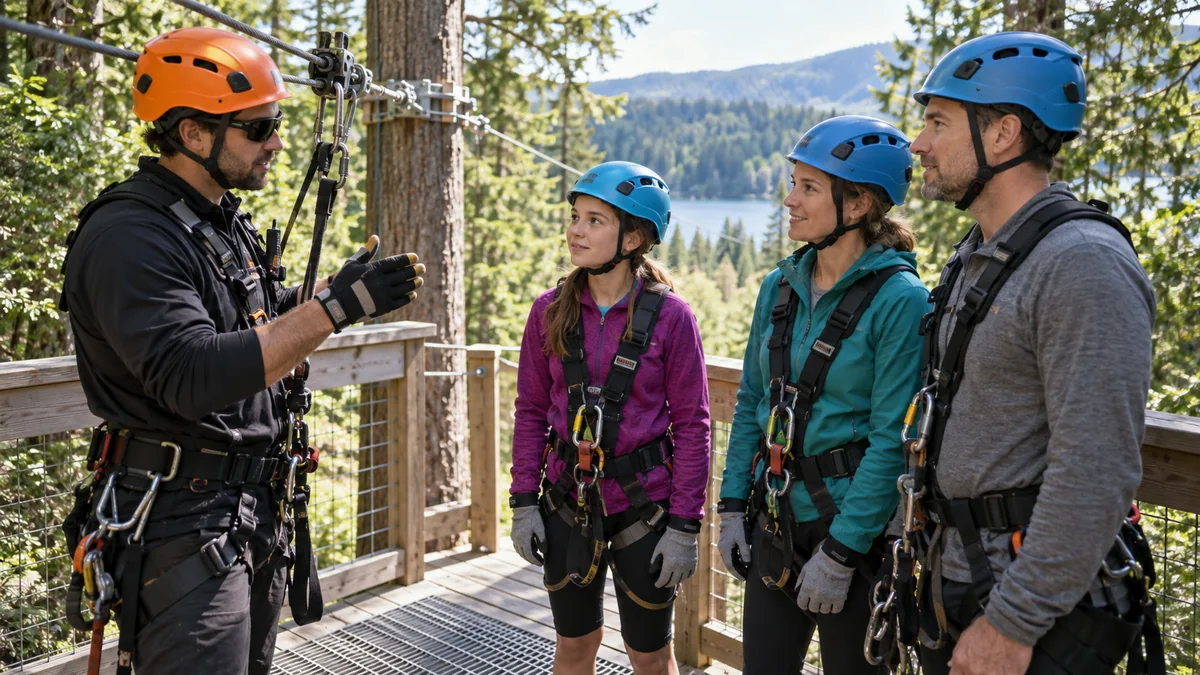
Zipline age requirements: how courses decide who can ride
A mother stands at a rope course check-in window with an eight-year-old who is tall for her age, while her five-year-old brother clings to her leg. The guide asks for heights and weights, glances at a printed chart on the wall, and then quietly says the older child can ride the beginner zipline, the younger one cannot. The same scene plays out at front desks across the country, and the rules that drive it are far less arbitrary than they look. Zipline age requirements sit at the intersection of harness engineering, course insurance, and operational judgment, and the way a course applies them depends on more than the year on a child’s birth certificate.
Most published zipline age rules look like a simple number, but in practice they are a stack of overlapping constraints. Operators blend a stated minimum age, a minimum weight, a maximum weight, a minimum height, a torso-length check for harness fit, and sometimes a behavioral or comfort threshold. This article walks through each of those layers, the reason behind them, and the practical questions parents, teens, group leaders, and first-time adult riders should ask before booking a session.
Why age alone is rarely the only rule
Age is the easiest number for a course to publish, which is why it usually leads the marketing copy. Behind the scenes, the equipment and the insurance carrier do not care how old a rider is. They care whether the rider’s body can sit safely inside a harness, whether the trolley and braking system can be operated or triggered by that rider, and whether the line was designed and tested for the resulting speed and weight.
Course operators group riders into categories that reflect harness geometry, not birthdays. A small harness from a major manufacturer is typically rated for riders between roughly 20 and 50 kilograms, with a torso length between about 35 and 60 centimeters. Those numbers translate into a height range of roughly 100 to 145 centimeters for children, depending on body proportions. A “minimum age of 6” line on a website is usually shorthand for “riders this young are statistically likely to fall inside the harness range,” with some operators building in a small buffer.
This is also why a course may turn away a tall, well-built eight-year-old’s friend who is only six but measures the same height. It is also why a 12-year-old who has not yet hit the weight floor may be told to wait a season. The published age is a starting point, not the answer.
How courses break riders into groups
Although every operator sets its own policy, most rope parks and zipline tours sort riders into a small number of practical buckets. Understanding the buckets makes it easier to predict what a course will ask of your child before you arrive.
- Toddler or pre-rider bucket, often under about 3 to 4 years. These children rarely ride at all and instead participate in ground-based activities.
- Junior or kid bucket, often around 5 to 8 years, paired with strict height and harness-fit checks. Junior ziplines are usually short, low, and slow lines built specifically for first-time riders.
- Youth or “junior plus” bucket, often around 9 to 13 years, on longer and higher lines, sometimes with tandem riding required for the smallest participants.
- Teen and adult bucket, often 14 and up, with weight and waist-size checks that matter more than age.
When a course only publishes a single age number, the safest assumption is that the operator has quietly merged two of these buckets. A booking page that says “ages 6 and up” often means junior lines for 6 to 9 year olds and full lines for everyone older, and the check-in staff will route riders accordingly.
The other measurements that matter as much as age
Parents who arrive prepared for a question about birthdays are often surprised when the guide reaches for a tape measure instead. Several physical measurements do more work than age when an operator decides who can ride, and the same measurements drive tandem rules for kids riding with an adult.
Weight floors and ceilings
Most zipline harnesses and trolleys are rated somewhere between roughly 18 and 120 kilograms. Below the floor, the rider can slide through the leg loops or the trolley brake will not engage properly. Above the ceiling, the dynamic load on the cable and anchors can exceed design limits. Operators usually publish these as a single combined range, but the check-in staff apply the same numbers regardless of how old the rider is.
Height and leg length
Zipline trolleys are mounted at a fixed height above the launch platform. Riders who are too short cannot reach the pulley, and riders whose legs dangle too far above the ground or water may not be able to adopt the proper landing posture. Many courses solve this with small step stools, but there is still a practical minimum for safe independent riding.
Torso length and harness fit
This is the measurement most riders have never heard of and the one operators care about most. Harnesses are designed to fit a specific chest-to-waist distance, and a rider whose torso is too short or too long can sit in a harness that does not load correctly. A well-fitted junior harness will keep a small rider upright and centered during a ride. A poorly fitted one will let the rider slide sideways or down through the leg loops, especially at the moment of braking.
Hand size and grip strength
For courses that use a hand-controlled braking lever, the rider’s hand has to be able to reach and pull the lever hard enough to engage the brake. Younger children’s hands often cannot generate the necessary force, which is why some operators require an adult tandem partner for kids under a certain age rather than running them on the line alone.
Behavioral and comfort thresholds
Age rules also cover situations that no harness can fix. A child who is asked to step off a 6-meter platform, lean forward, and trust an unfamiliar piece of equipment may freeze at the launch. Operators frequently reserve the right to refuse a rider who cannot follow the three launch commands in sequence, regardless of their measurements. This is a safety rule dressed up as a courtesy, and parents should treat it that way.
Typical age and size ranges at a glance
The table below summarizes common zipline age and size expectations across different course types. The numbers are typical ranges drawn from how many operators set their policies. They are not a substitute for the specific course’s own published rules, which always take priority.
| Course type | Typical minimum age | Typical height range | Typical weight range | Notes |
|---|---|---|---|---|
| Beginner or kids-only zipline | Around 4 to 6 | Approximately 100 to 140 cm | Approximately 18 to 60 kg | Often a separate short line; adult helper may be required for the smallest riders. |
| Junior or family zipline | Around 6 to 8 | Approximately 110 to 150 cm | Approximately 22 to 90 kg | Most common entry point for first-time families with mixed ages. |
| Full tour or multi-line course | Around 10 to 12 | Approximately 130 to 195 cm | Approximately 30 to 113 kg | Tighter gear ratios; some operators require a hand-test demonstration before riding. |
| High-speed or extended zipline | Around 12 to 14 | Approximately 140 to 200 cm | Approximately 40 to 120 kg | Higher braking force, longer ride, and harder landings favor larger, more experienced riders. |
| Tandem with adult | Varies, often as low as 3 to 4 | Driven by the adult’s measurements | Combined weight within harness range | Adult provides steering, braking, or both; child rides attached in front or behind. |
These numbers cluster around a few common denominators because the equipment does. A 25-kilogram rider, a 30-centimeter torso, and a 110-centimeter height tend to be the lower bound at which most off-the-shelf junior harnesses and trolley systems start to behave as their designers expected.
How operators actually check these rules
Checking happens in three places: at booking, at check-in, and on the platform. Each stage has a different purpose, and knowing the difference helps families avoid disappointment.
- Booking stage. Many online systems ask for an age or date of birth per rider. The system usually does not validate height or weight. It exists to keep an operator from over-promising a course they cannot deliver, and to flag obvious mismatches such as a toddler on a high-speed line.
- Check-in stage. A guide or front-desk staff member weighs or estimates weight, measures height, and visually checks harness fit. A small number of courses will refuse to let a child ride on this stage alone, even if the age is technically acceptable, because the harness does not fit.
- Platform stage. A second guide performs a final visual and verbal check just before the rider launches. This is the last gate before commitment, and it is the gate that catches the rider who passed the first two checks but is clearly not ready in the moment.
For parents, the practical takeaway is that a booking confirmation is a reservation, not a guarantee. The final decision is made by the guide at the platform, which is exactly how the system is designed to work.
Side-by-side comparison of course types
The second table puts the same data into a quick comparison. It is meant for families trying to choose between a beginner line, a family course, and a longer tour on the same day. The right answer depends less on which child is the bravest and more on which course matches the smallest rider in the group.
| If your child is… | Best fit | Why it tends to work | What to watch for |
|---|---|---|---|
| Under 5, first time on a course | Beginner or kids-only zipline | Low cable, short run, soft landing zone, and harnesses sized for small torsos | Some courses still require an adult rider on the line as a tandem partner |
| 5 to 8, mixed family day | Junior or family zipline | Most courses run one of these as the default entry point, with harnesses to fit both parents and children | Ask whether siblings above 12 will be rerouted to the full course mid-session |
| 9 to 13, ready for a longer ride | Full tour or multi-line course | Higher cables and longer runs match the harness range for this age band | Taller kids who are still under 35 kg may be measured off the course without a tandem option |
| 14 and up, no prior experience | Full tour or high-speed line | Standard adult harness range, predictable braking | Some operators run a short orientation lap on a practice line first |
| Adult outside the standard size range | Course with inclusive harness stock | Specialized harnesses, sometimes imported, fit a wider weight and torso range | Call ahead; not every course stocks them |
Reading the table top to bottom covers most of the common family scenarios. The exception is a group of mixed ages where the youngest rider sets the ceiling, in which case the right call is usually a junior course for everyone, not a private session on the full tour.
Special cases that change the answer
The equipment and layout described in the general zip line overview help explain why there is no universal age cutoff: cable length, speed, braking system, harness range, and rescue plan differ by course. Operator rules are the final authority. For example, the published Zipline Stoderzinken participation rules combine a minimum age with separate adult-accompaniment and consent requirements. A different course may use different numbers, so families should verify the actual operator’s rules before paying.
Younger children riding tandem with a parent
Tandem riding lets a course extend the minimum age well below the solo-riding threshold, sometimes down to 3 or 4 years old, because the adult partner carries the harness load and operates the brake. Tandem rules usually specify that the adult must be above a minimum weight as well, so the smaller child does not overwhelm the harness geometry. Parents should ask about tandem weight combinations when booking, especially if the adult is on the lighter side.
Teens who are tall but light
A 14-year-old who is 175 centimeters tall and weighs 40 kilograms will often meet the height rule but fall under the weight floor for some harnesses and trolley systems. The fix is usually a different harness model, not a refusal, but it can take a few extra minutes of fitting. Calling ahead lets the course have the right gear ready.
Adults who are outside the standard range
The same rules that protect small children protect very large adults. A rider above roughly 120 kilograms may not fit the standard harness geometry, and a rider below roughly 45 kilograms may not load the trolley brake correctly. Courses that advertise themselves as inclusive usually stock a wider harness range, and a phone call is the fastest way to confirm whether a specific rider can be accommodated.
Pregnant riders
Most operators, including reputable rope parks and zipline tour companies, decline to take visibly pregnant riders because the harness design was not tested for that use case. Each course sets its own threshold, often somewhere in the second trimester, but a few decline to ride at any stage of pregnancy. This rule is about the harness, not about whether ziplining is a personal choice.
Riders with casts, braces, or recent injuries
Plaster or fiberglass arm casts usually disqualify a rider because the harness and the braking system need both arms to be free and functional. Some courses can accommodate a wrist or hand brace, others cannot. Recent shoulder dislocations, spine injuries, or surgeries typically require written medical clearance, and a few courses decline those riders outright.
Group bookings with mixed ages
Group leaders organizing birthdays, school trips, or family reunions are often the people who feel the sharpest edge of these rules. A group that books a full tour may find that a few of its youngest members get routed to a separate junior line or stay on the ground. If your group needs everyone to participate on the same course, ask the operator about a private session where the rules can be matched to the group rather than to a published schedule.
How to prepare a child for a first zipline ride
Most refusals at the platform are not about measurements. They are about a child who freezes. Preparation does more than the harness chart to make a first ride go smoothly, and parents can do most of it at home the night before.
- Watch a video of the exact course. Most operators publish one. Watching it reduces the unknown at the platform.
- Practice the launch commands. Most launches are a three-step sequence: stand, sit, go. Repeating those words out loud a few times the night before removes a layer of surprise.
- Explain the brake. Children handle the unknown better when they understand the equipment. Tell them how the trolley stops and that the guide will catch them if anything looks wrong.
- Dress for the harness. Closed-toe shoes, hair tied back, no bulky jackets. Layers that can be removed at the platform work better than one heavy coat.
- Eat a small snack. A hungry, cold child is a tired, cold child at the platform. A small snack 30 minutes before the session keeps energy steady without making them queasy.
- Talk about nerves honestly. “It is okay to be scared” lands better than “There is nothing to be scared of.” Most guides prefer a child who admits they are nervous over one who says they are not.
These are the same things an adult first-time rider should consider, with the extra step of making sure a younger child has an adult partner at the platform who is calm and unhurried.
What to ask when you call or book
Five short questions cover most of what a course needs from you, and they also help you compare operators when you have more than one option. The phrasing below works for both a website booking form and a phone call.
- What is the minimum age for the course I am booking, and is there a separate minimum for a solo rider versus a tandem rider?
- What is the height, weight, and torso range the check-in staff actually measure?
- Do you have a junior or beginner line my younger child can ride while older siblings do the full course?
- What happens if my child shows up and does not meet the harness or weight criteria? Is there a refund, a reschedule, or a ground-based alternative?
- Are there any specific clothing, footwear, or jewelry rules I should know about before we arrive?
An operator that answers these clearly and without hesitation is almost always an operator that runs a tighter course. Vague answers are a signal to keep looking.
Common misconceptions about zipline age rules
A few patterns come up often enough to be worth naming. None of them are true in the way people repeat them, and each one is worth correcting before you book.
- “If my child meets the minimum age, they can ride.” Age is a starting point, not a guarantee. Height, weight, torso, and behavior all share the decision.
- “The course is the same for everyone, so the rules should be the same for everyone.” Courses often have multiple lines with different minimums, and the operator will route riders to the right one.
- “If a course does not list a minimum age, anyone can ride.” The default in the industry is to apply the harness and weight rules, and most courses will not put a small child on a line that exceeds the harness rating simply because no one wrote down an age number.
- “Bigger harnesses mean more freedom, not less.” A harness that is too large is a safety issue, not a convenience. Operators that take pride in their work will refuse a too-large fit rather than strap someone in and hope.
- “Age rules are a marketing choice, not a safety choice.” Most age rules are driven by the equipment, the insurance carrier, and the operator’s own experience. They are rarely arbitrary.
None of this means a parent should be afraid of the rules. It means the rules are doing their job when they sort riders honestly, and the families that understand how the system works tend to have the smoothest day.
What about indoor ziplines, ninja courses, and trampoline parks?
Ziplines attached to indoor venues, ninja warrior gyms, and trampoline parks follow the same physics, and the rules look similar on paper, with a few practical differences worth knowing.
- Harnesses are often simpler and sometimes replaced by a chest-and-shoulder sling on very short indoor lines. This changes the weight and torso calculation but not the basic logic.
- Behavior rules tend to be stricter because the courses are smaller and the lines are busier. A child who cannot follow a three-step launch sequence is more disruptive indoors than on a long outdoor line.
- Some indoor venues run a single zipline with a single harness, so the minimum age is essentially the harness minimum. There is no “junior line” to fall back on.
- Weight and height limits are often posted on a sign at the entrance rather than on the booking page, which is why a quick walk-by can save a long refund conversation.
If a child has outgrown an indoor venue’s zipline, an outdoor course with a dedicated junior line is usually the next step, and a useful first step before a full tour.
What the published rules do not say
Even when an operator publishes detailed age and size rules, a few things are usually left to the on-site guide. Knowing about them helps families avoid surprises and helps the guide do their job without awkward conversations.
- Children who are not within the stated size range will be measured at check-in. Estimations are not a substitute for measurements, and a guide who does not measure is not doing the job.
- Children with sensory, attention, or anxiety differences can ride, but a parent or guardian should be ready to stay on the platform and follow the guide’s direction. A pre-arrival call lets the course set expectations and pair the rider with a more patient guide if one is available.
- Riders who do not meet the size rules on the day can sometimes be moved to a different line, watch siblings ride, or join a ground-based activity instead. Operators that have built this alternative into their day are usually the better-run businesses.
- Refunds for riders who cannot ride depend on the operator’s policy. Some refund the unused portion, others credit a future visit, and a few do neither. The booking form is where this is decided, not the day of the visit.
The unspoken part of the system is that a guide is making a judgment about each rider every time. The job of the published rules is to make that judgment rare, not to make it disappear.
How to read a course’s published rules
Most course websites publish their rules in one of three places: a dedicated FAQ page, the booking flow, or a “what to expect” PDF. Each of those formats hides different things, and a quick read of all three gives a more complete picture.
- Look for the number that matters. The booking flow usually shows the minimum age for the specific session. The FAQ usually shows the more detailed height, weight, and harness rules. The PDF usually shows the rules the operator most wants to enforce.
- Look for the wording “may” and “must.” “May” usually means the operator is leaving room for a guide’s judgment. “Must” usually means the rule is non-negotiable. Both are useful, but in different ways.
- Look for exceptions. A course that publishes tandem rules, junior-line rules, and full-tour rules has clearly thought through how to handle mixed-age groups. A course that only lists a single set of rules may not have the equipment to handle yours.
- Look for the “what to wear” section. A course that explains footwear, hair, and jewelry in detail is usually a course that explains safety in detail too.
This kind of read takes a few minutes and saves an afternoon.
How courses and parents share responsibility
A clean, safe day on a zipline is the result of a small amount of work on each side. The course brings the equipment, the trained guides, and the published rules. The family brings accurate information at booking, a child who has been prepared for the launch, and a willingness to accept the guide’s decision at the platform. When either side skips a step, the day goes less well, and usually the rider pays the price.
If you are reading this as a parent, the simplest framework is: book with measurements, not birthdays, and arrive 15 minutes before the start time so the harness fitting is unhurried. If you are reading this as an operator, the simplest framework is: publish every number you actually check, and train your guides to use those numbers rather than to wing it.
Both sides, working from the same set of facts, tend to arrive at the same decision. The published zipline age requirements are a starting point for that conversation, not the end of it.
Frequently asked questions
What is the minimum age to ride a zipline?
Most courses set the minimum solo riding age between 6 and 8 years, with some junior lines accepting riders as young as 4 with a parent on a tandem setup. The number is driven by the harness, trolley, and braking system rather than by the rider’s birthday, so the height and weight rules at the same course will give a more accurate answer for your child.
Why do ziplines have a minimum age at all?
The minimum age is a proxy for a stack of physical and behavioral requirements the equipment actually cares about: harness fit, reach to the trolley, ability to operate the brake, and ability to follow the launch sequence. A child who is younger than the published age is statistically unlikely to meet all of those requirements, even though individual cases vary.
Can a 5-year-old ride a zipline?
On a dedicated junior or kids-only zipline, often yes, especially when riding tandem with a parent. On a full tour or multi-line course, the same child will often be too small for the harness and trolley. The right question to ask the course is whether they have a junior line that fits your child’s height and weight, not whether the child is “old enough.”
Can a teenager ride a zipline by themselves?
Most courses treat riders aged roughly 12 to 14 and up as independent riders, provided they meet the height and weight rules. A few courses require a parent signature or a hand-test demonstration for riders under 18. Calling ahead removes the guesswork.
What if my child meets the age but not the weight requirement?
It happens often, especially with tall, lean preteens. The course will usually try a different harness or a tandem setup, but if no equipment in their inventory fits, they will route your child to a junior line, an alternative activity, or ask you to come back another time. This is a fitting problem, not a safety judgment about your child.
Do zipline age requirements change by country or state?
Yes. Operators work within their local regulator’s framework, and the published numbers reflect the regulator, the equipment manufacturer, and the operator’s own insurance carrier. The age and size ranges described here reflect common practice across many North American and European courses, but the specific course you are booking is always the final authority.
Can a parent ride tandem with a small child?
Most courses offer tandem riding, but the rules are stricter than they look. The adult partner usually has to be above a minimum weight so the harness geometry works for both riders, and a few courses will not run tandoms on their longest or fastest lines. The booking call is the right place to ask about a specific adult and child combination.
What happens if a rider is refused at the platform?
The guide will explain which rule the rider does not meet, and the operator’s policy will determine what happens next. Some courses offer a partial refund or a credit for a future visit. Others offer a ground-based alternative for the rider while the rest of the group goes ahead. Reading the booking terms before paying is the simplest way to know which policy applies.
Are there medical conditions that change the age or size rules?
Yes. Pregnancy, recent surgery, certain heart and spine conditions, and some orthopedic injuries will lead a course to decline a rider regardless of age or size. A few courses accept written medical clearance from a doctor. The course’s own published medical list is the right place to start, and a phone call is the right next step.
Do ziplines have a maximum age?
No. A fit older rider who meets the weight and harness rules can ride as long as the equipment fits and the rider can follow the launch sequence. The course will not impose an upper age, although a few courses recommend a pre-ride conversation with a guide for riders with balance, joint, or blood-pressure concerns.
Related reading
Explore High Ropes Adventure
Trip tools
Essential adventure planning guides
Use these practical guides to compare rope park activities, prepare for a first high ropes day, check a booking, choose suitable footwear and contact the editorial team. Each page links to the relevant live tools and current planning sections.
Latest articles
- How to find Morgan Jay tickets without overpaying
- How to find national parks near me: a practical local search guide
- Paylater travel: how buy now, pay later works for trip bookings
- Bagsmart Blast Travel Backpack: A Practical Review for Day Trips and Adventure Days
- How to choose an outdoor rocking chair that actually lasts
- Indiana travel advisory map: how to read it before a day trip
- How to plan an outdoor day around a concert stop: a cardi b tickets field guide
- Outdoor sectional sofas: a practical buyer’s guide for patio living
- How amusement parks actually work: rides, safety, and what to expect
- Beis Travel: What the Bag Brand Offers for Outdoor Days